Haplogroup I2a1a2b1a

– 5 min read


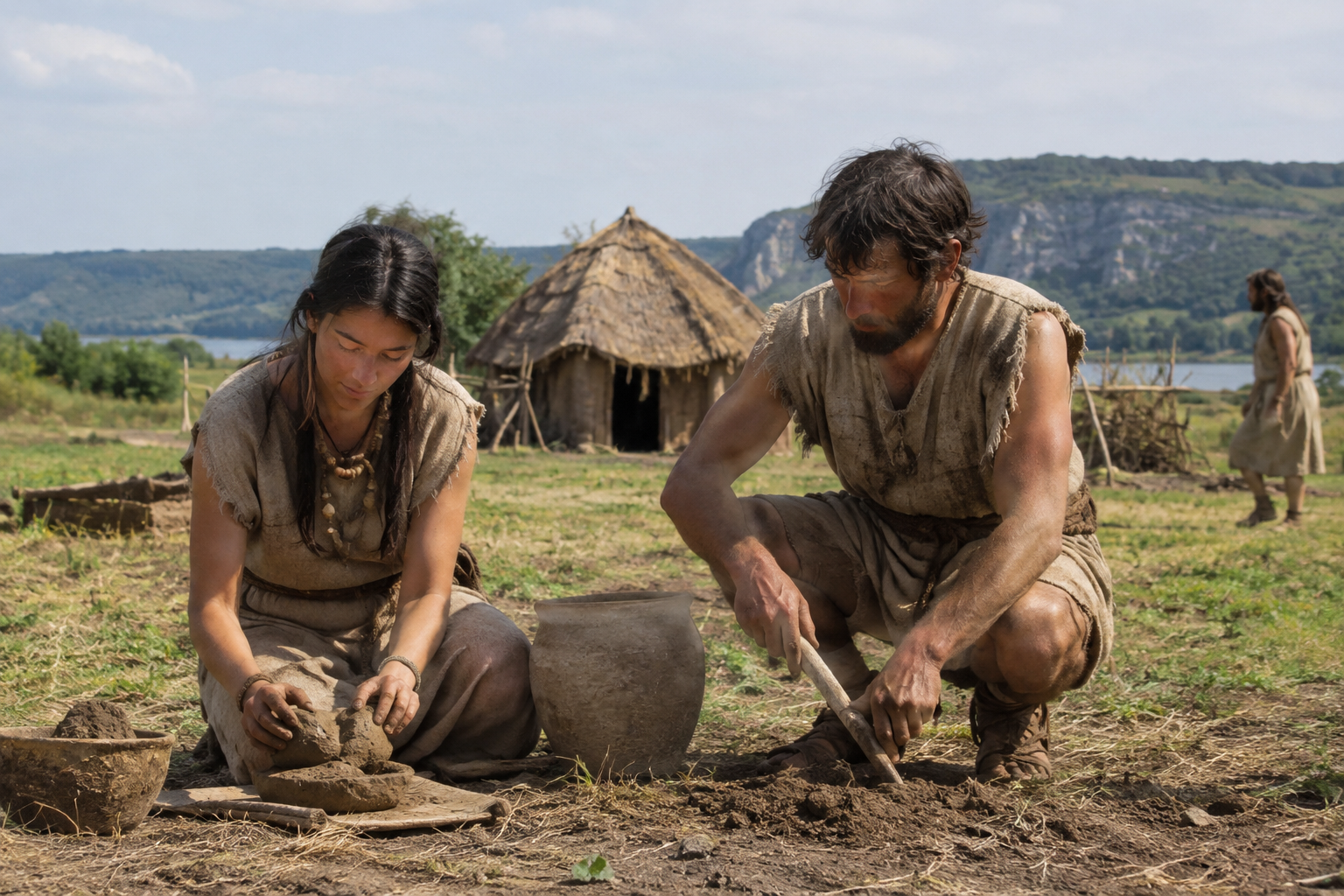
At Yunatsite in modern Bulgaria, one Early Bronze Age man identified as YUN037, dated to around 2770 BC, offers a small but telling glimpse into the paternal history of southeastern Europe. His reported connection to the Y-DNA branch I2a1a2b1a matters not because one grave can explain a whole people, but because it places this lineage in a region that had already seen millennia of farming, mobility, and social change.
That is the first thing worth saying about I2a1a2b1a: it belongs within the broader I2 family, a long-established European Y-chromosome branch, but a Y-line traces only one direct paternal line out of the many ancestors any individual had. What makes the evidence interesting here is that the currently supplied ancient examples point not to one famous dynasty or one dramatic migration episode, but to the Balkans and the lower Danube world during the Bronze Age, when older local lineages and newer population movements were meeting in complicated ways.
Yunatsite is one of those sites that keeps turning up in discussions of prehistoric southeastern Europe because the region was anything but isolated. By the late 4th and early 3rd millennia BC, communities in Bulgaria were living in a landscape shaped by the legacies of Neolithic farming, Chalcolithic tells, and growing connections with steppe-derived populations to the north and northeast.
Within that setting, YUN037 is significant as an Early Bronze Age male from Bulgaria linked to I2a1a2b1a. Even without inventing a grand biography for him, the broader historical point is clear enough: paternal lines from the I2 world did not vanish when new ancestry streams entered the Balkans. They persisted, and in at least some cases remained part of Bronze Age communities that were already genetically mixed in ways archaeologists and ancient-DNA researchers are still working to map.
A large ancient DNA study of the wider region and its prehistoric transformations has helped frame this background, showing just how dynamic southeastern Europe was across the Neolithic, Copper Age, and Bronze Age periods. That wider context matters more than any simplistic claim of an "unchanged native line," because the Balkans were repeatedly connected to surrounding zones of migration and exchange. You can explore that broader regional backdrop in research on ancient populations of the region.
It is tempting to treat a precise label like I2a1a2b1a as though it came with a ready-made ethnic passport. It does not. The useful way to read it is more modestly: this is a downstream paternal branch within haplogroup I2, and its appearance in Bronze Age Bulgaria and Romania suggests continuity of one male line through a period of major cultural and demographic change.
That matters because Bronze Age Europe is often described in terms of sweeping replacements. The reality on the ground was more untidy. Some paternal lines expanded dramatically in certain regions; others endured in smaller numbers, or persisted locally while populations around them changed in language, burial custom, alliance networks, and ancestry profiles. I2a1a2b1a belongs to that more textured story.
In other words, if you carry this haplogroup today, the ancient evidence does not pin you to a single tribe, language, or kingdom. It does suggest that one branch of your direct paternal line was present in the lower Danube-Balkan zone by the Bronze Age, in communities living through the sort of slow and cumulative historical changes that archaeology often reveals better than legend does.
The second sample is I10479, from Bronze Age Romania at Arman-Carlomanesti, associated here with the Moneoru Culture and dated to around 2000 BC. This is a valuable comparison with Yunatsite because it shifts the picture northward into the Romanian archaeological record while remaining within the broader lower Danube sphere.
One sample from Romania and one from Bulgaria do not amount to a map of the whole haplogroup. But together they show that this paternal branch, or a reported association with it, appears on both sides of a historically important zone linking the Balkans, the Carpathian foothills, and the western Black Sea hinterland. That is exactly the kind of pattern ancient DNA is good at catching: not a heroic founding ancestor, but a distribution across connected Bronze Age landscapes.
Romania around 2000 BC was no backwater. It sat amid networks of metallurgy, pastoral mobility, settlement change, and cultural interaction stretching toward the Carpathians, the steppe, and the Balkans. A genetic study investigating population history in the North Pontic and neighboring worlds is useful here because it underlines how interconnected these frontier zones were during the millennia leading up to and including the Bronze Age. For that bigger frame, see this ancient DNA study of migrations in the North Pontic region.
If there is a historical theme that suits these samples, it is this: the lower Danube was never simply a line on a map. It was a corridor. People, animals, technologies, and marriage ties moved through it for thousands of years, and paternal lineages moved with them.
That helps explain why an I2-derived branch can appear in Bronze Age contexts that were already shaped by multiple ancestry sources. The paternal line may be old in Europe, but its Bronze Age carriers were not frozen relics from a Mesolithic past. They were Bronze Age men living in Bronze Age societies, taking part in the same processes of adaptation and mixture as everyone else around them.
This is also where readers should be careful with historical labels. A site in Bronze Age Bulgaria is not therefore "Thracian" in the later classical sense, and a Bronze Age grave in Romania is not automatically evidence for a named people known from much later texts. Archaeology and genetics work best here when they stay close to date, place, and context.
Two ancient men are not many. Yet there is something instructive about the pair. They place I2a1a2b1a, as reported in this dataset, in two neighboring but distinct Bronze Age settings: Yunatsite in Bulgaria and Arman-Carlomanesti in Romania. That is enough to move the branch out of the realm of purely modern surname projects and into securely archaeological time.
For family historians, this is often the most useful threshold. Once a paternal branch appears in datable prehistoric individuals, you can begin to think not just in terms of modern national boundaries, but in terms of older historical landscapes: tell settlements, river corridors, mixed farming communities, and the social worlds of the Early and Middle Bronze Age Balkans.
It also reminds us that some haplogroups are historically interesting precisely because they are not tied to a single famous ruling house. Their value lies in showing ordinary continuity across extraordinary periods of change.
The strongest supported insight for I2a1a2b1a is not a romantic tale of kings, but a grounded archaeological one: this paternal line is represented in Bronze Age southeastern Europe, with current examples in Bulgaria and Romania. That places it in a region where deep local ancestry, incoming steppe-related ancestry, and long-lived settlement traditions all overlapped. For someone researching this haplogroup today, that is a meaningful clue that your direct paternal line may connect to the old and complicated human history of the Balkans and lower Danube, where continuity and change sat side by side.






Comments