Haplogroup I2a1a2a1a2

– 7 min read


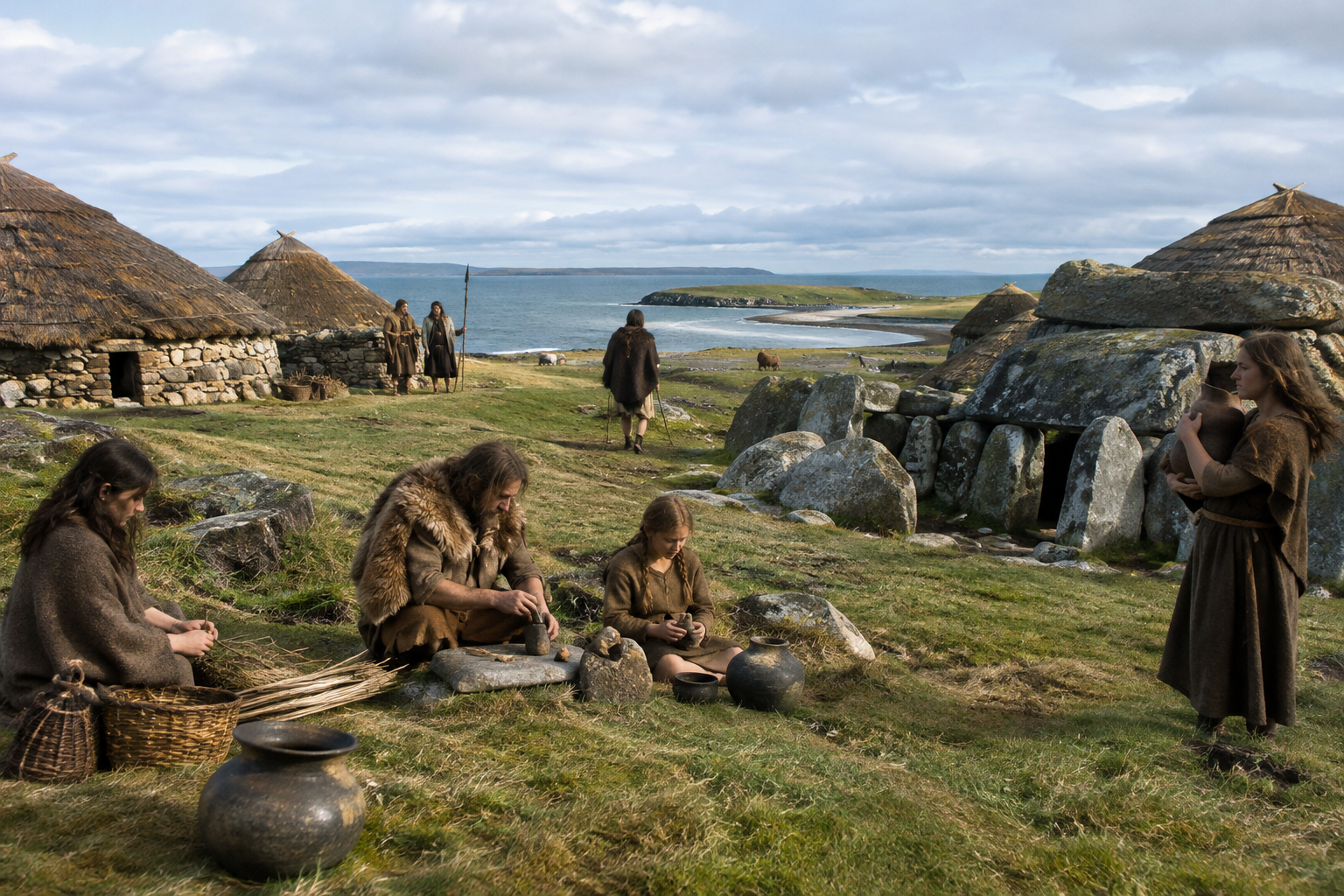
Some Y-DNA haplogroups announce themselves in grand imperial settings. Others turn up somewhere more revealing: in island tombs, chambered cairns, cave burials, and farming communities whose names survive only in archaeology. Haplogroup I2a1a2a1a2 belongs to that second category, and that is precisely what makes it so interesting. Its story, as far as the supplied evidence allows us to tell it, is bound up with prehistoric northwestern Europe, especially Scotland, Orkney, Ireland, and parts of northern continental Europe.
Y-DNA traces one very specific line of descent: the direct paternal line from father to son. It does not represent a person's whole ancestry, culture, identity, or family tree. But because the Y chromosome passes along that single male line, it can be remarkably useful for reconstructing patterns of continuity and movement across long stretches of time. In the case of I2a1a2a1a2, the most striking feature in the material provided here is how often related paternal branches appear in Neolithic and Bronze Age settings around the North Atlantic world.
This is not a branch we should lazily drape over every part of the long history of haplogroup I2. That would be bad genetics and bad history. What we can say more carefully is that the ancient samples supplied here place this lineage, or closely related paternal lines, in a deeply prehistoric landscape of tomb-builders, island communities, and later Bronze Age populations.
Broadly speaking, haplogroup I is one of the old European Y-chromosome lineages, with various branches appearing in European prehistory. Within that wider framework, the material here points us toward a northern story. Several of the most suggestive samples come from Neolithic Scotland and Ireland, with an additional continental clue from Germany and a Scandinavian clue from Gotland. That spread does not prove a simple migration arrow on a map, but it does suggest that related paternal lines were present across parts of Atlantic and northern Europe during the Neolithic and into the Bronze Age.
One of the most useful things about such evidence is that it reminds us prehistory was never neatly boxed into later national labels. Orkney was not "remote" in the way modern maps can make it seem. In the Neolithic it was a lively zone of monument building, seafaring, and community life. Ireland, western Scotland, and the northern isles were connected by water as much as separated by it.
Explore the Neolithic Expansion
The ancient DNA samples supplied for this haplogroup form a particularly evocative cluster. They are not all from one place or one century, and that matters. Instead, they show related paternal ancestry appearing across different communities and periods.
Start in Orkney. The sample I7554x, from the Neolithic Unstan Chamber Tomb Orkney Scotland and dated 3232 BC, places this paternal signature in one of the best-known ceremonial and funerary landscapes of prehistoric Britain. Chamber tombs are not just graves; they are statements about kinship, memory, and belonging. To find a relevant paternal line there is to glimpse not an isolated man, but a social world in which ancestry mattered enough to be built in stone.
Orkney appears again with I2978, I2637, and I2935, all listed simply as Neolithic Orkney Islands and dated 3200 BC. Then there is I35761 from Holm of Papa Westray North Scotland at 3000 BC, and I2932 from Neollithic Isbister Orkney Scotland at 2463 BC. These are not decorative additions to the record. Together they suggest that related paternal lines were established in the northern isles over many centuries.
Western Scotland strengthens the picture. I12317 from Late Neolithic Oban Argyll and Bute Scotland at 3550 BC and I3133 from Distillery Cave Oban Argyll and Bute Scotland at 3450 BC show this was not an exclusively Orcadian phenomenon. The sea lanes between Argyll, the Hebrides, and the northern isles were part of the same broad world of movement and exchange.
Ireland is there too. PB443 from Neolithic County Clare Ireland at 3552 BC, CH448 from Neolithic Ireland at 3000 BC, and ARD2 from Ardcrony Tipperary Neolithic Ireland at 3451 BC suggest that related paternal ancestry was also present across the Irish Neolithic. This does not mean the same family wandered around the whole Irish Sea world for a thousand years. It does mean that the paternal background linked with I2a1a2a1a2 was part of that wider prehistoric setting.
There are also important outliers. I0172 from Neolithic Germany Esperstedt at 3086 BC provides a continental point of comparison, while Ajvide52X from Ancient Gotlander Battleaxe at 2750 BC hints at the presence of related paternal lines in Scandinavia as well. These finds should be treated as context, not as proof of a single tidy route, but they broaden the map considerably.
Discover Neolithic Tomb Kinship
If the Neolithic evidence gives us depth, the Bronze Age material from Westray gives us something else: persistence. A whole cluster of samples comes from Bronze Age Orkney Westray Links of Noltland: KD064, KD064_3, and KD064_4 dated 1400 BC; KD059, KD049, and KD006 dated 1498 BC; and KD047 dated 1319 BC.
That concentration is hard to ignore. It suggests that in Bronze Age Westray, paternal lines associated with this haplogroup, or very near relatives of it, were still present long after the first farming monuments of Orkney had been built. Archaeologically, that matters because Bronze Age Britain was not simply a story of total replacement everywhere. In some regions, older local lineages seem to have persisted alongside cultural change. The Links of Noltland group is a fine example of how ancient DNA can sharpen that picture.
Again, caution is essential. Shared haplogroups do not by themselves prove unbroken father-to-son descent from a named Neolithic tomb occupant to a named Bronze Age islander. But they do make continuity a serious historical question rather than a romantic guess.
Readers interested in the wider issue of later prehistoric change and continuity may enjoy a related discussion in Late Bronze Age Central Europe: Ancient DNA, Isotopes and Burials Reveal Local Continuity Amid Cultural Change, which explores a similar problem in another region.
What, then, happened between those Orcadian tombs and the much later world of medieval and early modern Britain? The honest answer is that Y-DNA can illuminate the long background without filling every gap. Ancient DNA gives us snapshots. Written genealogy gives us named families. The two are related forms of evidence, but they are not the same thing.
Still, geography matters. The concentration of ancient samples in Scotland, Orkney, and Ireland places I2a1a2a1a2 in a historical zone that remained important through later British history: the Irish Sea, the western seaways, and the northwestern edge of Britain. That does not make the haplogroup uniquely "Scottish" or "Irish," nor does it let us assign it to one later people, language, or kingdom. What it does show is that this paternal background was embedded in regions that would later produce complex mixtures of local continuity, incoming elites, and shifting political identities.
That is one reason ancient DNA is so useful. Written history often starts by privileging conquerors, nobles, and churchmen. Genetics sometimes turns the telescope around and asks who was already there, generation after generation, before the documents begin speaking loudly.
The supplied noble connection here is the House Cholmondeley. Now, Cholmondeley Castle in Cheshire is not a grim Norman fortress with arrow loops and a moat full of menace. It is, as the supplied description makes clear, a grand country house built in the early 1800s for the Cholmondeley family on an estate with roots going back to the Norman period. In other words, it is a place that stages ancestry as much as it preserves it.
That is rather fitting for a Y-DNA article. The Cholmondeley family had long been major landowners in the area, and their earlier house, Old Hall, stood nearby from the seventeenth century. The present castle, designed in a romantic Gothic style, belongs to that very English habit of building something new that looks satisfyingly ancient. Its gardens, parkland, temple, and follies advertised status, continuity, and cultivated memory.
We should be careful here. The presence of the Cholmondeley family beside this haplogroup in the input does not by itself prove that every Cholmondeley male carried I2a1a2a1a2, nor that the family can be traced in a direct paternal line to a Neolithic Orcadian or Irish sample. That would be absurdly overconfident. But there is a meaningful historical parallel. Noble houses such as the Cholmondeleys preserved regional power through land, architecture, and record-keeping; ancient DNA preserves a different, much older layer of regional history through the bodies of ordinary and extraordinary people alike.
In that sense, Cholmondeley Castle is a useful reminder that ancestry is always being curated. Sometimes in parchment and stone, sometimes in bone and sequence data.
Read About the Cholmondeley Family
I2a1a2a1a2, viewed through the evidence supplied here, is a haplogroup of deep local history. Its ancient story is anchored not in a single imperial event but in repeated appearances across Neolithic and Bronze Age communities in Orkney, western Scotland, Ireland, and beyond. Samples such as I7554x, I35761, PB443, ARD2, and the Bronze Age Westray group including KD064 and KD059 make this branch historically interesting because they suggest long-term paternal continuity in places where archaeology already hints at strong community memory.
That is the real excitement of ancient DNA. It does not hand us fairy-tale pedigrees linking every modern tester to a tomb or a castle. What it does offer is something better: a way to place paternal ancestry in real human settings, from chamber tombs in Orkney to aristocratic landscapes in Cheshire. It lets us ask not merely who our ancestors were, but what sort of worlds they inhabited.
For readers drawn to the northern island dimension of this story, another excellent companion piece is the article on Gotland and prehistoric DNA, where island populations again complicate any simplistic mainland narrative.
Explore Neolithic DNA on Gotland
If your own Y-DNA points toward an old European paternal line, MyTrueAncestry can help you explore the ancient populations and archaeological samples that provide context for it. Those matches do not automatically prove direct descent from a particular ancient individual or noble house, but they can open a fascinating window onto the long history behind your DNA.






Comments