Haplogroup I2a1a2a1a1a

– 5 min read


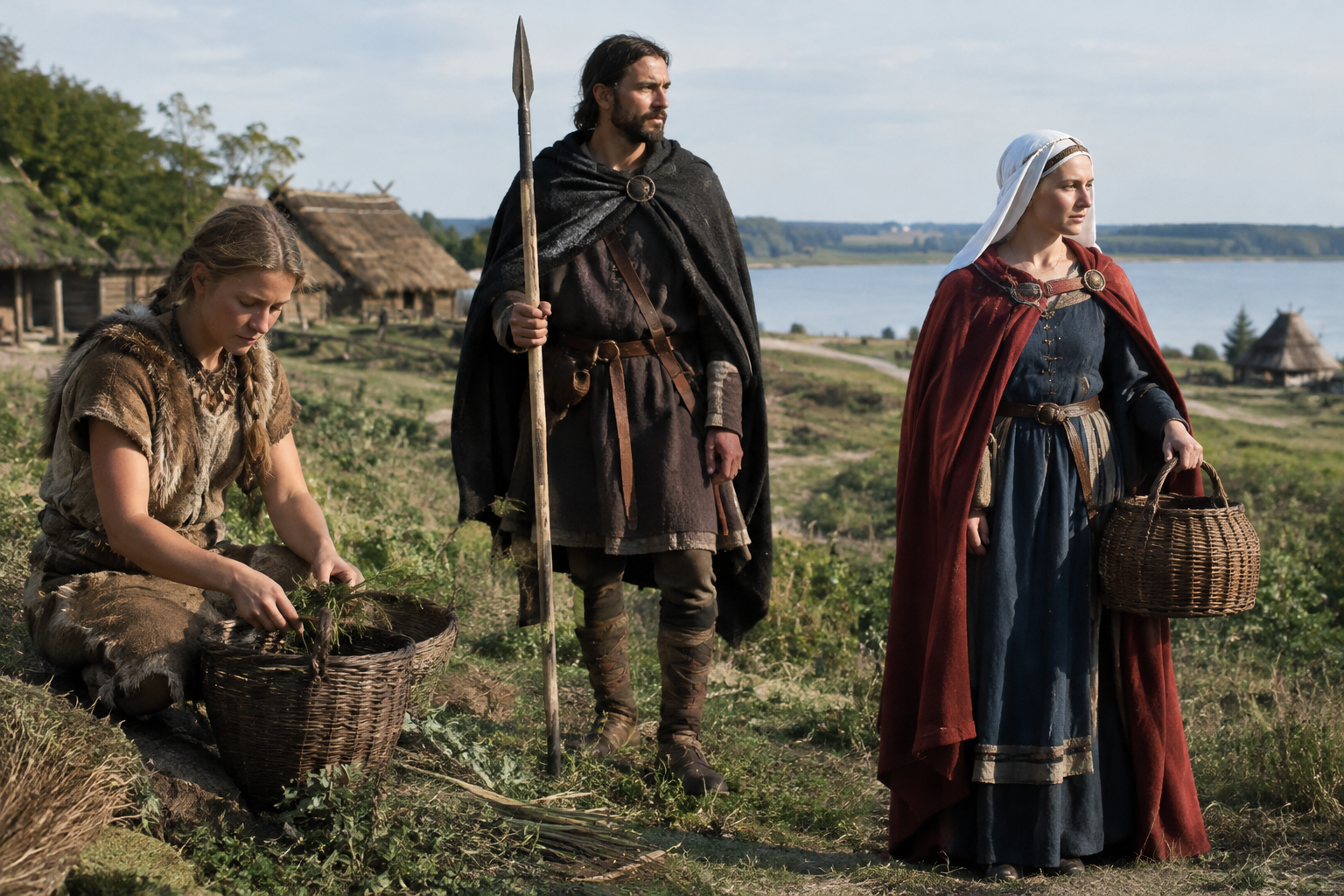
Some Y-DNA haplogroups announce themselves with a great splash across the map. Others are more interesting precisely because they do not. I2a1a2a1a1a belongs to that second category: a very specific paternal branch within the wider haplogroup I2 family, one of the old European Y-chromosome lineages that turns up again and again when ancient burials are tested. What makes a branch like this historically fascinating is not that it can be tied neatly to one people, one kingdom, or one noble house. Quite the reverse. Its story is about persistence, movement, and the awkward but rewarding business of joining archaeology, genetics, and written history without pretending they are the same thing.
Y-DNA traces a direct paternal line: father to son to son across generations. That makes it powerful, but also limited. It does not describe a person's whole ancestry, culture, language, or identity. Still, when a branch like I2a1a2a1a1a appears in ancient remains from Neolithic Denmark, Iron Age Bohemia, and medieval Italy, we are looking at something valuable: not a single family saga, but glimpses of a durable male line moving through very different historical worlds.
I2a1a2a1a1a is a downstream branch of haplogroup I, a major European Y-chromosome lineage with deep roots in the continent. Broadly speaking, branches of I and especially I2 are often discussed in connection with ancient European hunter-gatherer ancestry, but one must be careful here. The narrower the subclade, the less sensible it is simply to inherit the whole history of the larger parent branch and pin it onto the smaller twig. What we can responsibly say is that this lineage belongs to a family of paternal lines that has long been part of Europe's population history.
Ancient DNA has complicated older, tidier stories. Rather than showing a continent neatly replaced from one era to the next, the evidence often reveals mixture, survival, local continuity, and repeated reshuffling. A branch like I2a1a2a1a1a may therefore be best understood not as the badge of one ethnic label, but as part of the paternal background of multiple European populations over time.
The earliest of the supplied ancient anchors is CGG106742, from Early Neolithic Denmark Borremose, dated to 3591 BC. That alone is enough to make one pause. Here we have this paternal branch present in a northern European farming-era context, in a landscape where the meeting of incoming Neolithic farmers and older forager populations has become one of the central themes of archaeogenetics. A Y-line in such a burial does not tell us everything about that man's ancestry, but it does place this paternal branch within the social world of early settled communities in Scandinavia.
That matters because Neolithic Europe was not a uniform block. Farming spread, yes, but local populations did not all vanish into the archaeological floorboards. Paternal lines from older European backgrounds could persist, merge into farming communities, or expand under new cultural conditions. CGG106742 is therefore less a symbol of one migration than a reminder that the Neolithic north was made by contact and combination.
Several millennia later, the branch appears again in I20504, from Iron Age Prague Jinonice Central Bohemia, dated to 300 BC. The setting has changed completely. We are now in Iron Age Central Europe, in a region tied to networks of exchange, fortified settlements, and the fluid world often associated with Celtic cultural horizons. Caution is needed: a haplogroup does not make a man "Celtic." But the presence of this paternal line in Central Bohemia at this date shows that it was still part of the male landscape of Europe long after the Neolithic, in a zone where mobility, alliance, and regional continuity all mattered.
What is striking is not simply survival, but geographical range. Denmark to Bohemia is not a straight genealogical line, and we should not pretend it is. But it does suggest that related paternal branches within the I2 world were embedded in very different European regions over a long span of time.
Read about Iron Age Central Europe
The third ancient individual, R63, comes from Medieval Villa Magna Italy and is dated to 990 AD. Again, the value of the sample is not that it lets us draw a childish arrow from prehistoric Scandinavia to medieval Italy and call the matter settled. Rather, it shows this paternal branch, or a very close placement within it, in the Mediterranean world of the early Middle Ages.
Villa Magna evokes a different historical landscape altogether: post-Roman Italy, where ancient local populations, Roman legacies, Christian institutions, migration-period movements, and regional lordships all overlapped. By the late first millennium, Europe was not a set of isolated boxes. Men moved through military service, marriage alliances, trade, church networks, lordship, and landholding. A paternal branch turning up in medieval Italy after earlier appearances in northern and central Europe fits that broader pattern of long-term European interconnectedness.
It also shows why ancient DNA is so helpful. Written genealogies for the year 990 are patchy and elite-focused. DNA gives us another kind of archive: not names and charters, but biological traces of who was actually there.
Explore ancient to medieval Italy
This brings us, carefully, to the supplied noble connection: the House Carvajal and the Palacio de Carvajal in Caceres. Here it is essential not to overclaim. The historical association of a noble house with this haplogroup is not proof that every Carvajal male carried it, nor do the ancient samples from Denmark, Bohemia, and Italy demonstrate direct descent into the family. What they do offer is context for thinking about how old paternal lines can persist into the medieval and early modern nobility of Europe.
The Palacio de Carvajal is itself a fine reminder that noble families were historical actors, not abstract names in heraldic manuals. In Caceres, after a fire in 1393, the building took shape as one of the homes of the powerful Carvajal family. Its defensive-looking tower, later Renaissance changes, and early modern alterations tell a story of adaptation rather than frozen antiquity. This was a residence shaped by feud, status, and urban power in late medieval Extremadura.
That is worth lingering over. When people imagine castles and noble houses, they often think only of grandeur. But buildings like the Palacio de Carvajal preserve something more useful: the memory of how elite families lived inside cities, negotiated danger, rebuilt after catastrophe, and refashioned older structures for new political times. Today it stands as a historic monument within the old city of Caceres and serves public cultural uses, which is a rather splendid afterlife for a once-private aristocratic seat.
For a haplogroup article, the lesson is straightforward. Genetics can suggest the long persistence of paternal lines across Europe. History and architecture show us the later worlds into which some of those lines may have entered: households, factions, lordships, and stone residences that still define the character of places like Caceres.
So what does I2a1a2a1a1a reveal? First, that direct paternal lines can endure across extraordinary spans of time while passing through utterly different societies. Second, that ancient DNA works best when it is allowed to be modest. It can show us that related male lines were present in Early Neolithic Denmark, Iron Age Central Bohemia, and medieval Italy. It cannot, on its own, tell us language, rank, surname, or identity. Third, it reminds us that noble families and castles are part of the same human story as ancient burials, but not a shortcut to proving descent.
For MyTrueAncestry readers, that is where the real excitement lies. Not in claiming too much, but in seeing how a paternal branch can move from prehistoric settlement to Iron Age communities, from medieval cemeteries to the remembered landscapes of European noble houses. The science sharpens the history; the history gives the science a human setting.
If you want to explore whether your own DNA connects you with ancient individuals, historical populations, or the long paternal story behind haplogroups like I2a1a2a1a1a, MyTrueAncestry can open a remarkable window onto the past. Those matches do not automatically prove direct descent from a particular ancient person or noble family, but they can offer a vivid and meaningful perspective on where your deeper ancestry fits into human history.






Comments