Haplogroup I2a1a2a1

– 5 min read


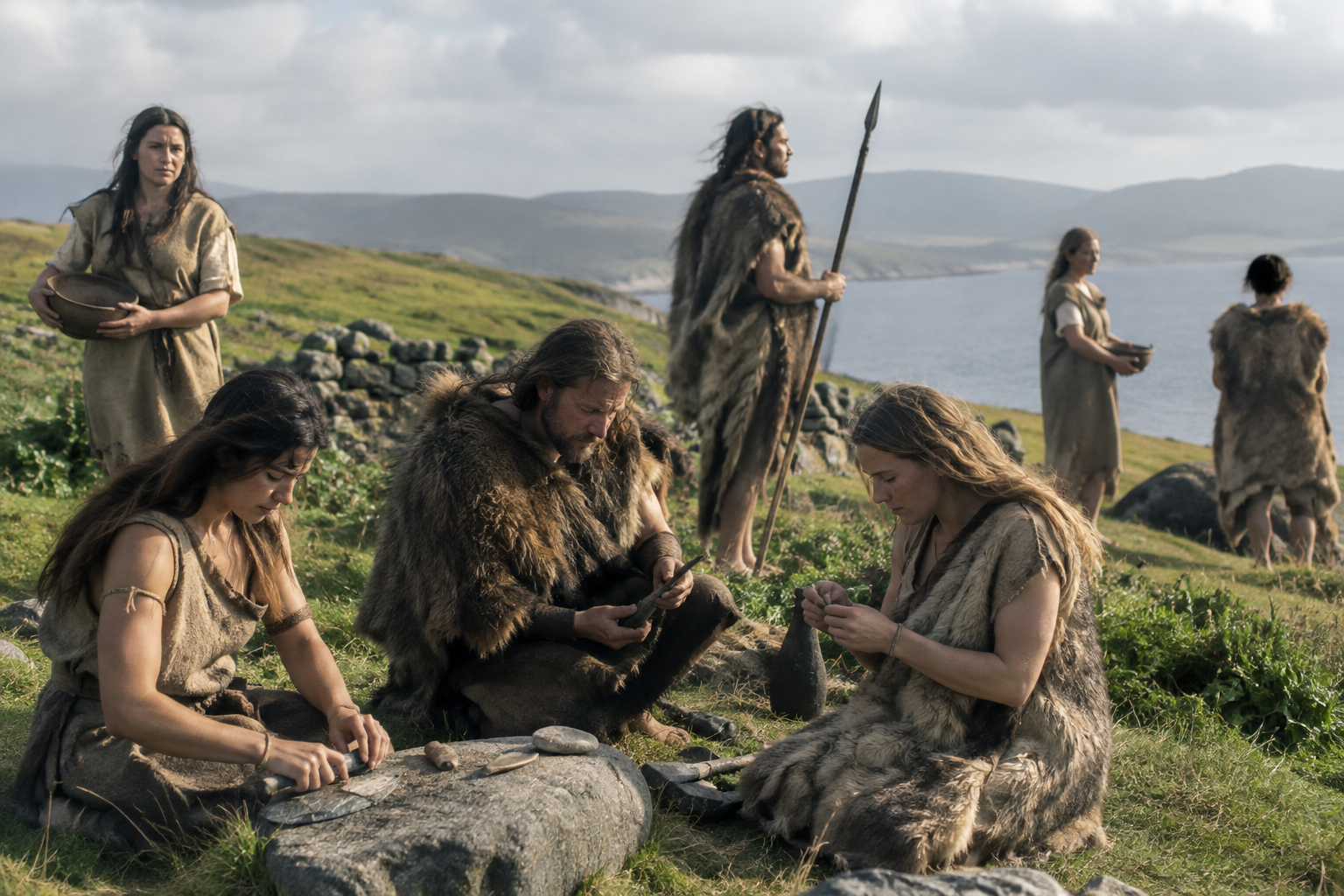
At Esperstedt in Germany, one Neolithic male dated to around 3086 BC, sample I0172, helps anchor an unexpectedly wide prehistoric story for haplogroup I2a1a2a1. He is not a king, not a legendary warlord, and not the sort of burial later chroniclers would ever have noticed. Yet lineages associated with this branch appear in a spread of Neolithic and late Neolithic contexts from central Europe to Ireland, Scotland, and Gotland, which is precisely what makes the evidence so interesting.
That pattern matters because Y-DNA follows one direct paternal line only: father to son across many generations. It does not describe a whole person or a whole people. But when the same paternal branch turns up in several ancient settings, it can reveal something about how male lines persisted, moved, or were absorbed into new cultural worlds.
The Esperstedt sample I0172 comes from Neolithic Germany, in a period when farming societies had already been established in central Europe for millennia, but population history was still anything but settled. Ancient DNA work on European prehistory has shown that Neolithic communities were not simple, uniform descendants of the first farmers. They also included varying amounts of ancestry linked to earlier European hunter-gatherers and, later, to incoming steppe-related populations.
In that wider setting, a lineage such as I2a1a2a1 stands out because the broader haplogroup I2 is one of Europe's old paternal families, frequently associated in deep time with Mesolithic and Neolithic males. That does not mean every sub-branch had the same path, or that every man carrying I2a1a2a1 belonged to one continuous tribe or culture. What it does suggest is persistence: some old European paternal lines survived profound cultural change rather well.
A major ancient DNA study of European population history, published in Nature, helped establish just how dynamic those Neolithic and post-Neolithic transitions were. Within that broader picture, the occurrence of I2-associated male lines in central European farmers shows that older paternal ancestry did not simply vanish when agriculture spread.
The strongest pattern in this sample set is not a single dramatic grave, but repetition in Neolithic Ireland. Sample PB443 from County Clare, dated around 3552 BC, sample ARD2 from Ardcrony, Tipperary, dated around 3451 BC, and sample CH448 from Neolithic Ireland around 3000 BC all point in the same general direction. Whatever the exact local family histories were, this was clearly a paternal lineage present in Ireland over many centuries.
That is important because Neolithic Ireland was not merely a farming backwater at the edge of Europe. It was a landscape of enclosure building, long-distance contacts, and above all monumental burial traditions. The island's great passage tombs and other collective burial sites belong to societies capable of organizing labor, memory, and ancestry on a grand scale. A recurring Y-line in this setting hints that certain paternal lines may have achieved local staying power within those communities, though not necessarily political dominance in any later sense.
We should be careful here. Repeated occurrence in Irish Neolithic males does not mean all such men were close kin, nor that a modern bearer of I2a1a2a1 descends from one famous tomb-building dynasty. But the clustering does suggest continuity within the island's early farming population, and perhaps the survival of lineages rooted in the meeting ground between incoming farmers and older European male ancestry.
Another notable appearance comes from I3133, dated around 3450 BC at Distillery Cave, Oban, in Argyll and Bute, Scotland. The western Scottish seaways were not marginal in prehistory; they were connective tissue. Boats, coastal movement, and island-hopping mattered enormously in the Neolithic world of Britain and Ireland, especially for the movement of people, ideas, and perhaps selected family lines.
The Oban sample places this paternal branch in a maritime zone facing both Ireland and the Hebridean world. That does not prove a specific route from Ireland to Scotland or the reverse, but it does fit a broader archaeological reality: the Irish Sea and Atlantic facade were busy contact regions rather than isolated edges. A lineage found in both Ireland and western Scotland belongs comfortably in that world.
This is a useful reminder that prehistoric geography is not our geography. Water often linked communities more efficiently than rough inland travel. So when a branch such as I2a1a2a1 appears on both sides of the sea, it may reflect the social importance of coastlines rather than distance between modern nation-states.
The most culturally distinct sample in this group is Ajvide52X, dated around 2750 BC and described as an Ancient Gotlander Battle Axe individual. Here the story shifts. Gotland had long been a place where different ways of life met: maritime networks, forager traditions, and later the arrival of groups connected with the wider Corded Ware or Battle Axe horizon in Scandinavia.
This makes the Gotland evidence especially valuable. Haplogroup I2a1a2a1 is not appearing here in a plain, unchanging Neolithic backdrop, but in a setting shaped by admixture and cultural transformation. Research on Gotland and surrounding regions has repeatedly shown that Neolithic Scandinavia cannot be reduced to a single ancestry block. Farmers, foragers, and later newcomers interacted in complex ways, and male lineages did not always change at the same pace as material culture.
A study in Nature helped clarify the scale of population turnover associated with later prehistoric movements into Europe. Against that background, an I2-linked paternal line in a Battle Axe context is a useful warning against simplistic equations: a new archaeological culture does not automatically mean every paternal line is newly arrived.
Scandinavia's Battle Axe culture
Taken together, these samples make I2a1a2a1 look less like a neatly bounded "ethnic marker" and more like a durable paternal thread running through several prehistoric societies of northwestern and northern Europe. In this small but suggestive set, the branch appears in Neolithic Germany, multiple Neolithic Irish contexts, western Scotland, and late Neolithic Gotland. That range is substantial.
The historical value lies in the combination of survival and adaptation. This branch appears in farming communities, in Atlantic-facing settings, and in a Scandinavian cultural horizon associated with major demographic change. In other words, the men carrying it were not frozen in one ancestral moment. Their descendants, or parallel branches of their wider paternal family, were present in very different archaeological worlds.
If your paternal line belongs to I2a1a2a1, the most defensible lesson from these ancient finds is not a claim to one tribe, one island, or one famous dynasty. It is something more interesting: this branch is associated here with men living across several important Neolithic and late Neolithic worlds, from central Europe to the Atlantic fringe and into the Baltic. That suggests a paternal history bound up with some of the deepest population layers of prehistoric Europe, and with the remarkable staying power of old male lines through ages of migration and cultural change.






Comments