Haplogroup I2a1a1b1a1b
– 5 min read


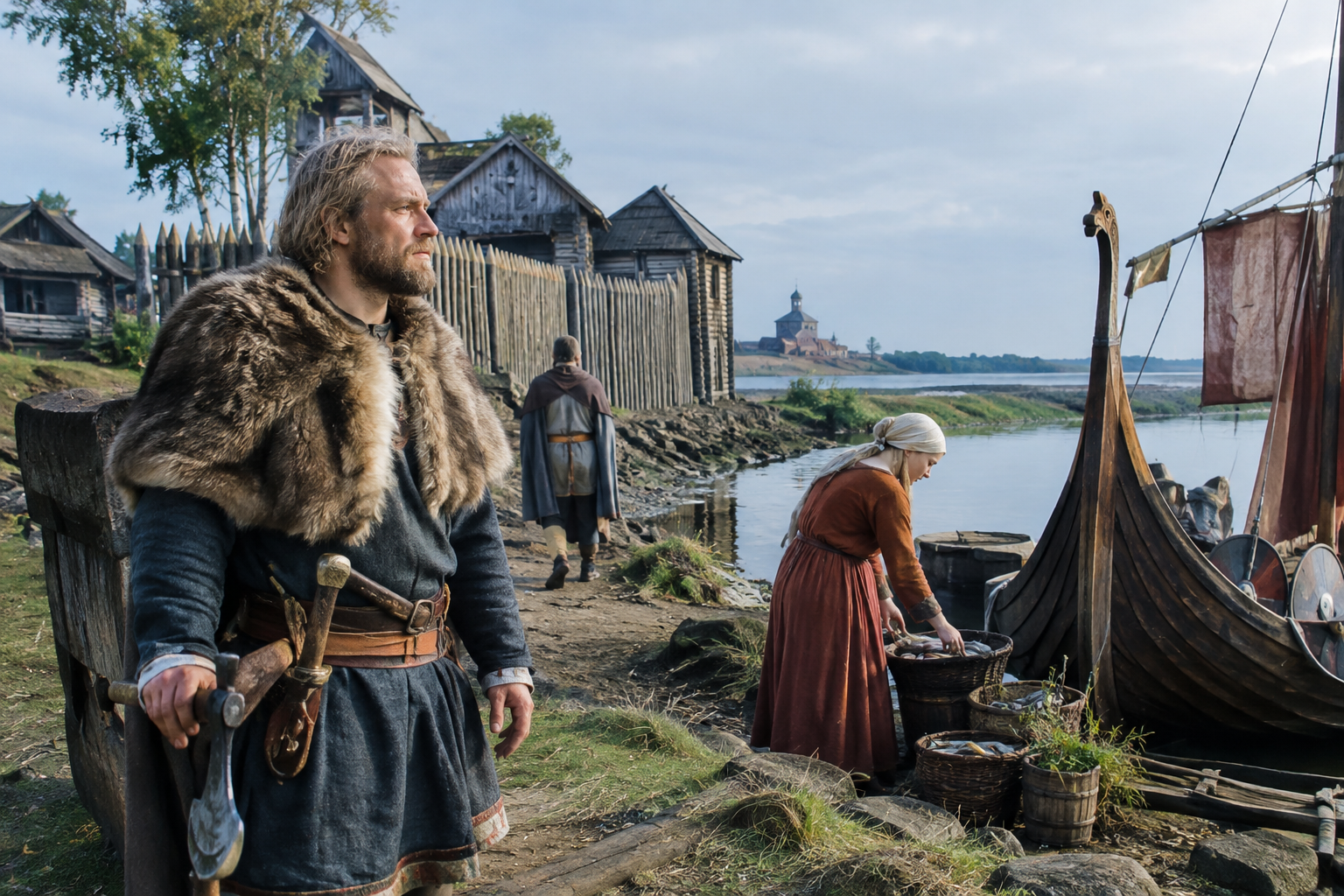
At Staraya Ladoga, on the Volkhov River in northwestern Russia, archaeologists and geneticists are looking at one of the most important frontier towns of the Viking Age. Among the burials there is an individual identified as VK22, dated here to around AD 1000 and associated with the Y-DNA haplogroup I2a1a1b1a1b. That may sound like a string of laboratory code, but in historical terms it places one paternal line inside a place that mattered enormously: a river-port linking the Baltic, the forest zone of Eastern Europe, and the trading worlds that stretched toward Byzantium and the Abbasid Caliphate.
Staraya Ladoga is interesting precisely because it refuses simple labels. It has often been folded into familiar stories about Vikings, Varangians, and the rise of early Rus', yet the archaeology of the site shows a settlement shaped by movement, exchange, and mixture. A Y-chromosome lineage such as I2a1a1b1a1b tracks only one direct paternal line, not a person's whole ancestry or identity. Even so, the presence of this branch in a Viking Age Ladoga burial is a useful clue about how older European paternal lineages were part of the human traffic of the North and East.
Staraya Ladoga was no sleepy riverside village. From the early medieval period it sat on one of the great communication routes of northern Eurasia, where people, goods, and ideas moved between Scandinavia, the eastern Baltic, the Slavic lands, and the wider river systems leading south. By around AD 1000, when VK22 lived, Ladoga had long been part of this connected world.
That matters for interpreting haplogroups. If a paternal line like I2a1a1b1a1b appears in such a setting, it should not be flattened into a single ethnic story. It does not automatically make VK22 "Scandinavian," "Slavic," or anything else on its own. What it does show is that this branch was present among the men inhabiting or passing through one of the most cosmopolitan contact zones of the Viking Age.
A broad ancient DNA study of Viking Age populations, available at https://www.biorxiv.org/content/10.1101/703405v1, helped establish just how mobile and genetically varied this world could be. That larger context is important here: Ladoga was not an outpost at the edge of history, but one of the places where northern European lineages met eastern routes in everyday life.
The haplogroup name matters because it is very specific. I2a1a1b1a1b is a narrow branch within the much wider Y-DNA haplogroup I, one of the old paternal lineages of Europe. The broad parent clade has deep roots in European prehistory, but one must be careful here: the ancient and modern history of the entire I haplogroup cannot simply be projected onto this exact subclade without direct evidence.
So the safe historical point is modest and useful. VK22 shows that this particular paternal line, or a reported assignment associated with it, was present in the Viking Age at Staraya Ladoga. In a site shaped by trade and migration, that places I2a1a1b1a1b within the lived history of the eastern Baltic-Rus' interface rather than in some abstract map of "ancient Europeans."
That is often how haplogroups become historically meaningful. Not through sweeping origin myths, but through being pinned to real people in real places. A burial in Ladoga tells us more than a thousand speculative arrows on a migration chart.
There is a temptation, whenever a Viking Age site appears, to imagine that every paternal lineage found there must reflect recent Scandinavian migration. But Ladoga was more complicated than that. Its inhabitants and visitors likely included people with varied family histories from across northern and eastern Europe, and the archaeological significance of the site lies precisely in that mixture.
For that reason, VK22 is best read as evidence of participation in a network. The individual's Y-DNA branch belongs to a paternal line that had become part of the human landscape of this trading world by about AD 1000. That does not tell us whether his father's father's line arrived recently or had already been established regionally for generations, but it does anchor the lineage in a major historical setting.
One of the best ways to understand this is to think geographically. Ladoga sits at the hinge between the Baltic and the interior river systems. Any lineage found there may reflect connections running west toward Scandinavia, south toward early Rus' centers, east into forest-zone communities, or some combination of all three. The site is valuable not because it gives a simple answer, but because it records a population living in the midst of movement.
The wider I2 family is often associated, in broad prehistoric terms, with long-standing European paternal ancestry. That background is real at the level of the parent haplogroup, but the more interesting historical question for I2a1a1b1a1b is not simply where its deepest ancestors lived many millennia earlier. It is how such a line persisted, shifted, and resurfaced in medieval settings shaped by commerce, war, settlement, and marriage.
VK22 offers exactly that kind of glimpse. By the end of the first millennium AD, northern and eastern Europe were not divided into neat cultural boxes. Linguistic frontiers, political loyalties, and family histories overlapped untidily. A direct paternal line could survive through centuries of social change while the language, religion, or political identity of its carriers changed around it.
This is one of the central lessons of archaeogenetics. A Y-chromosome branch can remain continuous even when the historical world built around it alters dramatically. In that sense, I2a1a1b1a1b at Staraya Ladoga is not just a label on a tree of mutations. It is a reminder that medieval mobility often redistributed old lineages into new historical worlds.
Germanic languages and genomics
There is only one ancient individual listed here: VK22 from Viking Age Staraya Ladoga. That means the article should not pretend to reconstruct a dynasty, a tribe, or a continental migration route from a single burial. One man with one Y-chromosome lineage cannot stand in for all the people of Ladoga, still less for all Vikings or all early Rus'.
But a single sample can still matter a great deal when the archaeological setting is strong. Ladoga is precisely such a setting. Because the site sits at the crossroads of northern exchange networks, VK22 helps place I2a1a1b1a1b in a documented medieval context where different populations met face to face. For anyone researching this haplogroup today, that is a tangible historical foothold.
The result also sits comfortably alongside a broader pattern emerging from medieval and Viking Age aDNA: paternal lineages do not map perfectly onto the historical labels later attached to regions or peoples. The ancient record keeps showing us a more mixed, more local, and more interesting past than tidy nationalist stories would prefer.
Baltic connections in the early medieval north
For I2a1a1b1a1b, the strongest point is not a grand claim of royal descent or a single fixed homeland. It is the very concrete appearance of this paternal branch in VK22, a man from Viking Age Staraya Ladoga around AD 1000. That places the lineage in one of the great contact zones of northern Europe, where old paternal lines were carried through a world of river travel, trade, and cultural mixing. If this is your haplogroup, the ancient evidence currently points not to a fairy-tale pedigree, but to something historically richer: participation in the busy, entangled human networks of the medieval Baltic and eastern European world.






Comments