Haplogroup I2a1a1a1a1b3

– 5 min read


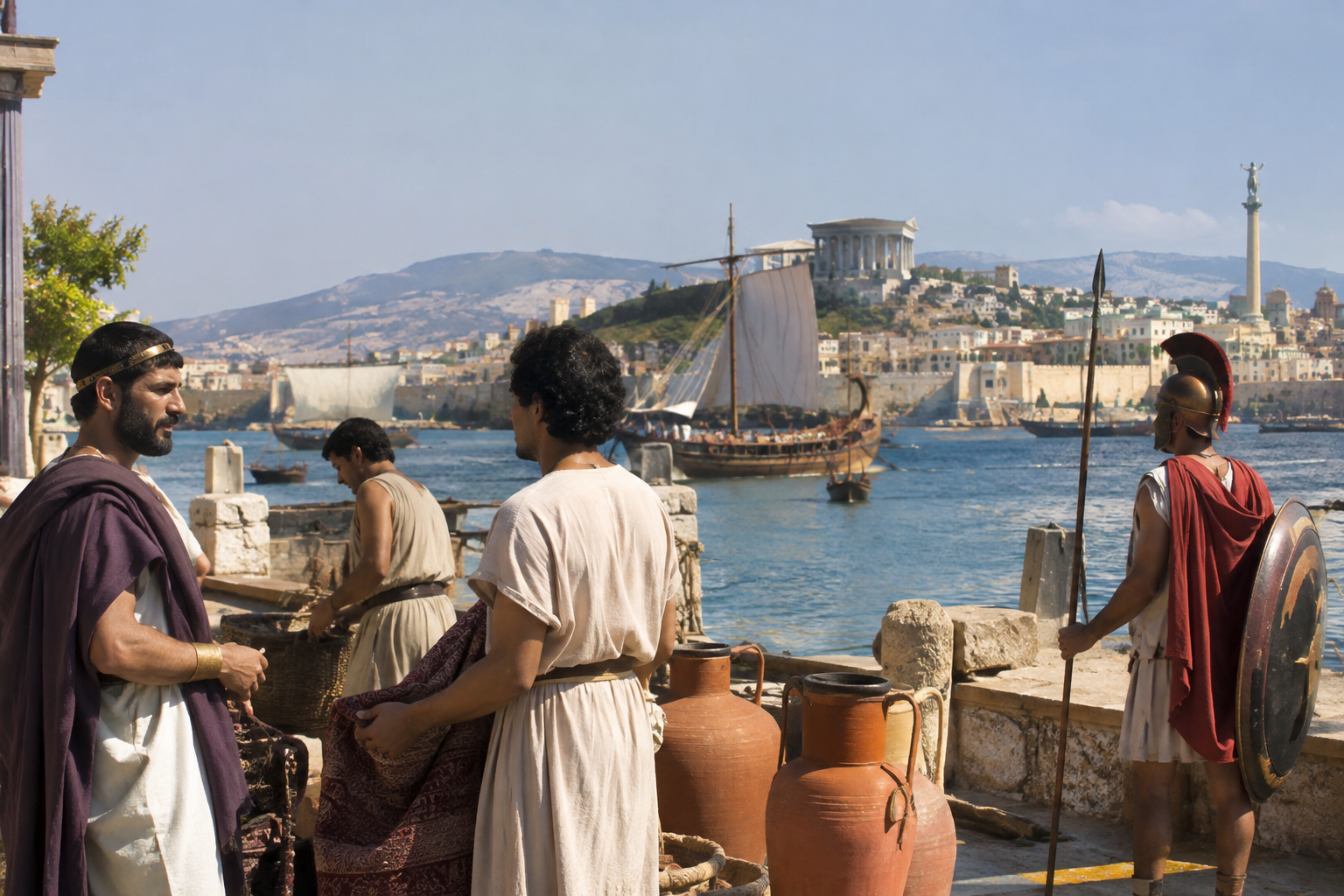
At Carthage, around 300 BC, one ancient male sample stands out for MyTrueAncestry users interested in a very specific paternal line: I31735 from ancient Tunisia. He has been associated with the Y-DNA haplogroup I2a1a1a1a1b3, a remarkably narrow branch of a much older European-rooted paternal family. That is immediately interesting, because Carthage is so often imagined through its Phoenician founders, its great Mediterranean empire, and its wars with Rome. Yet the men buried in Punic North Africa did not all share one simple origin story.
This is where Y-DNA is useful, so long as we keep its limits in view. It traces one direct paternal line only, not a person's whole ancestry, language, or cultural identity. Even so, a lineage such as I2a1a1a1a1b3 appearing in Punic-era Carthage is a neat reminder that ancient port cities were full of complicated biographies. A major ancient DNA study of Punic and neighboring populations, published in Nature, has helped bring that complexity into much sharper focus.
Carthage was founded by settlers from the Phoenician world, but by the first millennium BC it had become far more than a colonial outpost. It was a great North African city tied into exchange networks that linked the Levant, Sicily, Sardinia, Iberia, and the wider central and western Mediterranean. Any assumption that its population should look narrowly Levantine in genetic terms was always likely to be too tidy for the archaeology.
Sample I31735 matters precisely because he puts a paternal lineage usually discussed in European contexts into a Punic North African setting. That does not mean he was "a European" in any modern sense, nor does it let us reverse-engineer his life story from one chromosome. It does mean that by around 300 BC, Carthage included at least some men whose direct paternal ancestry belonged to lineages outside the stereotypical founding picture.
That fits what historians already suspect from texts and material culture. Carthage recruited, traded, colonized, intermarried, enslaved, and governed across huge distances. In such a world, a city's population was constantly being remade. Ancient DNA does not flatten that story; if anything, it makes it busier.
The awkward-looking string I2a1a1a1a1b3 is a very fine-grained twig on the larger haplogroup I tree. The broader haplogroup I is one of the long-established paternal lineages of Europe, with deep time depth and many branches that took quite different paths. That larger background is real, but it should not be carelessly pasted onto this exact subclade as though every branch shared the same history at every period.
So what can responsibly be said here? Only that a man associated with this narrow lineage turns up in ancient Carthage, in a setting where we might otherwise expect discussion to focus almost entirely on Phoenician-descended paternal lines. The narrower the branch, the more careful one must be. A single ancient carrier is evidence of presence, not proof of origin, dominance, or a named ethnic identity.
Still, presence matters. For men researching this haplogroup today, I31735 shows that one branch of the I2 family was part of the human mixture of the central Mediterranean in the late Iron Age. That is historically rich terrain: merchants, settlers, soldiers, sailors, craftsmen, and families moving in both ordinary and extraordinary ways across sea routes that connected three continents.
Ancient Carthage was never isolated from Europe. Its political rivals and trading partners included communities in Sicily, Sardinia, and Iberia, and Carthaginian influence stretched into all of them at one time or another. If a European-rooted paternal branch appears in the city, that does not require a dramatic tale of invasion or sudden replacement. In the ancient Mediterranean, people arrived by many quieter routes: marriage, commerce, household mobility, military service, or multi-generational settlement.
The real value of I31735 is that he anchors this discussion in one documented individual rather than in vague maps full of arrows. Around 300 BC, in Tunisia, a man with a paternal line associated with I2a1a1a1a1b3 was part of the Carthaginian world. That is a small fact, but a stubborn one. It makes the old historical category "Punic" look less like a biological box and more like what it really was: a cultural and political world inhabited by people of varied backgrounds.
This also sits comfortably beside a broader pattern now emerging from ancient DNA studies around the Roman and pre-Roman Mediterranean. Cities, ports, forts, and colonial settlements often contain more diversity than older narratives allowed. That does not make every site a free-for-all, but it does mean that paternal lineages can show unexpected geographical combinations without any contradiction at all.
With only one supplied ancient individual, it would be irresponsible to pretend we have a whole demographic history of I2a1a1a1a1b3 in North Africa. We do not. We cannot say this was a common Carthaginian lineage, nor can we tie it securely to a particular named population moving into the city. But archaeology often advances through exactly this sort of modest, well-documented surprise.
One reason the sample is so useful is that Carthage occupies a special place in popular imagination. Many readers expect a straightforward Phoenician-to-Punic narrative, perhaps with some local North African admixture. What the genetic evidence increasingly shows is that the western Mediterranean was not tidy enough for such a simple picture. Punic societies could be locally rooted and still genetically diverse, maritime and urban while also deeply entangled with inland populations and overseas arrivals.
For users interested in lineages from the broader I2 world, that matters because it widens the range of plausible ancient settings. The branch was not confined to a single cultural label. Its carriers could turn up in contexts shaped by trade empires, colonial foundations, and mixed populations. In that respect, the Carthage evidence echoes findings from other MyTrueAncestry discussions of mobile and blended ancient communities, whether in Roman Hispania or in studies of diverse early medieval burials in Madrid.
The approximate date of I31735, around 300 BC, places him in the period when Carthage was still a major independent power. This was the age just before the full crisis of the Punic Wars with Rome, when Carthage remained a formidable state with extensive military and commercial reach. That timing matters, because it places the sample in a living Punic environment rather than a later Roman one.
In other words, this is not simply a case of "later Mediterranean mixing under empire." It belongs to the Carthaginian world itself. If a lineage associated with I2a1a1a1a1b3 appears here, then diversity was not just the by-product of Roman expansion. It was already part of the western Mediterranean before Rome's political dominance.
That is an important corrective. We sometimes treat pre-Roman peoples as though each had a compact, easily bounded biological identity, only for Rome to mix everything up later. The evidence from places like Carthage suggests a messier and more interesting truth. Long before imperial unification, maritime societies were already absorbing newcomers and generating new local populations from many strands.
The strongest supported insight for I2a1a1a1a1b3 is not a grand claim about kings or a single homeland. It is the more historically valuable point that this paternal branch was present in the cosmopolitan Punic world of ancient Carthage by around 300 BC. For someone tracing this line today, that places one documented carrier in one of the great crossroads of the ancient Mediterranean, where ancestry, culture, and identity did not run in neat parallel lines.
That makes I2a1a1a1a1b3 less a badge of one people than a clue to movement, contact, and survival across changing historical worlds. In Carthage, at least, this lineage belonged to the human reality behind a famous civilization: not an abstract empire, but an actual man, I31735, living in North Africa at a time when the Mediterranean was already deeply interconnected.






Comments