Haplogroup I2a1a1a1a1a1a1f

– 6 min read


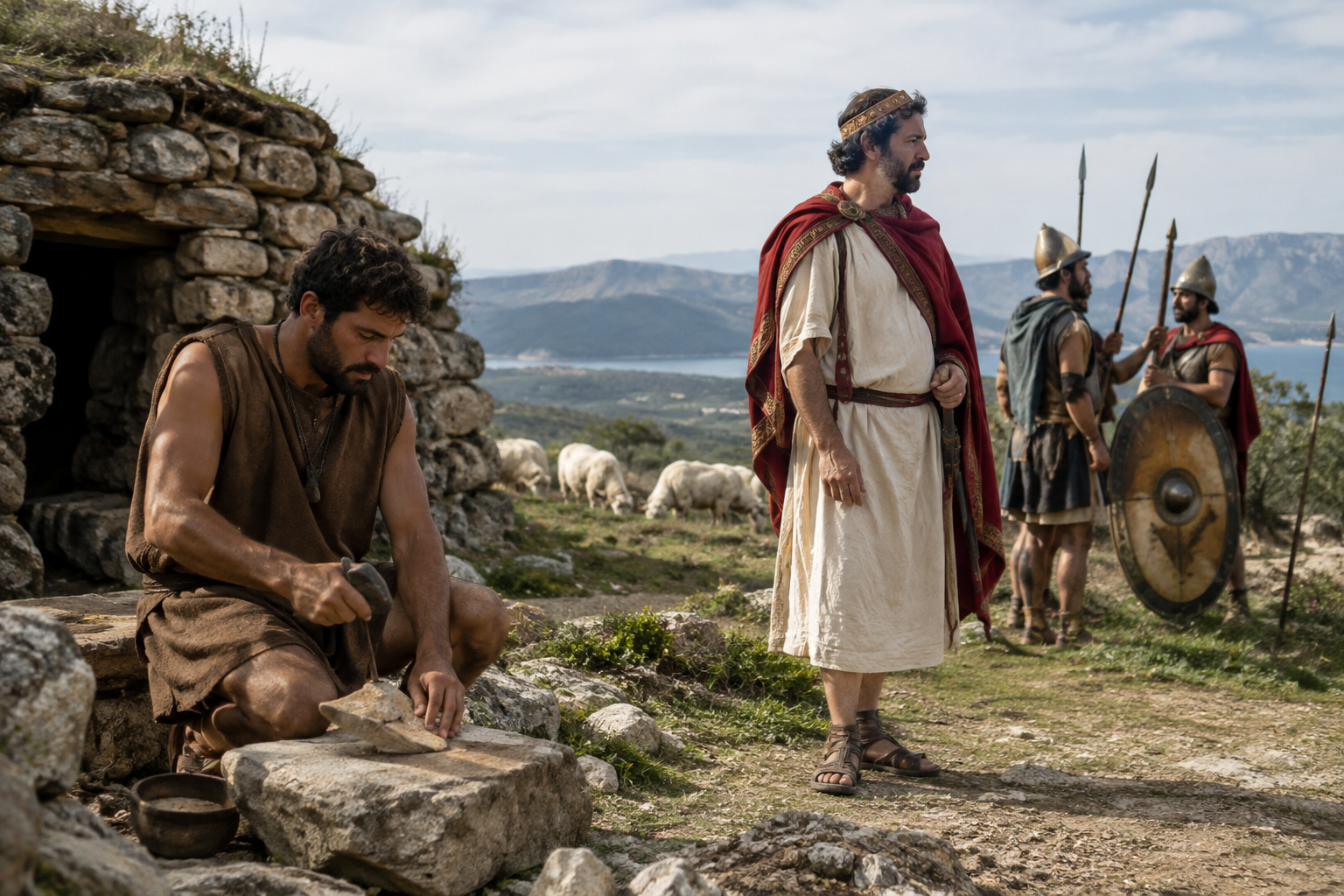
Some Y-DNA haplogroups arrive in the historical record with trumpets and banners. Others appear more quietly, in the laboratory, from a tooth in a Sardinian burial or a bone from a later settlement layer, and then begin to raise awkwardly interesting questions. Haplogroup I2a1a1a1a1a1a1f belongs to that second category: a very specific paternal branch whose story is not told by grand chronicles, but by deep ancestry, island history, and the patchy survival of male lines across long stretches of time.
That is worth pausing over. Y-DNA haplogroups trace one narrow line only: the direct paternal line, father to son to son. They do not describe a person's whole ancestry, culture, language, or identity. But they can be extraordinarily useful for reconstructing how male lineages moved, persisted, and sometimes vanished. With a branch as specific as I2a1a1a1a1a1a1f, caution matters. We can place it within the wider Y-chromosome family of haplogroup I, a lineage long associated with parts of prehistoric Europe, but we should not simply pour the entire history of broad I2 into this one tiny twig of the tree as if nothing changed along the way.
Broadly speaking, haplogroup I is one of the old European Y-chromosome lineages, with sub-branches that appear in different prehistoric and later populations across the continent. Within that wider framework, branches of I2 have often been discussed in connection with European hunter-gatherer ancestry and, in some regions, later continuity into farming and post-farming societies. But I2a1a1a1a1a1a1f is not the whole of I2. It is a much narrower descendant line, and that means the evidence has to be handled with care.
What a specific subclade like this can sometimes show is not the sweeping origin story of an entire continent, but the survival of a paternal thread in a particular region. In this case, the supplied ancient evidence points us toward Sardinia, and that is immediately intriguing. Sardinia is one of those Mediterranean places where archaeologists, historians, and geneticists all find themselves circling the same questions: continuity, isolation, seaborne contact, and the long afterlife of old lineages in an island setting.
For readers interested in the broader context of how ancient DNA reshaped this kind of research, MyTrueAncestry has a useful introduction here.
The first anchor point is SID005, dated to 2200 BC and described as Early Bronze Age Sardinia. Even in a short line of sample metadata, there is a great deal to think about. By the Early Bronze Age, Sardinia was not some untouched backwater floating beyond history. It was a lived-in island with communities negotiating local traditions, new technologies, and maritime contact across the western Mediterranean.
If a branch connected with I2a1a1a1a1a1a1f appears in that setting, it suggests that this paternal heritage was present on Sardinia by the Early Bronze Age. That does not tell us when the lineage first arrived on the island, nor whether it came with earlier inhabitants, later movements, or several waves of men whose lines merged into island populations. But it does place the lineage firmly in a prehistoric Sardinian context.
This matters because Sardinia is often discussed as a place of partial continuity, where some ancient genetic signatures persisted longer than in more heavily transformed mainland regions. Yet continuity is never simple. One paternal lineage surviving in one man does not mean a population stood still. It means only that one male line, or one branch close to it, was present there at that date.
For a wider look at island populations and the ancient DNA evidence from this part of the Mediterranean, readers may enjoy this related piece.
Discover Ancient Italian Islands
The second sample is where things become especially interesting. ORC002, dated to 230 BC, comes from Interior Sardinia Carthaginian Era. Now we are no longer in prehistory but in a Mediterranean world of colonial entanglement, trade, war, and imperial competition. Sardinia in this period sat within the orbit of Carthage and, increasingly, Rome. Coastal settlements, inland communities, Punic influence, and local traditions all overlapped in ways that written sources only partly capture.
If the same narrow paternal branch, or one close enough to be relevant here, appears in both SID005 and ORC002, the cautious historical point is not that we have found one family marching unchanged across two millennia. We have not. Rather, what we may be seeing is the persistence of a paternal line in Sardinia across major political and cultural change. The island of 230 BC was not the island of 2200 BC. But some male lines may have endured through all the upheaval.
That sort of continuity is precisely why ancient DNA is so useful. Written history tends to notice conquerors, magistrates, generals, and kings. Genetics sometimes notices the stubborn local men whose descendants remained in a valley, a village, or an upland community long after states came and went.
That Sardinian and Punic setting also makes this related article especially relevant.
It is tempting, when faced with a highly specific haplogroup, to demand a neat migration map: first here, then there, then into this people, then into that kingdom. Real history is usually less obliging. The safest reading of the evidence supplied here is regional and chronological. A paternal branch associated with I2a1a1a1a1a1a1f appears in Sardinia in the Early Bronze Age and again in interior Sardinia in the Carthaginian era. That is enough to suggest a meaningful Sardinian story, likely involving long-term local survival of some paternal lines amid broader Mediterranean contact.
Beyond that, broader hypotheses belong to the wider study of haplogroup I2 in Europe and the Mediterranean: old European roots, later reshaping by Neolithic expansion, Bronze Age population movements, and the uneven survival of older male lines in regions where geography encouraged continuity. Sardinia has often been one of those regions where old patterns lingered, though never in complete isolation from the outside world.
Readers curious about how later Roman and post-Roman Italy complicate these questions of continuity and change might also enjoy the following article.
So how does one move from Bronze Age and Carthaginian Sardinia to an English noble house? Carefully, and without pretending the DNA proves more than it does.
The supplied family connection is the House Fane, associated with Apethorpe Hall, more usually known as Apethorpe Palace in Northamptonshire. This is a building with layers, and layers are really what this whole article is about. It began as a medieval manor, came into the hands of the Fane family in the late 1400s, and in the early 1600s was transformed by Sir Walter Mildmay and his son into a grand courtyard mansion. James I was notably fond of it, staying there repeatedly while hunting in nearby Rockingham Forest, and Charles I also visited before the Civil War changed the political world around such houses.
Apethorpe is not evidence for a haplogroup. Stones do not carry Y-DNA reports. But houses like this preserve something else: the memory of how male lines, inheritance, property, and status were organized in later historical societies. They remind us that paternal descent mattered socially long before it could be tested genetically. A noble house, a surname, an estate, a line of succession: all these are historical expressions of concerns that ancient DNA now examines biologically from another angle.
That is why the connection is interesting even when it is not definitive. A reported association between a haplogroup and a noble family does not prove that every man of that family carried the same Y-DNA, nor that any ancient Sardinian individual was an ancestor of the Fanes. What it does offer is a way of thinking across timescales. Ancient DNA reveals the deep background of paternal lines; aristocratic houses show how later societies recorded, celebrated, and contested descent in writing, architecture, and landholding.
For readers who want the family story in fuller detail, MyTrueAncestry has a dedicated article on the house itself.
The fascination of I2a1a1a1a1a1a1f lies precisely in its narrowness. This is not a giant umbrella lineage that can lazily be attached to half of Europe. It is a fine-grained paternal marker, the sort of branch that becomes meaningful when anchored to real ancient individuals such as SID005 and ORC002. Those two samples hint at a Sardinian story stretching from the Early Bronze Age into the Carthaginian era: not a frozen island, but a place where some male lines may have persisted through enormous cultural change.
Set beside a later historical house like the Fanes at Apethorpe, the point is not to claim an unbroken genealogical chain. It is to see how different kinds of evidence illuminate different parts of the past. Ancient DNA gives us biological lineages. Archaeology gives us burials, settlements, and dates. History gives us names, estates, and royal visits. Put together, they do not solve every puzzle, but they make the past far more human and far less abstract.
If your own paternal ancestry leads into one of these old European branches, MyTrueAncestry can help place it in a wider ancient context. You may discover DNA similarities to ancient individuals or populations that shed light on where parts of your deep ancestry were once found. That is not the same as proving direct descent from a Bronze Age islander or a noble family at Apethorpe, but it can be a remarkably vivid way to explore the long history behind your DNA.






Comments