Haplogroup I2a1a1a1a1a1a1

– 6 min read


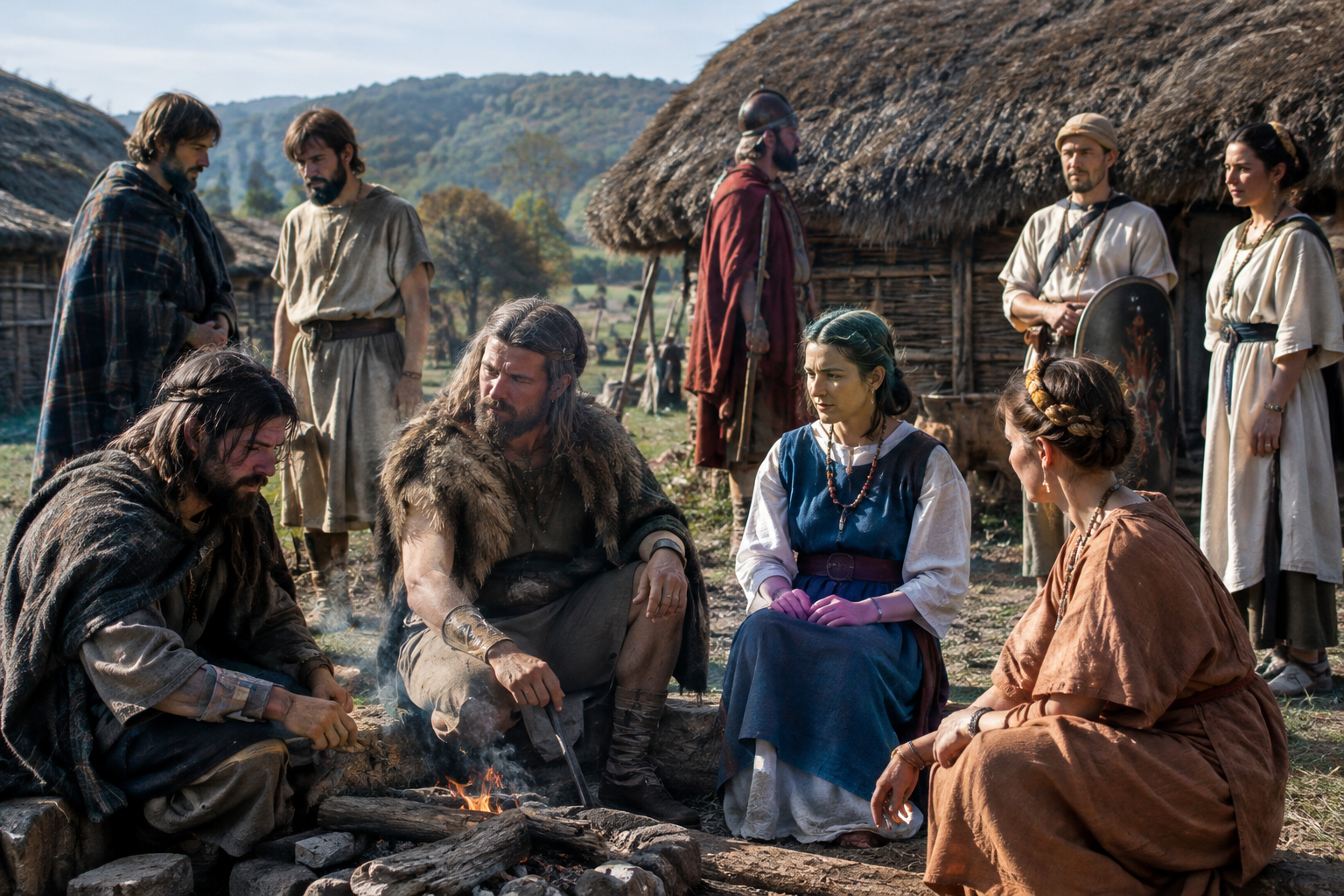
Some Y-chromosome lineages announce themselves with a fanfare of famous kings or sweeping migrations. Others are more elusive, turning up instead in graves, ruined towers, and the quiet continuity of particular regions. Haplogroup I2a1a1a1a1a1a1 belongs to that second category. It is interesting precisely because it sits inside the old European Y-DNA family of haplogroup I, a branch widely associated with deep prehistoric roots in Europe, yet the evidence supplied here places this very specific paternal line in a striking set of later contexts: Iron Age Gaul, Roman Britain, and Sardinia across more than two millennia.
That matters because Y-DNA tracks one narrow line of descent: father to son to son. It does not describe a person's whole ancestry, culture, or identity. But when ancient DNA keeps finding related paternal branches in different times and places, it gives us a way of following one thread through the larger historical fabric. In this case, the thread runs through Celtic-speaking regions of western Europe, touches Mediterranean islands, and then invites us to think carefully about how such old lineages may have survived into the medieval and early modern worlds of clans, lairds, and fortified houses.
I2a1a1a1a1a1a1 is a very narrow branch within haplogroup I, one of the major Y-chromosome lineages of Europe. At this depth in the tree, caution is essential. We should not simply take the entire history of broad haplogroup I2 and paste it onto this much smaller subclade as if nothing changed along the way. Still, it is fair to say that this lineage belongs to a paternal family with long-standing European associations, and the ancient samples supplied here suggest a western and central Mediterranean as well as western European story.
The interesting pattern is not a single dramatic origin claim, because the supplied evidence does not justify that, but rather a sequence of appearances in places that mattered greatly in later European history: Iron Age tribal Gaul, Britain under Roman rule, and Sardinia between the Bronze Age and the Carthaginian era. That spread hints at movement, survival, and regional continuity over long periods.
Explore Celtic Origins Through Ancient DNA
The strongest cluster in the evidence comes from Iron Age eastern France, among individuals associated with the Sequani Tribe. That is immediately evocative. The Sequani occupied a region around the Jura and upper Saone, a landscape of uplands, river routes, and frontier politics. This was not some remote backwater. It was part of the Celtic world of late prehistoric Gaul, tied into exchange networks and the rivalries that would eventually draw in Rome.
Several individuals from this setting are associated with the haplogroup: CGG023691 from Les Moidons dated to 500 BC; CGG023687 from Les Moidons dated to 455 BC; CGG023709 from Les Moidons dated to 455 BC; and CGG023692 from Les Moidons dated to 450 BC. Alongside them stand the Parancot individuals CGG023678, CGG023698, and CGG023723, all dated to 455 BC.
That concentration is important. One isolated sample can be a curiosity. A repeated cluster in the same tribal and regional setting begins to look like a real local paternal presence. It does not prove that every Sequani man carried this lineage, nor that these individuals all belonged to a single close family. But it does suggest that branches related to I2a1a1a1a1a1a1 were established in Iron Age Gaul and were not merely passing through.
For readers interested in the wider archaeological world around such finds, MyTrueAncestry's look at Late Iron Age Mobility and Burial Practices in Celtic Switzerland offers a nearby regional comparison, especially useful for understanding the movement and local rootedness of communities in the broader Celtic zone.
Discover Late Iron Age Celtic Mobility
The Sardinian evidence gives this haplogroup a broader horizon. Sample SID005, from Early Bronze Age Sardinia, is dated to 2200 BC. Much later, ORC002 appears in Interior Sardinia during the Carthaginian Era, dated to 230 BC. These two finds, separated by nearly two thousand years, are especially suggestive because they imply that related paternal lines were present on Sardinia across very different political worlds.
Bronze Age Sardinia belonged to the island's own prehistoric development. By the Carthaginian era, Sardinia had become tied into the western Mediterranean struggles of Punic expansion, local communities, and eventually Roman intervention. The survival of a related paternal branch across that span does not mean political continuity, but it may point to demographic persistence beneath changing powers. Islands are often good places for seeing this sort of long continuity mixed with outside contact.
Then there is Britain. Sample I12931, from Late Iron Age Gloucestershire Britain, dated to 125 AD, places the lineage in western Britain during the Roman period. The date is telling. By 125 AD Britain was not pre-Roman in a simple sense, but neither had older local populations vanished. Roman rule created roads, forts, taxation, and mobility, yet many paternal lines clearly persisted through the transition. A lineage seen among Iron Age Gauls and also in Roman Britain is perfectly plausible in a world where the Channel was a corridor rather than a barrier.
Readers who want more on that mixed world of continuity and change should explore MyTrueAncestry's article on Genomic History and Natural Selection in Roman and Early Medieval Britain. It is a reminder that Roman provinces were populated not by abstract "Romans" and "natives," but by layered communities with deep local roots.
Read Roman and Early Medieval Britain DNA
So where does this leave us when we turn from burials to castles? Not with a magic genealogical shortcut, certainly. We cannot leap from an Iron Age burial in Gaul or a Sardinian Bronze Age grave to a named medieval family and declare descent. That is not how responsible archaeogenetics works. But we can say that lineages such as I2a1a1a1a1a1a1 help explain how very old paternal branches can remain embedded in regions that later generated clans, lordships, and hereditary houses.
This is where Clan Barclay enters the story. The supplied association points us to Towie Barclay Castle in Aberdeenshire, a 16th century tower house built by the Barclay family and later linked with the Forbeses and other local lairds. The building belongs to a Scotland of clan rivalry, royal politics, and changing forms of lordship. Thick walls, hall, and private chambers speak to a social order in which a residence was also a statement: protection, authority, lineage, and local standing all set in stone.
And here one of the most useful lessons of DNA and archaeology appears. Written genealogy begins late and often selectively. Castles appear later still. But paternal lineages are older than both. A ruined tower in Aberdeenshire cannot prove a Y-DNA assignment, yet it stands in a landscape where many male lines had already been present, branching and rebranching, for centuries before the first mason laid stone. Genetics gives us the long background; architecture and records give us the later named actors.
Towie Barclay Castle also tells a broader regional story. Like many Scottish towers, it eventually declined as elite taste moved away from fortified residences. What remains is a ruin, but a revealing one: a sign of continuity in a countryside where families rose, intermarried, feuded, adapted, and endured. In that sense it is not unlike a haplogroup branch - narrower than the whole population, but stubbornly persistent across change.
For more on that family context, the MyTrueAncestry community article on Clan Barclay is the obvious companion piece, especially if you want to move from the genetic backdrop into the documented history of the name itself.
Explore the History of Clan Barclay
The real fascination of I2a1a1a1a1a1a1 is that it refuses to stay in just one historical box. The evidence supplied here places related paternal branches in Early Bronze Age Sardinia, Carthaginian-era interior Sardinia, Iron Age Sequani territory in Gaul, and Roman-period Britain. That is not a neat ethnic label. It is something more interesting: a glimpse of how old European male lines could persist through changing languages, political systems, and identities.
In other words, this haplogroup is not "the DNA of the Sequani," nor "the DNA of the Barclays," nor "the DNA of Sardinia." It is one paternal branch that appears in several important historical settings. Ancient DNA helps us see those settings as connected by human movement and continuity rather than separated into tidy textbook chapters.
If the interplay of lineages, families, and strongholds interests you, readers may also enjoy MyTrueAncestry's article on The House of Berkeley, another example of how hereditary history and place can be explored alongside genetic thinking without confusing one for the other.
If you carry haplogroup I2a1a1a1a1a1a1, or a nearby branch, your paternal line may belong to one of these long European stories of survival, movement, and regional continuity. MyTrueAncestry can help you compare your DNA with ancient individuals such as CGG023691, CGG023678, I12931, SID005, and ORC002, placing your results in a deeper archaeological context. Those matches do not prove direct descent from any one ancient person or membership in a noble family, but they can open a remarkable window onto the old worlds your ancestors once inhabited.






Comments