Haplogroup I1a3a2b
– 5 min read


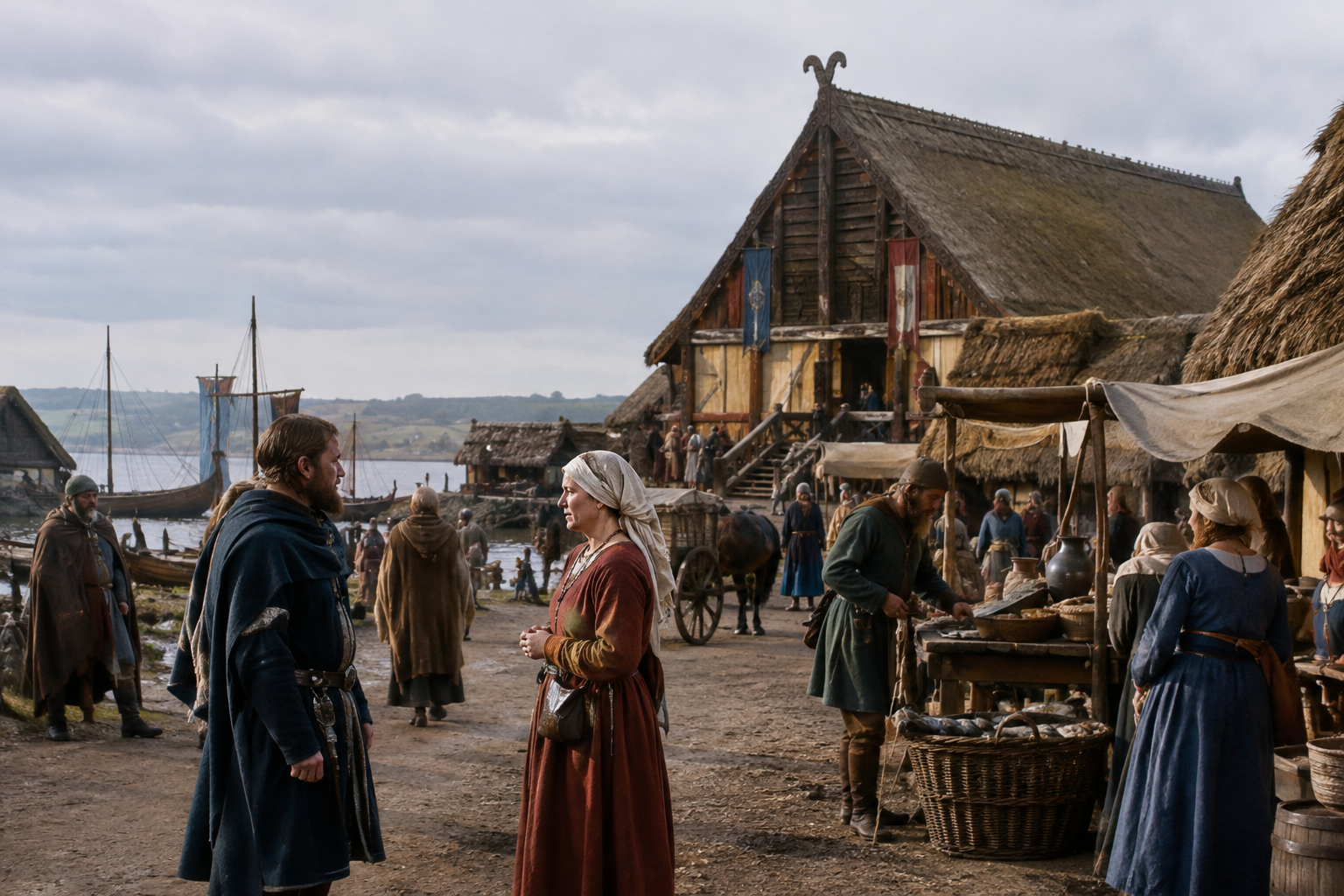
In about AD 1070, at Hedeby in southern Jutland, one man carried a paternal line now identified here as I1a3a2b. The sample, SWG007, comes from the post-Viking Age levels at Hedeby Schleswig Rathausmarkt, a place whose very name tells you this is not a saga landscape but an urban one: market ground, traffic, exchange, administration, and the busy afterlife of one of the great North Sea and Baltic crossroads.
That matters because Y-DNA is at its most interesting when it turns up not in a mythical founding hero, but in a real person from a real settlement. A haplogroup traces one direct paternal line only, not a person's whole ancestry, language, or identity. Even so, a lineage found at Hedeby around the late 11th century immediately places I1a3a2b in a world shaped by Scandinavian mobility, Christianization, and the long commercial reach of the Viking and post-Viking north.
Hedeby, near the base of the Jutland peninsula, was one of the best-positioned towns in northern Europe. It linked the North Sea and the Baltic, drew merchants from across the Scandinavian and continental worlds, and sat in a frontier zone where Danish, Saxon, Slavic, and wider northern connections overlapped. By the time of SWG007, we are already looking at a settlement transformed by the later Viking Age and its aftermath, not an isolated warrior camp.
The date attached to this individual, around AD 1070, places him in a period when Hedeby's political and economic importance was changing, but its significance as a contact zone remained unmistakable. A paternal lineage like I1a3a2b in this context is therefore not just "Scandinavian" in a vague sense. It is part of the lived population of a town where people, goods, and family lines could move through wide northern networks.
An ancient DNA study examining early medieval populations around the North Sea and in England is available through this research publication. Even where a single sample like SWG007 should not be made to carry more than it can, the broader value of such work is that it helps place northern paternal lines within the demographic reshaping of the early medieval centuries.
The key point is to distinguish the narrow branch from the broader tree. I1a3a2b is a subclade within the wider Y-DNA haplogroup I1, a lineage strongly associated in many ancient and modern studies with northern Europe, especially Scandinavia. But it would be careless to pour the entire history of I1 into this much smaller branch as though every subclade shared exactly the same path.
What we can say more safely is that a reported association between SWG007 and I1a3a2b fits very well with what one might expect in a late Viking or post-Viking southern Scandinavian setting. Hedeby is precisely the kind of place where a northern paternal line could be documented in archaeological reality rather than reconstructed from later surnames or family legend.
And there is a second point worth making. For many people exploring their paternal ancestry today, the temptation is to imagine a haplogroup as a tribe badge. Archaeology is much less tidy. A man carrying I1a3a2b at Hedeby could have belonged to a community speaking Norse, living under Danish influence, trading with Saxons and Slavs, and participating in a Christianizing world that was already more urban and more entangled than popular images of the Viking Age often allow.
Southern Jutland was never merely the edge of somewhere else. It was one of those regions, like Kent or the lower Rhine, where history tends to happen in layers. The area around Hedeby and Schleswig sat close to the shifting meeting ground between the Danish kingdom and the Saxon world to the south, while sea routes connected it outward to Norway, Sweden, the British Isles, Frisia, and beyond.
That makes the location of SWG007 especially useful. If a lineage appears in a remote farmstead, one kind of story suggests itself. If it appears in a commercial and political hinge-point like Hedeby, another does. The significance of I1a3a2b here is not simply that it existed in Scandinavia, but that it is documented in one of the places through which Scandinavian influence circulated most effectively.
This wider setting also helps explain why Y-lineages found in medieval northern Europe cannot be read as static or neatly bounded. Towns like Hedeby gathered people from different backgrounds into the same economic and religious worlds. A paternal branch may persist through generations, but the societies carrying it are rarely closed boxes.
Germanic Languages and Genomics
One of the most useful ways to think about I1a3a2b is not as a relic of some frozen Viking essence, but as part of the continuity between Viking Age mobility and medieval population history. Around AD 1070, Scandinavia was not stepping out of history after the raids; it was entering a different phase of state formation, church organization, and urban development. Hedeby sits right in that transition.
That transition is often easier to see in archaeology than in legend. Market settlements, cemeteries, church-linked burials, and emerging towns reveal the reshaping of society more clearly than heroic literature does. A lineage like the one carried by SWG007 therefore belongs to the same long northern story that includes trade, conversion, settlement, and the making of medieval kingdoms.
For readers whose broader ancestry points toward Britain as well as Scandinavia, this is also a useful reminder that movements across the North Sea were not one-off events. They unfolded over centuries and involved many kinds of people, not only raiders. MyTrueAncestry has explored this wider setting in several directions, including northern migrations and early medieval population change.
There is only one ancient sample supplied here, and that should make us careful, not dismissive. A single well-placed individual can still be historically revealing when the context is strong. SWG007 is not just any medieval male; he is a man from post-Viking Age Hedeby, one of the most important archaeological settings in northern Europe for understanding movement, exchange, and Scandinavian-connected society.
That is often how ancient DNA advances: not by instantly explaining everything, but by pinning a lineage to a definite place and time. In this case, I1a3a2b is anchored to a late 11th-century southern Jutland context. For descendants and researchers alike, that is already a valuable piece of evidence, because it grounds the branch in the historical world of the Baltic-North Sea corridor.
The distinctive insight from I1a3a2b here is not royal glamour or a grand migration slogan. It is something better: a documented paternal line present in post-Viking Age Hedeby, at a date when Scandinavian society was urban, connected, and changing. If this is your Y-DNA branch, the strongest ancient clue in this evidence points toward the southern Scandinavian world of ports, frontiers, and North Sea-Baltic exchange.
That is the sort of finding archaeology is very good at: not turning DNA into myth, but setting one lineage back among the real people and real places of the medieval north.






Comments