Haplogroup I1a3a1a2a1

– 6 min read


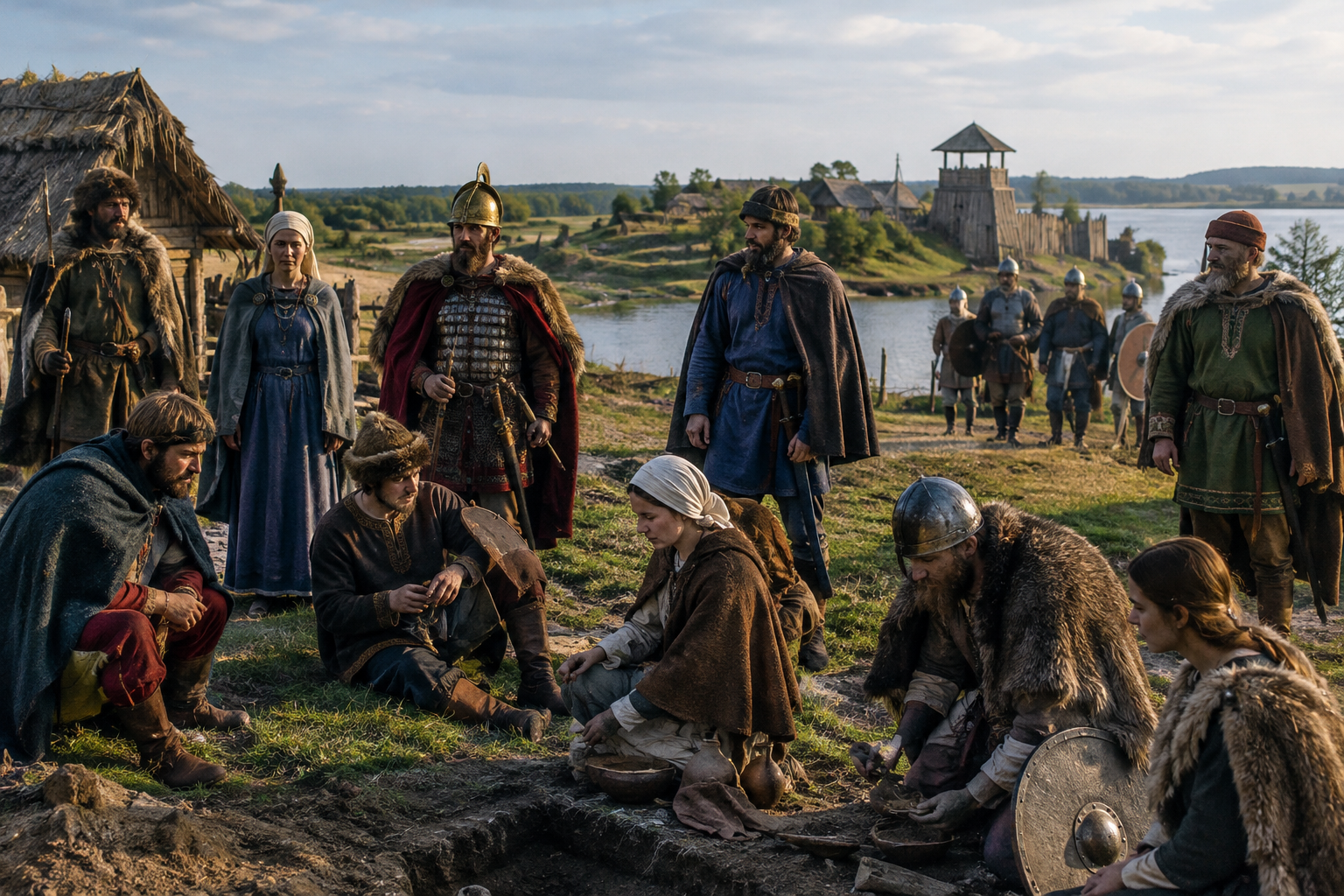
There is something especially arresting about a narrow Y-chromosome branch like I1a3a1a2a1. It does not tell the whole story of anyone's ancestry - no Y-DNA haplogroup can do that - but it follows one direct paternal line across centuries in a way that written records usually cannot. When that line turns up in ancient burials scattered from Poland to Bulgaria, Serbia, and Hungary, it gives us a glimpse not of a single people marching in lockstep, but of men moving through the unsettled world of late antiquity and the early Middle Ages.
This is what makes I1a3a1a2a1 historically interesting. It sits within the broader Y-DNA haplogroup I1, a major European paternal lineage often discussed in connection with northern Europe. But a specific downstream branch such as I1a3a1a2a1 must be treated more carefully than the wider parent haplogroup. We should not simply pour the entire history of I1 into this smaller twig of the tree. What the evidence here does suggest is that this paternal line appears in contexts linked to Gothic communities, late Roman frontier zones, Avar-period Hungary, and the post-Avar Frankish world. In other words, it belongs to precisely the kind of mobile, mixed, politically unstable landscape that ancient DNA is so good at illuminating.
Y-DNA haplogroups trace a direct father-to-son line. That makes them powerful for reconstructing paternal history, but also easy to misuse. Sharing I1a3a1a2a1 with an ancient individual does not mean you are his direct descendant, nor does it prove membership in any historic clan or noble house. What it does offer is context: a place in a much longer story about where certain paternal lines are found and how they moved.
For this branch, the strongest pattern in the supplied evidence belongs to the centuries around the collapse of Roman power in Europe. That was the age of federates, Gothic settlements, military service, shifting alliances, and ambitious newcomers taking advantage of imperial weakness. Rather than imagining neat ethnic blocks, it is safer to picture corridors of movement stretching from the lands north of the Black Sea and the Polish plain into the Balkans and the Carpathian Basin.
The cluster of ancient finds in Poland is especially suggestive. Several samples from the Maslomecz Wielbark area - PL057, PL059, PL062, and PL071, all dated to 250 AD - place this paternal line in a community archaeologists associate with Gothic-period settlement. That does not mean the haplogroup was uniquely "Gothic," nor that every Goth carried it. But it does show that this paternal branch was present in one of the best known late Iron Age and Migration Period contact zones of eastern Europe.
The Maslomecz samples are not isolated curiosities. They are joined by GRK021 from Grodek nad Bugiem, dated to 400 AD, showing the same broader historical zone still mattered as the Roman world entered its most fragile phase. By then, communities in this region were tied into long-distance political and military developments reaching south into the Balkans and west toward the Roman frontier.
That wider map becomes clearer with I41203, a 400 AD individual from a Gothic Grave Aul of Kan Omurtag at Han Krum Village, Bulgaria. Here the same paternal branch appears deep in the Balkans, in a setting connected with Gothic presence in late antique Bulgaria. This is important because it turns a local Polish pattern into a broader Migration Period one. We are no longer looking only at one cemetery or one frontier district, but at paternal continuity across a moving world.
Then there is VIM5 from Late Antique Roman Viminacium, Moesia, Serbia, dated to 400 AD. Viminacium was not a barbarian village on the margins. It was one of the major Roman sites on the Danube frontier. Finding this lineage there is a useful reminder that paternal lines do not belong to neat civilizational boxes. A lineage found among Gothic-associated burials can also appear in a Roman imperial setting, because those worlds were entangled - through war, recruitment, settlement, marriage, and opportunism.
By the seventh century the story shifts again into the Carpathian Basin. KUP014, from an Early Avar Elite Grave at Kunpeszer, Hungary, dated to 609 AD, and RKF054 from Rakoczifalva, Hungary, dated to 650 AD, show the same paternal line in the age of Avar rule. This does not make I1a3a1a2a1 an "Avar haplogroup." Rather, it shows that men carrying this lineage were part of the mixed populations living under, around, or within Avar political structures.
Finally, TMH-509 from Tiszafured-Majoros-halom, Hungary, dated to 800 AD, places the lineage in a Frankish Empire Post Avar context. If one were looking for a single lesson from this run of samples, it would be that paternal lineages can survive dramatic political change. Goths, Romans, Avars, and Franks are not successive labels pasted onto biologically separate peoples. Ancient DNA keeps showing us that the men buried under those labels often came from overlapping and mobile populations.
By the Middle Ages, written history begins to speak more loudly than the graves. Yet the relationship between the two is tantalising. Not because ancient DNA can magically identify a medieval surname, but because it helps us think about how paternal lines could persist through centuries while identities, languages, and allegiances changed around them.
That is where the later associations in this case become so evocative. In northeast Scotland, Clan Leslie is linked with Balquhain Castle in Aberdeenshire, a long-time Leslie seat whose story reaches back to the fourteenth century. An earlier stronghold stood there before the present tower house rose in the sixteenth century. It developed into a fortified L-plan residence, bound up with the ambitions of a major regional kin group. Feuds, changing loyalties, national conflict, civil war damage, and eventual ruin all left their mark. Balquhain's broken walls do not prove a haplogroup, of course. But they do preserve the social world in which paternal descent, lordship, and family memory mattered intensely.
Across the Channel, House de Gournay brings us into a different but related world. Chateau de Gournay was tied to an old Norman family that emerged in the eleventh century around Gournay-en-Bray, after the Viking age, and became part of the warrior nobility of ducal Normandy. After 1066, members of the family belonged to that Anglo-Norman sphere where castles, landholding, and military service defined aristocratic status. Again, we should be strict: a historical association is not proof that every de Gournay male carried I1a3a1a2a1. But Norman history itself is a reminder that medieval elite lineages often grew out of centuries of earlier movement around the North Sea world.
Balquhain Castle and Chateau de Gournay stand in very different landscapes - one in the harsh politics of northeast Scotland, the other in the feudal memory of Normandy - yet both belong to a recognisable medieval habit of turning lineage into stone. Castles were not merely defensive shells. They were statements about inheritance, authority, and who claimed the right to endure in a place.
That is why they make such a useful counterpart to Y-DNA. Castles preserve the memory of families in the documentary age; ancient DNA preserves traces of male lines in the pre-documentary and semi-documentary ages. The two are not the same sort of evidence, and one must never be used to force conclusions from the other. But together they help explain why people are so interested in paternal ancestry. One line runs through bones and mutations, the other through seals, charters, ruined towers, and family tradition.
For readers interested in the Scottish side of that story, Clan Leslie offers a particularly good example of how local power and family identity could be anchored in one ancestral seat for generations, even as wider kingdoms rose and fractured around it.
So what does haplogroup I1a3a1a2a1 reveal? First, it appears in a striking chain of ancient contexts running from Poland to Bulgaria, Serbia, and Hungary, especially in the centuries between 250 AD and 800 AD. Second, those contexts belong not to one simple ethnic story but to a world of frontier mixing: Gothic communities, Roman provincial centres, Avar-period elites, and post-Avar populations under Frankish influence. Third, its later historical associations with families such as Clan Leslie and House de Gournay are best read as regional and historical parallels, not proofs of direct descent.
In other words, this haplogroup opens a window onto the long afterlife of late antique mobility. It reminds us that paternal lines can pass through many political identities without changing their underlying biological continuity. A man carrying this lineage might, in different centuries, have lived in a Gothic-associated settlement, on a Roman frontier, in an Avar-controlled landscape, or under Frankish rule. That is the point. Human history is not tidy, and the Y chromosome, at its best, helps us see just how untidy it was.
If you would like a wider grounding in how archaeologists and geneticists piece these stories together, the broader field of ancient DNA is worth exploring in its own right.
Learn How Archaeogenetics Works
Upload your DNA to MyTrueAncestry to explore whether your results show similarities to ancient individuals like PL057, I41203, VIM5, KUP014, or TMH-509, and to place your own ancestry within the deeper historical landscapes discussed here. Such matches can offer remarkable clues about ancient population history, even when they do not prove direct descent from a particular warrior, clan, or noble house.






Comments