Haplogroup I1a2b4

– 7 min read


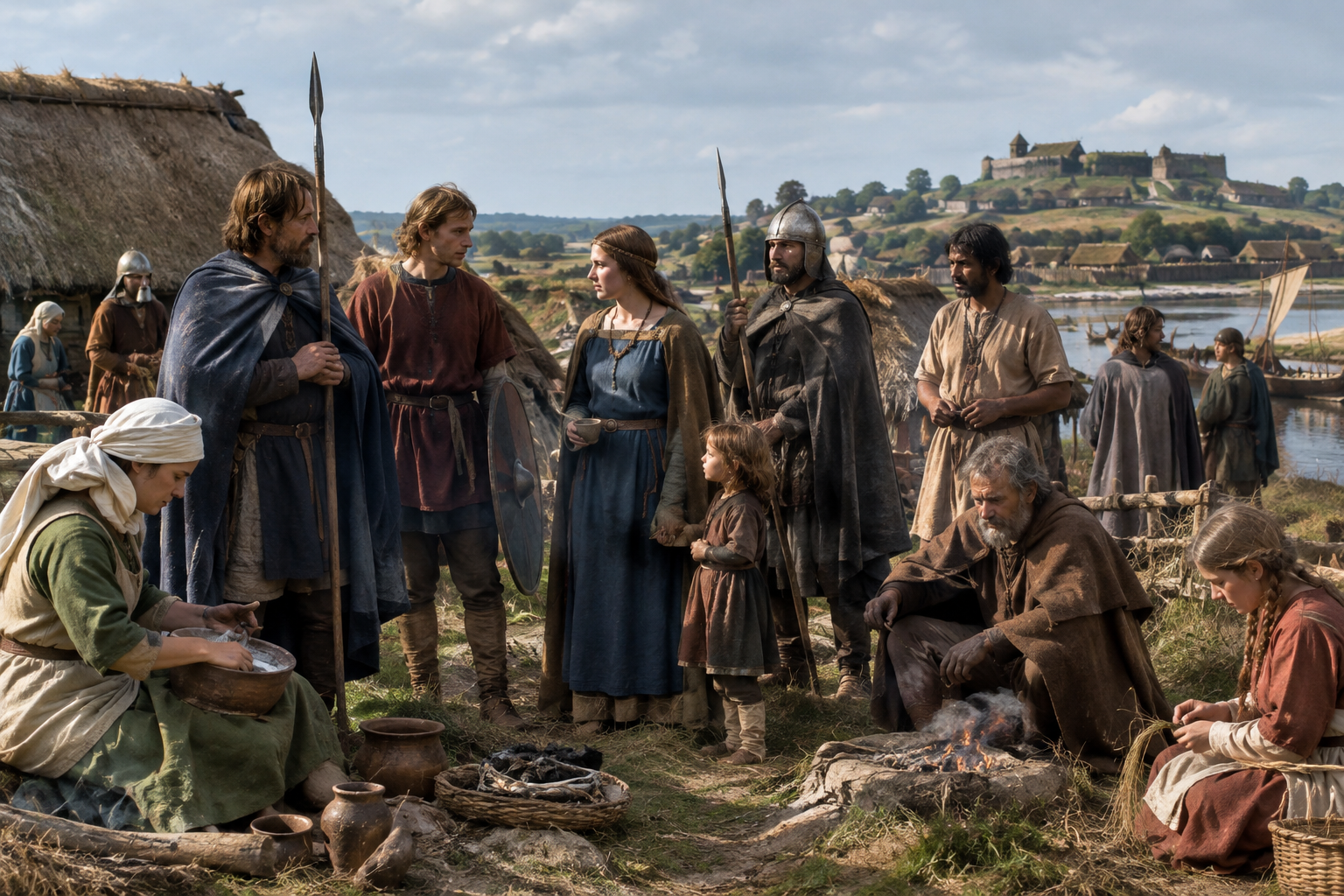
There is something wonderfully stubborn about a Y-chromosome lineage. Kingdoms collapse, languages change, castles rise and fall into ruin, but a paternal line can keep threading its way through history, almost invisibly, until ancient DNA suddenly brings it back into view. Haplogroup I1a2b4 belongs to that kind of story: a very specific branch within the wider Y-DNA haplogroup I1, a lineage most strongly associated in broad terms with northern Europe, especially the Scandinavian and North Sea world.
That broad setting matters, but so does caution. A Y-DNA haplogroup traces only one line of ancestry: your direct father-to-father-to-father line. It does not describe all of a person's ancestry, culture, identity, or family history. For a narrow branch such as I1a2b4, it is especially important not to pour the entire history of haplogroup I1 into one downstream twig as if they were all the same thing. What the evidence here does suggest is striking enough: this lineage appears in ancient individuals from Denmark, northern Germany, and early medieval England, placing it squarely in the world of North Sea mobility, post-Roman migration, and the making of early medieval northern Europe.
The deeper background of I1a2b4 lies within the wider I1 family, a Y-chromosome lineage long studied in northern Europe. The exact age and birthplace of this very specific subclade should not be guessed at without direct evidence, but the archaeological pattern in the supplied ancient samples gives us a sensible framework. Some of the earliest relevant finds come from Denmark, and that matters because Denmark sits at one of the great historical crossroads of the north: a peninsula and island zone looking toward the Baltic, the North Sea, and the river routes of continental Europe.
Two early samples are especially suggestive. CGG105333, from Nordic Bronze Age Denmark Vordingborg dated 1814 BC, and CGG106702, from Neolithic Denmark Karlstrup dated 1769 BC, push the story back well before Saxons, Franks, or Vikings were names in written history. These individuals do not let us claim an unbroken ethnic identity across millennia, but they do show that paternal lines associated with this branch were present in Denmark in deep prehistory. That is an important difference. Ancient DNA is not telling us "the Danes were already there" in any simple modern sense; it is showing that some northern paternal lineages had remarkable time depth in the region.
For readers interested in the wider prehistoric backdrop to these Danish finds, MyTrueAncestry has a useful piece on the region's much earlier transformations:
By the later Iron Age and Roman-era north, this paternal thread is still visible. CGG107400, from the Danii Tribe Denmark Sjaelland Southwest Vemmelev Hemmeshoj dated 275 AD, places the lineage in a setting that looks much closer to the historic peoples of the late antique north. Again, one must resist the temptation to draw a straight line from one burial to a named people in medieval chronicles, but the geography is telling. Denmark is not acting here as an isolated pocket. It is the hinge between Scandinavia and the continent.
Once we reach the centuries around the end of Roman rule in the west, the picture becomes even more vivid. The lineage appears in regions associated with Germanic-speaking groups moving, settling, and reshaping power across Europe. In central Germany, we find OBM012 from Thuringii Tribe German Obermoellern dated 500 AD, and DRH013 from Thuringii Tribe Germany Deersheim Saxony-Anhalt also dated 500 AD. These samples place the haplogroup in the world of post-Roman central Europe, where local continuity, political reorganization, and long-distance connections all overlapped.
West of there, in the Frankish sphere, three samples from Merovingian Period Frankish Moemlingen Germany dated 650 AD - Mln25, Mln44, and Mln45 - show the lineage present in a region tied to one of the most important kingdoms of early medieval Europe. That does not make I1a2b4 a "Frankish haplogroup" in any simplistic sense. What it does show is that this paternal branch was part of the biological landscape of the Merovingian world, where Roman provincial populations, incoming groups, and shifting elite networks all met.
If that frontier world interests you, there is a particularly apt companion read:
Read the German frontier story
There is also an intriguing earlier continental sample, HVN010, from Celto-Longobard Haeven Mecklenburg-Vorpommern dated 250 AD. Even the label tells us something about the difficulty and richness of this period. The north was not arranged into neat genetic boxes. Archaeology and DNA repeatedly show mixed communities, overlapping identities, and people on the move. Haplogroups help trace paternal lines through that complexity, but they do not abolish the complexity.
If one wanted a textbook example of how ancient DNA can illuminate the North Sea world, one could do worse than look at the English samples here. The lineage appears repeatedly in early medieval England, especially in eastern and northern sites linked to the centuries after Rome's withdrawal.
At West Heslerton in Yorkshire, in the Vale of Pickering, we find a cluster: I11588 from Saxon England North Yorkshire West Heslerton Vale of Pickering dated 500 AD, I20638 from Post-Roman England North Yorkshire Vale of Pickering dated 500 AD, and a remarkable series from the Early Anglo Saxon Cemetery West Heslerton Yorkshire dated 550 AD: I20679, I20639, I20646, I20661, I20645, I20650, and I20656. This is exactly the sort of concentration that makes archaeogenetics so powerful. We are no longer dealing with a stray isolated find, but with a lineage repeatedly present in one early Anglo-Saxon landscape.
Other English sites widen the picture: BUK038 from Early Anglo Saxon Period Buckland Dover England dated 400 AD, HAD003, HAD015, and HAD016 from Early Anglo Saxon Period Hatherdene Close Cambridgeshire England dated 500 AD, OAI009 from Anglo Saxon Oakington England dated 470 AD, I20637 from Post Roman Era Worth Matravers Dorset England dated 600 AD, and LAK009 plus LAK002 from Early Medieval Suffolk England Lakenheath dated 650 AD.
Taken together, these finds strongly place I1a2b4 in the same historical arena as the Anglo-Saxon migrations and settlement of early medieval England. That does not prove that every man with this lineage in England arrived from overseas in one single movement, nor that every bearer identified in the same way. But it does support a larger pattern of paternal connections linking Denmark, northern Germany, and England across the North Sea.
Readers who want to dig deeper into that process should have a look at this related article:
Explore Anglo-Saxon migration DNA
The story does not stop in the 7th century. SWG008, from Post Viking Age Hedeby Schleswig Rathausmarkt Southern Jutland dated 1140 AD, shows the lineage still present in one of the most famous trading zones of the medieval north. Hedeby was no sleepy backwater. It was one of those places where merchants, languages, goods, and identities collided. To find the lineage there in the post-Viking period reinforces the impression that this was a durable North Sea paternal branch, one that survived the dramatic political shifts from tribal confederacies to kingdoms to Christian medieval polities.
For a broader look at how these seaways shaped Britain over the long term, this is well worth reading:
What, then, do we make of the supplied noble connection: House Bruggeman and Craigie Castle in South Ayrshire, Scotland? The answer is: something interesting, but not something magical. Craigie Castle began as a stronghold of the de Cargyl family in the 12th century, later passed to the powerful Wallace family, and then to the Kennedys. The surviving tower house is mostly 16th century, though it stands on the site of an earlier medieval castle bound up with lordship, feuding, and alliance-making in southwest Scotland.
That history matters because castles are not just buildings; they are fossilized politics. Craigie was part fortress, part residence, part public claim to local authority. Over time its military role faded, and like many Scottish castles it became more domestic before decline and ruin overtook it. What remains is not genetic proof of any one paternal line, but a stage on which later medieval families acted out questions of inheritance, landholding, and power.
It would be irresponsible to claim that the de Cargyls, Wallaces, Kennedys, or House Bruggeman were proven carriers of I1a2b4 merely from this association. But geographically and historically, the connection is still suggestive. Scotland, especially the Lowlands and western seaboard, sat within the same larger North Sea and Irish Sea world that ancient DNA has already mapped for this lineage. Families attached to castles like Craigie lived in a landscape shaped by centuries of movement from Scandinavia, northern England, and the continent. Genetics cannot replace the charter evidence or the family records; it can, however, remind us that medieval lordship rested on populations with much deeper and more tangled histories than heraldry alone can show.
For readers interested in one of the major families tied to Craigie's history, this companion piece is a natural next stop:
The great value of haplogroup I1a2b4 is not that it hands us a neat tribal label or a guaranteed noble pedigree. It does something more interesting. It anchors one paternal lineage in prehistoric Denmark, carries it through migration-age northern Europe, places it among early medieval populations in Germany and England, and shows its persistence into the medieval North Sea zone.
That is precisely where ancient DNA is at its best. Written genealogy usually begins late and privileges the literate, the wealthy, and the landholding. Ancient DNA reaches behind those records into cemeteries, settlement edges, old trading towns, and forgotten burial grounds. It does not tell us that a Bronze Age man in Vordingborg was the direct ancestor of a lord at Craigie Castle. But it does let us see the much longer human background out of which such medieval families emerged.
If your own Y-DNA falls within I1a2b4, or near it, MyTrueAncestry can help place that paternal line into a much wider historical frame. You may discover genetic similarities to ancient individuals from Denmark, Germany, or early medieval England and begin to see how one branch of your ancestry fits into the making of northern Europe. Those matches do not prove direct descent from any specific ancient person or noble house, but they can open a remarkably concrete window onto the past.
Upload your DNA to MyTrueAncestry and explore where your ancient connections may lead.






Comments