Haplogroup I1a2b

– 5 min read


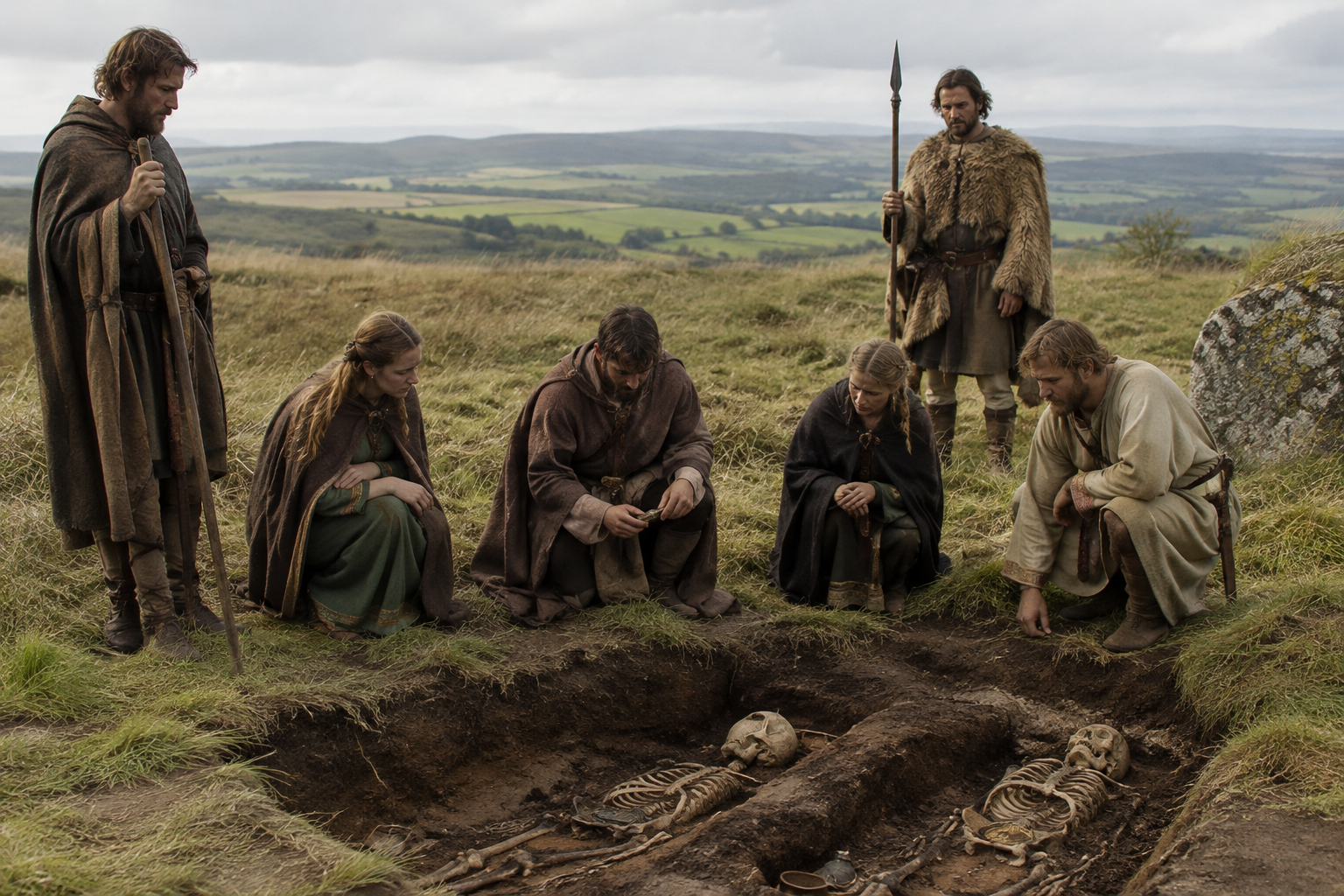
At West Heslerton in Yorkshire, several men buried in an early Anglo-Saxon cemetery around AD 550 have been associated with the Y-DNA haplogroup I1a2b. That is immediately interesting because West Heslerton is one of those sites where archaeology and genetics meet on very solid ground: not a saga landscape, not a later medieval pedigree, but a real burial community from the centuries when post-Roman Britain was being remade.
The cluster matters because it is not a lone outlier. The sample IDs I20639, I20646, I20661, and I20656 all come from the same cemetery and the same broad early Anglo-Saxon horizon. In other words, I1a2b appears here not as an abstract label on a map, but as part of a local male presence in eastern Britain during the 6th century. Since Y-DNA follows one direct paternal line only, it does not define the whole ancestry of these men, but it can help show which paternal branches were present in the communities forming early medieval England.
West Heslerton has long been archaeologically important because it sits in a region central to debates about migration, settlement, and identity after Roman rule. The cemetery belongs to that formative period when parts of lowland Britain saw the emergence of new burial customs, new political groupings, and growing connections across the North Sea.
What makes the I1a2b-associated samples here so useful is their repetition. One man with a particular paternal line might tell us very little. Four men from the same cemetery, all in the same broad period, suggest that this was a lineage actually embedded within the local community. That does not automatically make them close relatives, nor does it mean the whole cemetery shared the same paternal ancestry, but it does show that this branch had a real foothold in early Anglo-Saxon Yorkshire.
An ancient DNA study examining early medieval England has helped place sites like West Heslerton into a larger picture of migration and mixture between incoming continental populations and people already living in Britain. For readers wanting broader context on that transformation, see this related piece on Anglo-Saxon migration and the early English gene pool.
The West Heslerton group is not the only sign of this lineage in the region. Another associated sample, I20638, comes from post-Roman England in the Vale of Pickering, dated around AD 500. Geographically, that places it in the same wider North Yorkshire landscape, and chronologically it sits right at the start of the post-Roman transition that would shape the early English kingdoms.
This is the sort of pattern archaeologists like because it is specific without being overblown. We are not looking at a sweeping continental claim built on one dramatic grave. Instead, we can see I1a2b appearing in more than one burial context in the same northern English region across the 5th and 6th centuries. That strengthens the case that this paternal branch belonged to part of the male population involved in the North Sea world taking shape in eastern Britain.
Research on ancient genomes from Roman and early medieval Britain has made precisely this point: some changes after Rome were substantial, but they were also regional, uneven, and socially complex. The evidence is better read as the history of communities than as a cartoon of total replacement. One major study of this period is here, and it helps explain why repeated lineages in places like Yorkshire matter.
A further associated sample, I20637, comes from Worth Matravers, Dorset, dated around AD 600. This is useful because Dorset is not Yorkshire. It belongs to a rather different regional story on the south coast of England, where post-Roman communities developed under different pressures and with different local histories.
That wider spread matters. If I1a2b had turned up only in one Yorkshire cemetery, we might suspect an intensely local paternal cluster. With Worth Matravers added to the picture, the branch looks less like a single family pocket and more like one of the paternal lines circulating within early medieval England across multiple regions. That still does not tell us its exact route into Britain, or whether every carrier shared the same recent homeland, but it makes the branch historically visible on more than one stage.
For a broader look at the same general period, this MyTrueAncestry article on ancient DNA in post-Roman Britain is especially relevant.
There is also a much earlier associated individual in the record: CGG106702 from Karlstrup, Denmark, dated to about 1769 BC, in the Neolithic. This is the kind of sample that invites excitement and caution in equal measure. Denmark is an important region in the long history of haplogroup I1 and related northern European paternal lines, but a Bronze Age or late Neolithic-era presence in southern Scandinavia does not, by itself, let us draw a neat straight line to 6th-century Yorkshire.
Still, Karlstrup is valuable because it reminds us that the parent world of I1-related lineages belongs deep in northern European prehistory. By the time we meet I1a2b-associated men in Anglo-Saxon England, the broader paternal background is already old. What changes over time is not the existence of the lineage itself, but the historical settings in which it appears: first in prehistoric Scandinavia, later in the migration-era and post-Roman societies around the North Sea.
Readers interested in that older Scandinavian backdrop may want this companion article on Denmark's Mesolithic-Neolithic transition.
It is worth being precise here. I1a2b is not the same thing as the whole of haplogroup I1. I1 as a broader paternal family has a strong long-term association with northern Europe, especially Scandinavia, but that does not mean every narrower sub-branch followed exactly the same path, spread at the same time, or carried the same historical significance.
What the current set of ancient associations does support is a modest but meaningful statement: this branch appears in early medieval England, especially in northern and eastern contexts tied to the post-Roman and Anglo-Saxon world, and it also has a deeper northern European background suggested by the Danish sample. That is already a good historical story. It does not need embellishment.
Another useful comparison comes from the North Sea world more generally, where movement between Scandinavia and Britain continued long after the first Anglo-Saxon settlements. This related article gives a wider frame for that interaction: North Sea migrations to Britain.
If your paternal line falls under I1a2b, the most distinctive point from these ancient finds is its visible place in the North Sea zone of early medieval history. The strongest evidence here comes from Yorkshire, where multiple 6th-century men from West Heslerton carried this association, with further support from nearby post-Roman North Yorkshire and from Dorset in southern England. That makes I1a2b a branch with a plausible and historically grounded connection to the male populations involved in the making of early England, while still sitting within the deeper northern European history of the wider I1 family.






Comments