Haplogroup I1a2a1a1d2a1b

– 6 min read


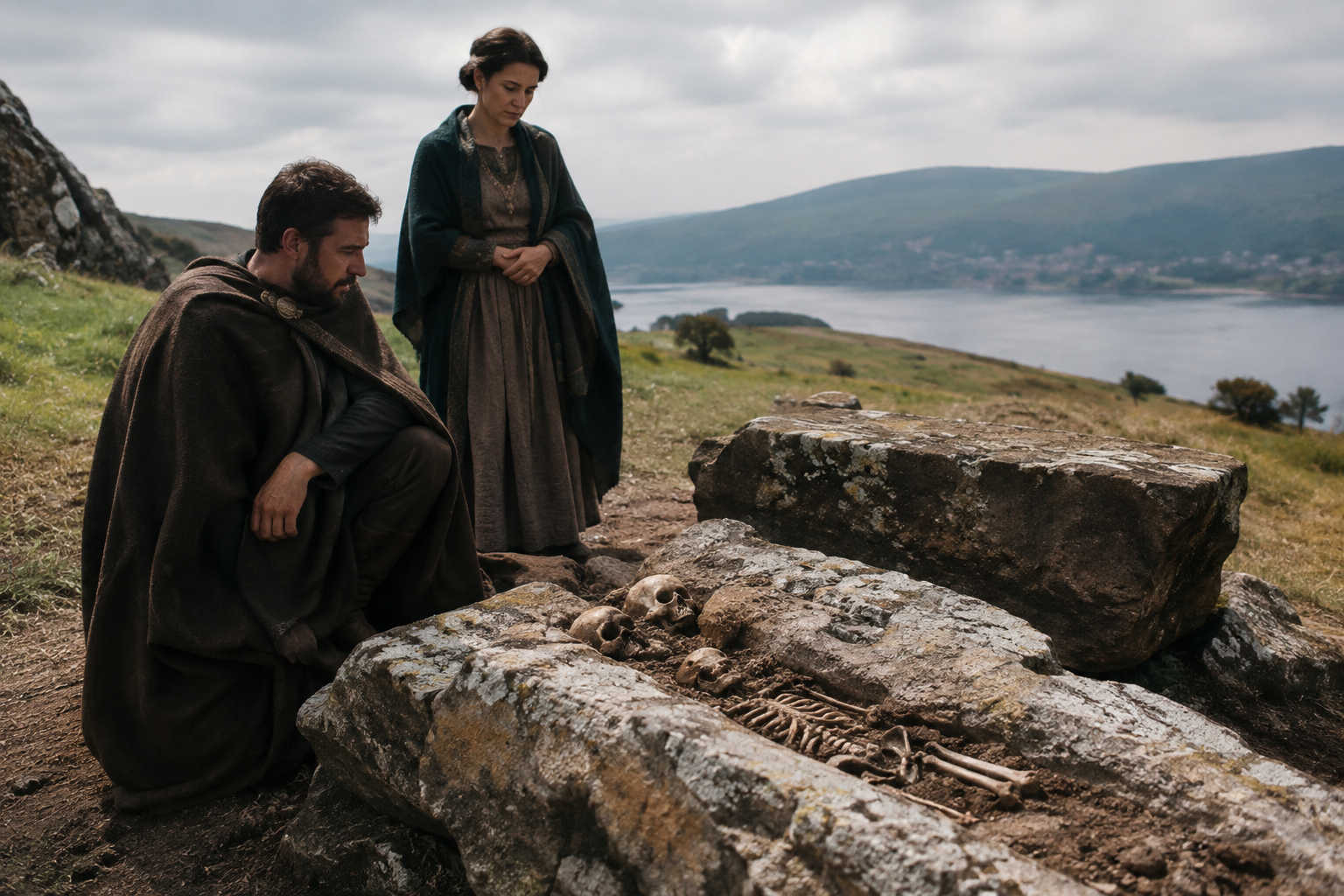
Some Y-DNA haplogroups arrive in the historical record with trumpets and banners. Others slip in more quietly, through one grave, one excavation, one fragment of paternal continuity that reminds us how much of the past survives in small details. Haplogroup I1a2a1a1d2a1b belongs to that second category. It is a very specific branch within the broader Y-chromosome tree, and that matters because the narrower the branch, the more careful we must be. A deep subclade is not a shorthand for an entire people, kingdom, or dynasty. It is a marker of one direct paternal line among many.
In broad terms, this lineage sits within haplogroup I1, a branch of haplogroup I that is well known in European population history and is often discussed in connection with northern Europe, especially in later prehistoric and early medieval contexts. But a subclade as specific as I1a2a1a1d2a1b should not simply inherit the whole story of I1 without caution. What ancient DNA can do, however, is place such lineages into real landscapes and real communities. In this case, one particularly evocative clue comes not from Scandinavia or England, but from late antique Bulgaria, in a Gothic grave.
As ever with Y-DNA, the line traced here is only the direct male line: father to son to son across generations. It does not represent a person's full ancestry, identity, or family tree. That limitation is not a flaw. It is precisely what makes Y-DNA so useful when we want to follow one thin but durable thread across time.
The wider haplogroup I family has deep roots in Europe, and its later branches appear in a range of prehistoric and historic settings. For I1 in particular, scholars usually discuss northern Europe as an important arena in its later expansion, though the details of when and how different downstream lines spread remain an active subject of research. That is exactly why ancient DNA is so valuable. Rather than relying only on modern distributions, it gives us dated snapshots: this lineage, or a related one, was here, in this place, at this time.
For a lineage like I1a2a1a1d2a1b, the most responsible approach is to resist tidy ethnic labels. It may be tempting to say "this is a Gothic line" or "a Norman line" or "a Scandinavian line," but history is rarely so neat. Paternal branches can move through trade, war, marriage, military service, resettlement, and the accidents of survival. What we can say is that lineages within the I1 world became part of the shifting populations of northern and central Europe and, by late antiquity, could also be found much farther south and east through migration-period mobility.
That brings us to the Goths: not a static, biologically uniform tribe, but a moving and changing historical community. Ancient DNA has made that abundantly clear. Gothic-associated cemeteries can contain people of varied ancestry, and the old fantasy of a genetically pure "people" dissolves on contact with the evidence. Which, frankly, is one of the most interesting things about them.
The key ancient sample supplied for this lineage is I41134, described as Ancient Individual:Gothic Grave Aquae Calidae Bulgaria Year:350 AD ID:I41134. That single line contains quite a world.
Aquae Calidae, in present-day Bulgaria, lay in a region touched by Roman administration, frontier pressures, and the movements of peoples in late antiquity. A Gothic grave there around 350 AD places this paternal signal in a moment when the Balkans were anything but peripheral. They were central to the drama of the later Roman world: armies on the move, federate groups, local populations, imperial negotiation, and occasional catastrophe.
Sample I41134 is valuable not because it proves direct descent to anyone living today, and certainly not because it defines all Goths, but because it shows that a paternal branch connected to this haplogroup's story was present in a Gothic-associated burial in the Balkans during the fourth century. That is a proper piece of evidence. It tells us that at least one male line of this kind had entered, or was part of, the social world of Gothic communities in late antique southeastern Europe.
There is an additional lesson here. When historians once spoke of the Goths sweeping across Europe as if they were a single coherent bloodline, they were simplifying a far messier reality. Ancient DNA from sites like Aquae Calidae helps correct that picture. We are not looking at a single biological bloc but at a historical coalition, absorbing people and lineages as it moved and changed.
How, then, do we move from a fourth-century grave in Bulgaria to the medieval landscapes of England? Not by claiming a direct family tree where none has been proven. Rather, we do it by understanding how paternal lineages can persist through centuries while the political map changes completely around them.
By the high Middle Ages, England was a place where many older European paternal lines had been folded into new ruling structures: Anglo-Saxon, Scandinavian, Norman, and countless local survivals besides. The Norman Conquest did not wipe the slate clean. It overlaid one elite system onto a population already shaped by earlier migrations. So when a medieval castle enters the story of a haplogroup, the connection is historical context, not automatic genetic proof.
The supplied family note points not really to Bray Castle, but to Lewes Castle in Sussex. Built soon after the Norman Conquest around 1069 by William de Warenne, it was established to control the area and the crossing of the River Ouse. It began as a timber fort on two man-made mounds and later became a stone fortress with a keep and curtain walls. That is classic Norman rule made visible in earthwork and masonry: authority planted onto the landscape as much as onto parchment.
Lewes Castle later stood near the events of the Battle of Lewes in 1264, when Simon de Montfort captured King Henry III nearby. In other words, this was not a decorative residence. It was part of the machinery of conquest, lordship, and political struggle. Though it declined as a military site, portions survived, were restored in the nineteenth century, and today it remains one of the best-known Norman castles in England, housing a museum of Sussex and the medieval past.
The mention of the House Bray alongside Lewes is a useful reminder that genealogical memory can be untidy, while castles are often attached to stronger documentary traditions than family legends. If one is interested in paternal history, that distinction matters. Surnames, landed families, and lineages do not always align cleanly, and noble association should never be mistaken for confirmed haplogroup assignment.
Explore the House of de Warenne
So what does haplogroup I1a2a1a1d2a1b reveal? First, it points us toward a paternal history embedded in the wider story of European haplogroup I1, while reminding us that narrow subclades need narrow claims. Second, through sample I41134, it places part of that story in a Gothic-associated grave at Aquae Calidae in Bulgaria around 350 AD. That is a striking glimpse of migration-period complexity in the Balkans. Third, it gives us a way to think about how paternal lines can outlast empires, travel across regions, and later appear within very different medieval worlds.
But it does not tell us that every man of this haplogroup was a Goth, a Norman, or a member of any later noble house. It does not prove descent from Lewes Castle, from William de Warenne, or from the House Bray. Genetics is powerful, but only when used with discipline. A shared broad haplogroup is not the same as a documented pedigree.
Still, the attraction is obvious. One excavated man in late antique Bulgaria. One medieval castle in Sussex. Between them lies the long continuity of male lines passing through upheaval, conquest, resettlement, and survival. That is why haplogroups fascinate people: not because they offer fairy-tale certainty, but because they let us glimpse history at human scale.
If this lineage interests you, you may also enjoy reading more about the noble associations preserved in community history around The House of Bray, especially as a reminder that family tradition, local history, and genetic evidence all illuminate the past in different ways.
MyTrueAncestry lets you explore how your DNA compares with ancient individuals and historical populations, including the kinds of archaeological discoveries discussed here. A match to an ancient sample or population can open a fascinating window onto your deeper past, even though it does not by itself prove direct descent from a particular person, dynasty, or castle-owning family.
If you want to see whether your own ancestry shows connections to ancient European lineages, migration-period populations, or medieval worlds like those behind Aquae Calidae and Lewes, start exploring your results on MyTrueAncestry.






Comments