Haplogroup I1a2a1a1d1a1b2
– 5 min read


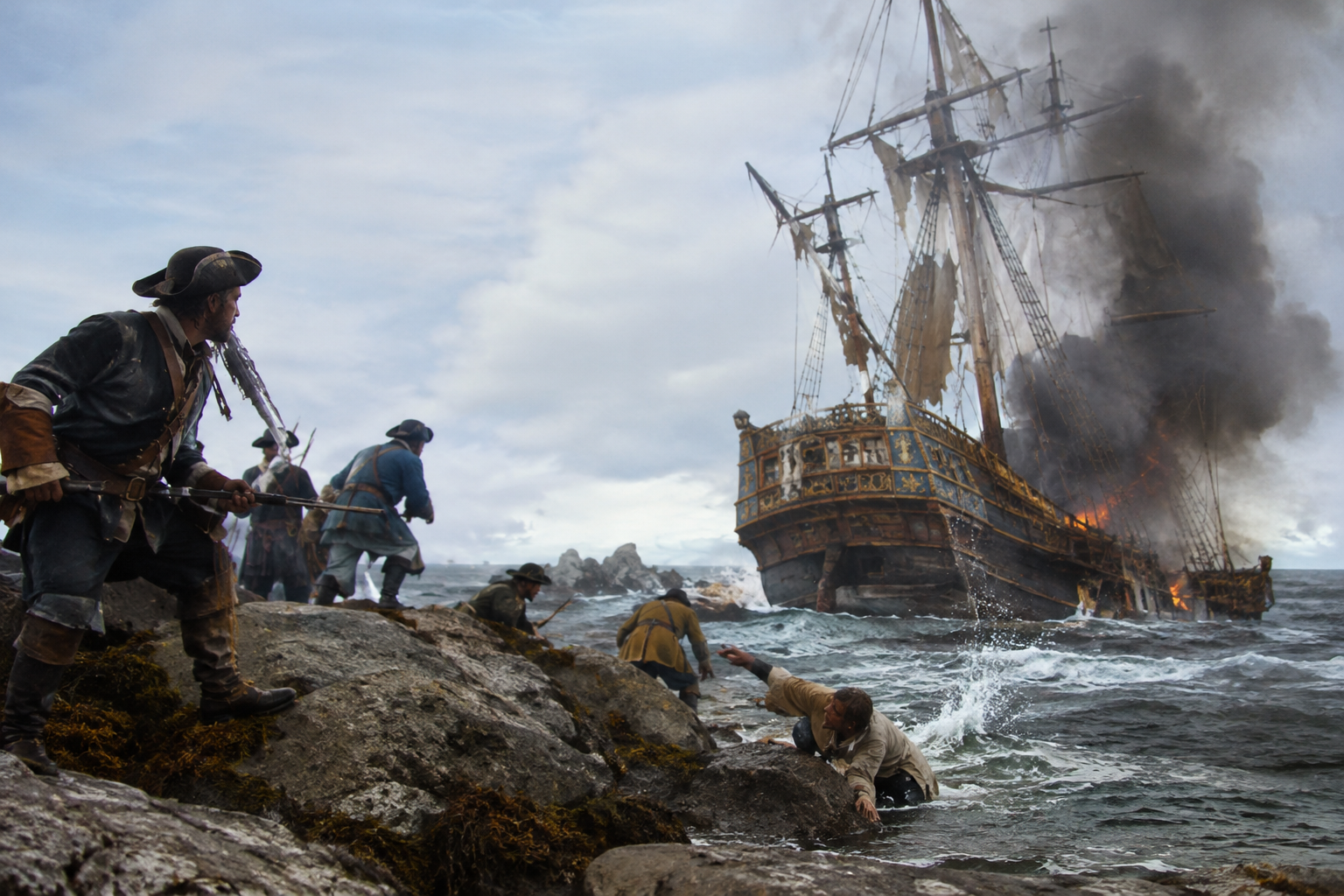
One of the most arresting finds for this lineage is not a princely tomb or a famous battlefield burial on land, but a sailor from the wreck of the Stora Kronan, the great Swedish warship lost in 1676 during the Battle of Oland. The ancient individual identified as kro013 comes from that disaster, a moment when Sweden's Baltic empire was being fought over at sea with brutal intensity. In this case, the Y-DNA haplogroup associated with the man is I1a2a1a1d1a1b2, a very narrow paternal branch within the broader Scandinavian-linked haplogroup I1.
That matters because Y-DNA follows only one line of descent: father to son, back through time. It does not define a person's whole ancestry, language, or identity. But when a lineage like I1a2a1a1d1a1b2 turns up in a well-dated historical context such as the Stora Kronan, it gives us something wonderfully concrete: not an abstract migration arrow on a map, but one real man caught up in one real historical catastrophe.
The Stora Kronan was one of the largest ships in the Swedish fleet, and its sinking has long stood as one of Sweden's most devastating maritime losses. At Oland in 1676, during the Scanian War, the ship exploded and went down with a huge loss of life. Sample kro013 belongs to that human story, and it anchors this haplogroup in the naval world of early modern Scandinavia.
Archaeologically, shipwreck burials are peculiar things. They are accidents, not formal cemeteries. Yet they can preserve a cross-section of society in a way that grand tombs often do not: officers, sailors, craftsmen, and marines thrown together by the discipline of shipboard life. A study of ancient populations across the European past, published in Cell, helped place many such later and earlier individuals into a broader genetic landscape, showing how fine-grained Y-chromosome branches can survive into historically documented settings.
For I1a2a1a1d1a1b2, that is the key point. We are dealing here not with a hazy prehistoric label but with a branch surviving into the seventeenth century in Sweden, among men serving a state deeply shaped by Baltic warfare, conscription, and mobility.
The wider haplogroup I1 is strongly associated with northern Europe, especially Scandinavia, and it appears frequently in discussions of Germanic-speaking populations and later Scandinavian expansion. But the full designation I1a2a1a1d1a1b2 is much narrower than I1 as a whole. It would be careless to pour the entire history of I1 into this one tiny twig of the tree.
Still, the broader setting is useful. In northern Europe, especially from the Iron Age onward, I1 branches become increasingly visible in regions tied to Scandinavian and Germanic historical developments. That larger background helps explain why a seventeenth-century Swedish naval sample belonging to a fine I1 sub-branch is perfectly plausible, even if the exact earlier history of this particular terminal line remains much more specific and much less broadly documented than the parent haplogroup.
That distinction matters for family historians. A man carrying I1a2a1a1d1a1b2 is not simply "a Viking haplogroup" or "a Swedish haplogroup" in any simplistic sense. He belongs to a deeply nested paternal branch whose known ancient appearance, in this article's evidence, is tied to a precise Swedish wartime context.
The Battle of Oland did not take place at the edge of the world. It unfolded in one of the most connected seas in Europe. The Baltic in the seventeenth century was a corridor of grain, tar, timber, iron, warships, tax systems, and imperial ambition. Men serving on Swedish naval vessels could be locally born, regionally recruited, or drawn from a wider orbit of Baltic possessions and contacts.
That is why kro013 should be read carefully. His Y-DNA branch gives us a paternal signature, but the shipboard setting warns against overly narrow assumptions. A Swedish warship was a state machine, not a village genealogy. The presence of I1a2a1a1d1a1b2 on the Stora Kronan makes excellent historical sense in a Scandinavian context, yet it does not mean every carrier of the lineage came from the same district, social rank, or surname tradition.
Even so, there is something especially vivid about seeing a paternal line survive not only through prehistory and medieval change, but into an age of artillery, admiralties, and named battles. Ancient DNA often feels most dramatic when it opens a Bronze Age mound. Here it is just as revealing when it surfaces from a floating fortress that shattered in full historical view.
To understand why a lineage like this can appear in seventeenth-century Sweden, it helps to remember that Swedish genetic history is layered rather than static. Long before the age of gunpowder fleets, Scandinavia had already seen the mingling of hunter-gatherer, early farmer, and later steppe-related ancestries, followed by centuries of regional reshaping in the Bronze Age, Iron Age, and Viking Age. By the early modern period, paternal lines in Sweden were the result of many centuries of continuity mixed with movement.
That broader background has been illuminated again and again by ancient DNA from Scandinavia, including work on Swedish and nearby populations from prehistory through the medieval period. Posts on Gotland, Viking Age burials, and early Christian Scandinavia show just how much regional variation there could be even within a recognizably northern European setting.
So while kro013 is late in date, he is not historically isolated. He belongs to a long Scandinavian story in which local continuity and wider Baltic connections both matter. His lineage sits in that overlap: narrow enough to be genealogically interesting, broad enough to fit the northern European historical record.
It is easy to underrate a haplogroup article built around one named ancient individual. Yet one securely contextualized sample can be more illuminating than a dozen vague associations. We know where kro013 comes from, roughly when he lived, and what sort of event ended his life. That is a far firmer footing than many ancient Y-DNA attributions offer.
There is also a methodological point here. Later historical samples are extremely useful because they connect genetic lineages to documented political worlds. In prehistoric graves, we often infer social context from archaeology alone. In a shipwreck like the Stora Kronan, the historical framework is already richly known: the Swedish navy, the Scanian War, the struggle for Baltic dominance. The DNA does not replace that history; it sharpens it by placing a particular paternal line inside it.
For someone researching I1a2a1a1d1a1b2, the most responsible takeaway is not a grand claim about kings or tribes. It is something more interesting, because it is better grounded. This is a Scandinavian-rooted paternal branch, evidenced here in a man from the Stora Kronan shipwreck at Oland in 1676 AD, a lineage carried through the era when Sweden projected power across the Baltic by sea.
That gives the haplogroup a distinctly human historical face: not merely ancient, not merely modern, but caught at the moment when lineage, state service, and one of northern Europe's great maritime disasters all met in the same cold water.






Comments