Haplogroup I1a2a1a1d1a
– 5 min read


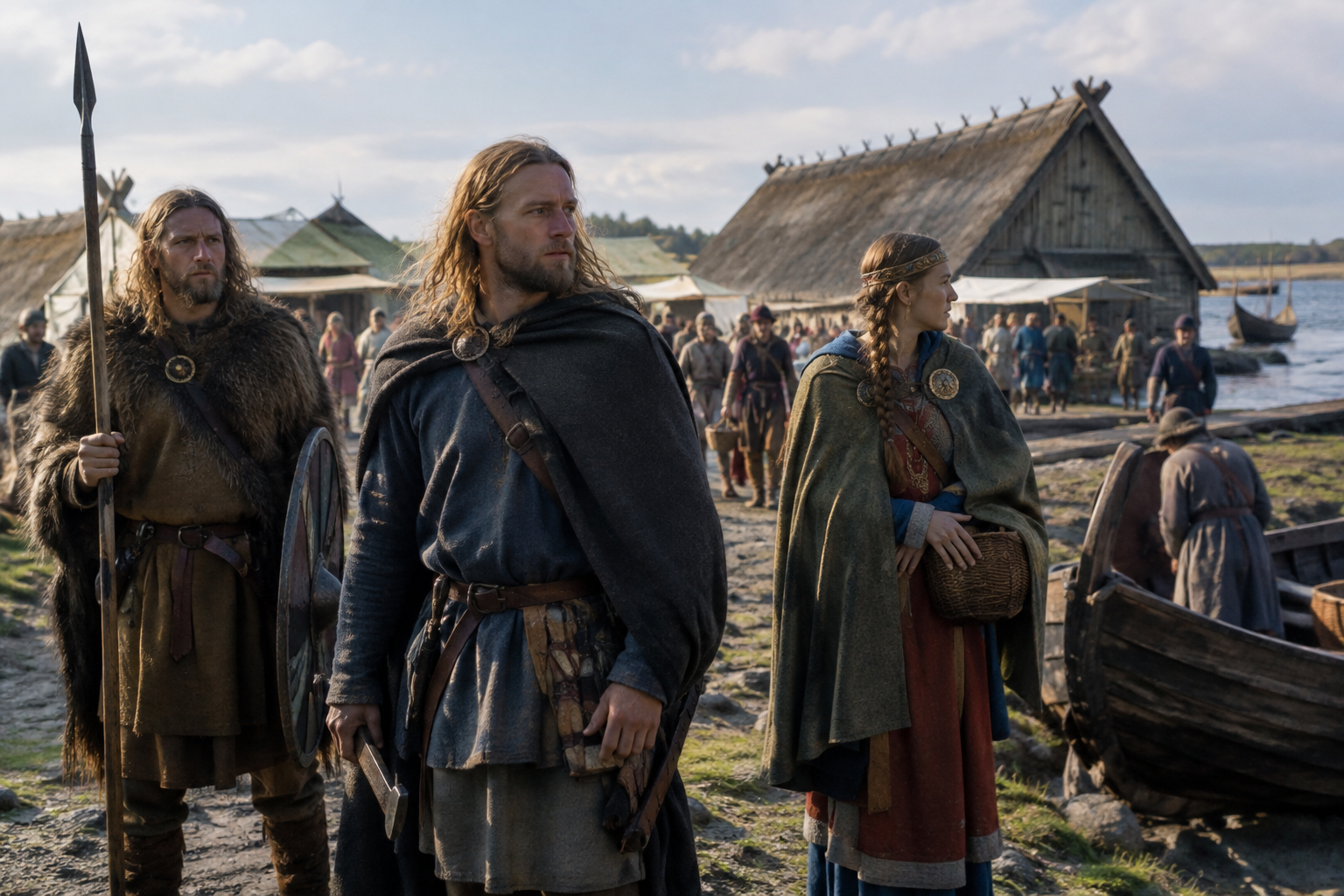
At Hedeby, the great trading settlement on the southern edge of Jutland, one post-Viking Age man carries a particularly useful clue for anyone following Y-DNA haplogroup I1a2a1a1d1a. Sample SWG015, dated to about AD 1105 and associated with Hedeby Schleswig Rathausmarkt, places this paternal line in one of northern Europe's busiest crossroads just after the classic Viking Age had ended. That matters because Hedeby was not an isolated village. It was a market town tied into the Baltic, the North Sea, and the political reshaping of Denmark and the wider Scandinavian world.
The haplogroup itself is a very narrow branch within the wider I1 paternal family, a lineage long associated in broad terms with Scandinavia and northern Europe. But a subclade such as I1a2a1a1d1a is not the same thing as all of I1. What the ancient evidence here can show, cautiously and quite usefully, is that this particular paternal branch was present in southern Scandinavia and the Baltic-connected world from Late Antiquity into the medieval period. Y-DNA tracks one direct male line only, yet when that line turns up at several sites across centuries, it starts to anchor family history in real archaeological landscapes.
Hedeby is often imagined through its Viking fame, but sample SWG015 belongs to the period after that headline age, when the town and its region were being drawn into a more openly Christian and more formally medieval political order. The date around AD 1105 places him in a world of traders, artisans, sailors, and local households living amid the aftermath of centuries of exchange. A paternal branch like I1a2a1a1d1a appearing here is not surprising in a Scandinavian setting, but it is valuable because Hedeby was precisely the kind of place where local continuity and wider mobility met.
In other words, this is not just "a Viking lineage" in the loose popular sense. It is evidence that one branch of a northern paternal network remained present in the very region where Danish, German, and Baltic interactions were dense and historically consequential. Research on early medieval northern European populations, including work on the formation of the early English gene pool, has helped underline how connected the North Sea world could be, even when the people buried in any one cemetery were locally rooted rather than dramatic long-distance migrants.
The earlier Scandinavian anchor in this set is CGG107427, described as Danii Tribe Denmark Sjaelland Regnemark and dated to about AD 375. The label "Danii" should be handled carefully: it points to a historical association in Denmark, not to a magical one-to-one proof of tribal identity from DNA alone. Still, the location on Zealand and the late fourth-century date place this individual in an important period, when the Roman world was changing rapidly and southern Scandinavia was part of wider northern European networks of prestige, exchange, and shifting power.
This is where I1a2a1a1d1a becomes historically interesting. If a man associated with this branch appears in eastern Denmark around AD 375, and another appears at Hedeby more than seven centuries later, we are looking at a paternal line with a documented footprint in Scandinavia across a long span of time. That does not mean uninterrupted local descent from one named man to another. It does mean the branch belonged to the deep male population history of the region, not merely to a brief intrusion or a single exceptional burial.
An ancient DNA study centered on Denmark and neighboring regions has made exactly this wider question so productive: not whether one burial can "explain a people," but how multiple burials, across centuries, reveal continuity mixed with change. For readers interested in Scandinavian population history before and after the better-known Viking period, that broader framing is often more useful than any heroic label.
The third sample, VK492, comes from Salme II-II on Saaremaa and is dated to about AD 725, in the Vendel Age. That is a particularly evocative setting even without embellishment. Saaremaa, in present-day Estonia, sits in the Baltic world rather than on its margins. A paternal line tied to I1a2a1a1d1a appearing here suggests that the branch was not confined to one Danish island or one later medieval town, but participated in the maritime sphere linking Scandinavia and the eastern Baltic.
Salme has become famous in ancient DNA and archaeology because the site speaks to movement across the sea in the centuries just before the fully developed Viking Age. The significance of VK492 is therefore not that it proves a single migration tale, but that it places this paternal branch inside that Baltic-connected milieu. Between Regnemark in Denmark, Salme on Saaremaa, and Hedeby in southern Jutland, the recurring pattern is coastal, maritime, and unmistakably northern.
A well-known early preprint on Viking-related genomics helped draw attention to how varied Scandinavian and Baltic-connected communities could be, and how ancient Y-chromosome evidence could sometimes map quite closely onto zones of seaborne contact. Without claiming more than the evidence allows, VK492 fits that larger archaeological picture of interaction around the Baltic Sea.
For a wider look at these regional connections, MyTrueAncestry readers may also enjoy this piece on early medieval northern populations across the Baltic zone.
Baltic Connections in Early Medieval North
Three samples are not a dynasty, a nation, or a complete map of a haplogroup. But they are enough to tell a coherent archaeological story. CGG107427 shows the branch in Denmark by around AD 375. VK492 places it in the Baltic maritime world by around AD 725. SWG015 shows it again in the Hedeby region by about AD 1105, after the classic Viking Age but in a landscape still shaped by Scandinavian exchange networks.
That sequence is useful because it spans very different historical settings: Late Antiquity, the Vendel Age, and the post-Viking medieval north. The branch I1a2a1a1d1a therefore appears, at least in the present evidence, as part of a durable northern European paternal background rather than a one-period curiosity. Its archaeological footprint is especially strong in the corridor linking Denmark to the Baltic.
There is also a methodological point worth making. Because this article is about a precise subclade, it is better to stay close to the actual samples than to recycle every broad claim ever made about haplogroup I1. The wider parent lineage has a long and complex history; this narrower branch is best understood through the places where it is directly observed. Here, those places are not vague. They are Regnemark, Salme, and Hedeby.
For someone who belongs to Y-DNA haplogroup I1a2a1a1d1a, the most responsible takeaway is also the most interesting one: this is a paternal branch with ancient evidence in Denmark and the Baltic-connected north over many centuries. The known ancient matches do not point to a single legendary founder, but to real men living in real historical settings, from fourth-century Zealand to Vendel Age Saaremaa and medieval Hedeby. That gives the lineage a credible archaeological home in the Scandinavian-Baltic world, and that is a strong beginning for any deeper family investigation.


Comments