Haplogroup I1a2a1a1a4

– 6 min read


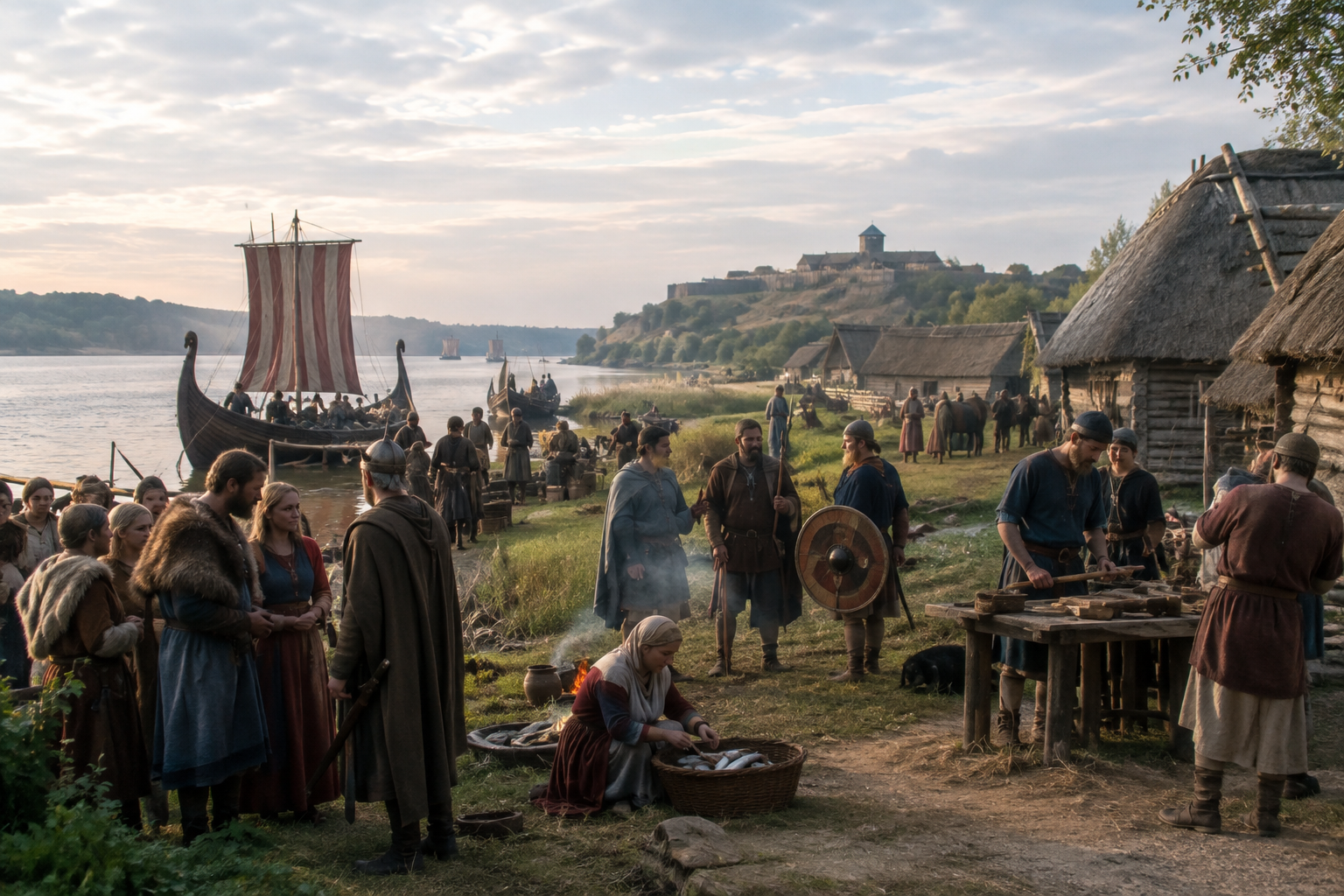
Some Y-chromosome lineages announce themselves with a neat, tidy historical label. This one does not. Haplogroup I1a2a1a1a4 is more interesting precisely because it refuses to stay in one neat box. In the ancient DNA record supplied here, its story appears not in a single kingdom or tribe, but across a long northern and central European arc: Bronze Age Denmark, Iron Age Zealand, Gothic and Longobard-era burials in the Balkans and Pannonia, Anglo-Saxon England, Viking Age Sweden, and medieval Sigtuna.
That is exactly why such a lineage matters. Y-DNA tracks one direct paternal line only - father to son to son across generations. It is not a summary of a person's total ancestry, culture, language, or identity. But when the same paternal branch turns up in burials scattered across time and space, it gives us a way of watching one narrow thread persist through very large historical changes. With a branch as specific as I1a2a1a1a4, caution is essential: we should not lazily assign to it every feature of the broader haplogroup I1. Still, the pattern in these samples points clearly toward a northern European, especially Scandinavian and Germanic, historical setting.
The broad parent haplogroup I1 is well known in discussions of northern Europe, especially Scandinavia. For a narrow subclade like I1a2a1a1a4, however, the responsible approach is to stay close to the evidence. What the supplied ancient individuals suggest is that this paternal branch, or a very close surrounding cluster of lineages, was present in southern Scandinavia by later prehistory and then appears repeatedly among groups associated with the Germanic-speaking world in the Roman Iron Age, Migration Period, and Viking Age.
One of the earliest clues comes from CGG106515, a Nordic Bronze Age Denmark Strandlunden II Gerlev individual dated 1265 BC. That matters because it places this paternal signal deep in the Scandinavian past rather than making it only a product of late historical migrations. Later we see CGG106734 from Germanic Tribe Iron Age Denmark Sjaelland Holbaek Fjord Trundholm Mose, dated 205 BC, and CGG107507 from the Danii Tribe Denmark Sjaelland Vester Egesborg Vordingborg, dated 175 AD. Add CGG107416 from Southern Sjaelland Praesto Endegaarde, dated 375 AD, and a picture begins to form: not a fleeting appearance, but repeated evidence in and around Zealand across many centuries.
That does not prove an unbroken father-to-son chain from the Bronze Age to later medieval families. It does, however, suggest regional continuity of a paternal lineage within the wider Scandinavian world.
The most striking thing about this lineage is what happens next. It does not stay politely at home. By late antiquity and the Migration Period, we find it in some of the most mobile settings in Europe.
Two especially revealing individuals are I15549 from Gothic Period Serbia Timacum Kuline Ravna Village, dated 395 AD, and I15545 from Gothic Era Serbia Timacum Slog Necropolis, dated 480 AD. Here we are far from Zealand, in the Balkans, in a world shaped by the breakdown of Roman power and the movements of Gothic groups through imperial provinces. These burials do not mean that all Goths carried this lineage, nor that Y-DNA can define who was or was not Gothic. But they do show that a paternal line with clear northern associations was present in communities tied to the Gothic sphere in late antique Serbia.
Something similar appears in Pannonia and adjacent regions. HMU069 from Longobard Period Pannonia Scarbantia Hegyko Barbaricum Hungary, dated 525 AD, and SZL041 plus SZL028 from Longobard Period Pannonia Savaria Szeleste Barbaricum Hungary, also dated 525 AD, place the lineage in the Longobard world of the middle Danube. So too does A181016 from Gothic Kecskemet-Mindszenti Transtisza Hungary, dated 450 AD. In nearby central Europe we also find OBM005, a Thuringii Tribe German Obermoellern individual dated 500 AD, and R3660 from Migration Period Scitarjevo Croatia, dated 500 AD.
What these sites reveal is not a single march of one tribe carrying one chromosome. Real populations were messier than that. But they do fit a broader historical pattern in which paternal lines with roots in the north appear among the mobile military and settlement networks of post-Roman Europe.
Readers interested in that wider context may enjoy the MyTrueAncestry article on Goths as a Multi-Ethnic Community: Ancient DNA, which explores exactly why these late antique identities were more complex than old nationalist stories allowed.
By the early medieval centuries, this haplogroup also appears in places that fit the better-known Scandinavian and North Sea story. SED014, from Anglo-Saxon Sedgeford England Norfolk, dated 600 AD, is a useful reminder that paternal lines found in Scandinavia and northern Germany could also travel into early medieval England. That is historically unsurprising, but ancient DNA makes the movement less abstract. Here, as so often, the chromosome is not telling us "this man was purely X or Y." It is showing that one paternal branch present in the Scandinavian-Germanic world also took part in the making of early English populations.
Then the Scandinavian evidence returns in force. VK337 from Viking Age Oland Sweden, dated 858 AD, gor164 from Viking Age Sweden Stockholm Gorla, dated 1050 AD, and VK357 from Viking Age Oland Sweden, dated 1053 AD, place the lineage squarely in the Viking Age. Finally, mbs022 from Medieval Sigtuna Sweden, dated 1100 AD, carries it into one of medieval Sweden's key urban centers.
That run of evidence - Bronze Age Denmark, Iron Age Zealand, Viking Age Sweden, and medieval Sigtuna - is perhaps the strongest part of the whole story. It suggests long-term persistence of this paternal branch within the Scandinavian sphere, even while other members of the same wider lineage appear farther south during the volatile centuries of migration and frontier warfare.
What, then, does any of this have to do with Clan Hamilton and Hamilton Palace in South Lanarkshire? Not direct proof, and that is the first thing to say plainly. A historical association between a haplogroup and a noble family should never be mistaken for certainty that every Hamilton male carried this exact branch, or that ancient individuals from Denmark or Pannonia were ancestors in a documented genealogical sense.
But the comparison is still historically worthwhile. Clan Hamilton belongs to the later medieval and early modern world shaped in part by the same long northern European population history in which I1-related paternal lines are often discussed. Hamilton Palace, the grand seat of the Dukes of Hamilton, stood in South Lanarkshire as one of the greatest aristocratic houses in Britain. Enlarged over the centuries and famous for its immense classical facade, art collections, books, and treasures, it projected dynastic authority in stone, display, and landscape.
And yet its end is wonderfully sobering. The palace stood over rich coal seams, and mining caused dangerous subsidence. By the late nineteenth and early twentieth centuries, grandeur collided with geology. The collections were dispersed, and the house itself was demolished in the 1920s. It is an almost Roman lesson: noble power can look eternal until the ground literally gives way beneath it.
That is where ancient DNA offers a different kind of memory from castles and archives. Palaces record status. Y-DNA records one paternal biological line. Neither gives the whole truth on its own, but together they remind us that family history has both a documentary side and a much deeper prehistoric one.
For readers who want to place this noble context more firmly within Scottish history, the MyTrueAncestry community's Clan Hamilton article is the obvious next stop.
The value of haplogroup I1a2a1a1a4 lies in its scale. It is narrow enough to feel personal, but broad enough to illuminate history. In the evidence supplied here, it seems tied above all to a northern European setting, especially southern Scandinavia, while also appearing in the mobile and mixed societies of the Migration Period and in later Viking and medieval contexts.
That does not make it a badge of ethnicity. It does not prove noble descent. It does not tell you that one ancient man in a Serbian necropolis was the forefather of a Scottish duke. What it does offer is something better: a disciplined way of linking family history to the bigger movements that shaped Europe - Bronze Age continuity, Iron Age regional populations, post-Roman mobility, Anglo-Saxon settlement, and Viking Age expansion.
If you are intrigued by how ancient DNA can illuminate long male-line history without collapsing it into myth, another useful companion piece is the broader MyTrueAncestry article Ancient DNA and the Rise of Archaeogenetics.
Learn How Ancient DNA Rewrites History
Upload your DNA to MyTrueAncestry and explore whether your own results show similarities to ancient individuals like CGG106515, I15549, SED014, or VK337, and to the wider populations that moved through Scandinavia, Britain, and the post-Roman world. These matches can open remarkable historical perspectives on your ancestry, even though they do not by themselves prove direct descent from any one ancient person or noble family.






Comments