Haplogroup I1a2a1a1a1b1

– 5 min read


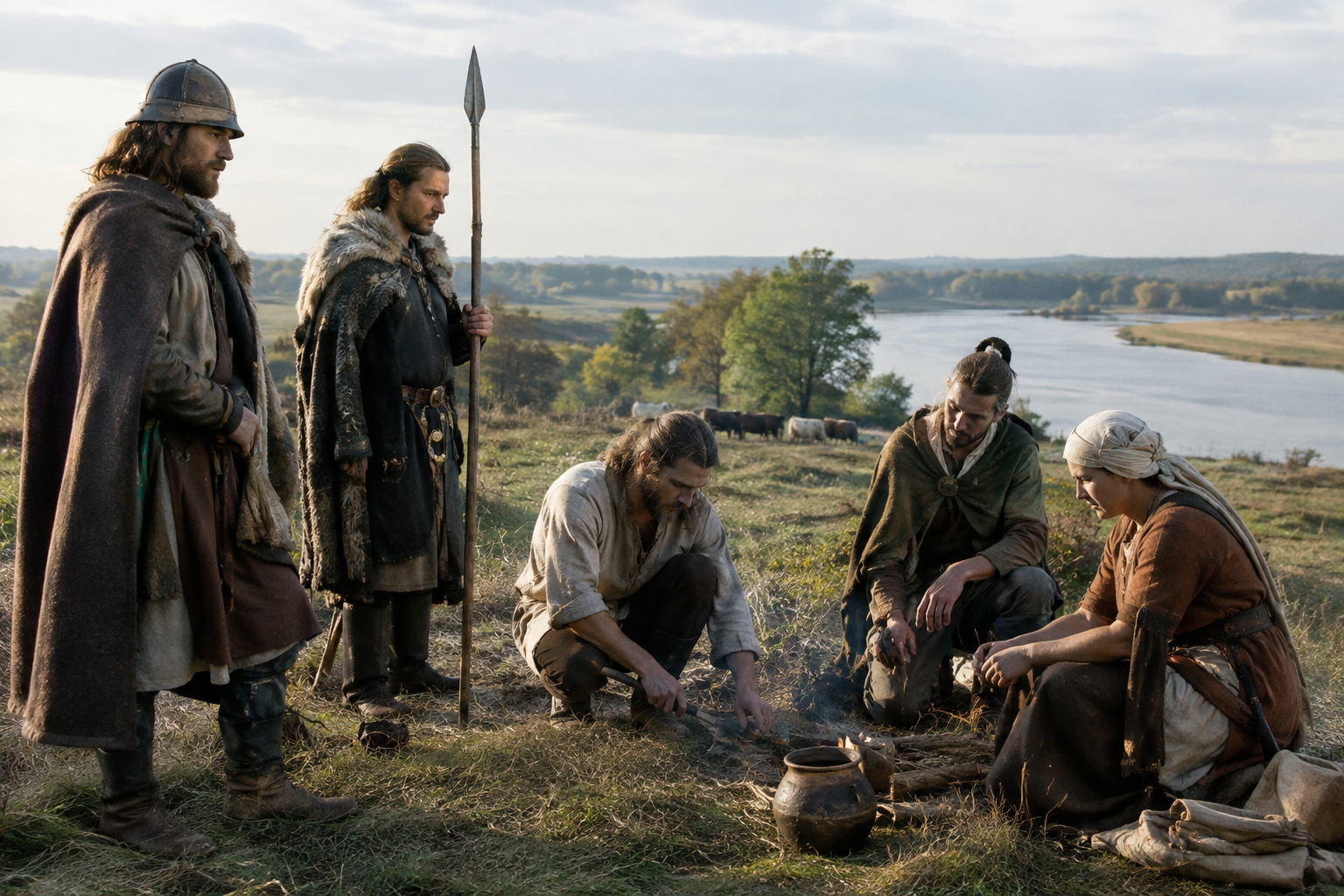
Some Y-chromosome lineages arrive in history with trumpets: a royal burial, a named dynasty, a string of clearly linked medieval records. Others appear more like footprints in wet soil, turning up first in a burial in Denmark, then in a Gothic-period grave in Hungary, then much earlier on the north shore of the Black Sea world. Haplogroup I1a2a1a1a1b1 belongs to that second kind of story, and that is precisely what makes it so interesting.
This is a very specific branch within the wider Y-DNA haplogroup I1, a paternal lineage often associated in broad terms with northern Europe. But caution is essential here. A narrow subclade like I1a2a1a1a1b1 is not the same thing as the entire history of I1, and Y-DNA itself traces only one line of descent: father to father to father. It does not describe a person's whole ancestry, culture, language, or identity. What it can do, though, is illuminate how particular paternal lines moved across landscapes and survived through major historical change.
In its broader setting, I1 is best known from northern Europe, especially Scandinavia. For a subclade as specific as I1a2a1a1a1b1, however, the safest approach is not to assign it a grand origin story beyond the evidence. Instead, we can follow where the archaeological record places related paternal lines and notice a pattern: northern Europe, the Baltic world, and then movement southward and eastward into the continental zones reshaped by the Roman Empire and the Migration Period.
That pattern fits what we know more generally about how paternal lineages could travel. They did not march about carrying ethnic labels pinned to their cloaks. They moved with families, warbands, traders, settlers, and local communities absorbing newcomers over generations. A Y-line found in Denmark in one century and in Hungary in another does not prove a neat single-file migration, but it can point to the sort of mobility that made late Roman and post-Roman Europe such a complicated human map.
Readers interested in the deeper Scandinavian background to such northern paternal lines may enjoy this broader look at Denmark before the historic kingdoms fully emerge.
The most striking thing about this haplogroup's sample trail is its spread across time and geography. One early signpost is poz643, from Bronze Age Southwest Ukraine Bereminay Komarow, dated 1500 BC. That matters because southwest Ukraine sat in a long-contact zone between central Europe, the forest-steppe, and the Black Sea hinterland. A paternal lineage found there belongs to a world of exchange, mobility, and shifting local traditions long before the medieval nations of Europe existed.
Then we meet CGG107515, listed as Danii Tribe Denmark Sjaelland Espe, dated 218 AD. This is the sort of sample that immediately draws the eye, because it places the lineage in Denmark in the Roman era. The label "Danii" inevitably invites comparison with early Danes, though one should avoid overstating what a single burial can prove about tribal identity. Still, the location on Sjaelland gives us an unmistakably Scandinavian setting for this paternal branch.
After that, the trail bends southeast into the Migration Period. A181015, from Gothic Kecskemet-Mindszenti Transtisza Hungary, dated 450 AD, places the lineage in the Carpathian Basin at precisely the time when Gothic groups, Roman collapse, Hunnic power, and local populations were entangled in one another's history. Another sample, RKF280, from Migration Period Hungary Rakoczifalva, dated 650 AD, shows that related paternal ancestry remained present in the region into the post-Roman centuries.
That sequence does not prove a straight genealogical chain from Ukraine to Denmark to Hungary. But it does provide a plausible historical frame: a paternal line with northern European associations appearing both in Scandinavia and in the mobile, mixed societies of the Middle Danube and Tisza regions.
If you want to see how archaeogenetics is reshaping our picture of Gothic communities in particular, this related article is an excellent companion.
There is something wonderfully untidy about the fifth to seventh centuries in central Europe. Historians love labels - Goth, Hun, Gepid, Lombard, Avar - but ancient DNA keeps reminding us that the people living through these upheavals were not arranged in tidy museum drawers. They married locally, joined coalitions, shifted allegiance, and buried their dead in landscapes already thick with older memories.
That is why A181015 and RKF280 matter. They place this paternal line in Hungary across a span when the region was one of Europe's great junctions. The Carpathian Basin was not simply a destination; it was a funnel. People arrived from the north, the east, the Balkans, and the former Roman provinces. A lineage like I1a2a1a1a1b1 appearing there fits a world of layered migration rather than a single dramatic conquest.
The earlier Ukrainian sample, poz643, also helps widen the lens. The northern Black Sea region and adjacent forest-steppe were deeply connected to later European population history. Anyone curious about that wider background will find a useful parallel in this community article.
How, then, do we move from Migration Period graves to an English noble house without committing the usual genealogical sins? Carefully.
The supplied noble association is with the House Paulet and Hinton House in Hinton Charterhouse near Bath. The house began as a medieval manor linked to the Priory of Hinton and was later rebuilt and enlarged after the Dissolution, when former monastic lands passed into private hands. In other words, this is not a fortress on a frontier but an English estate that captures one of the great social revolutions of the Tudor and early modern age: the transfer of church property into the hands of ambitious gentry and noble families.
Hinton House is historically interesting because its fabric preserves layers. There is the medieval estate beneath it, the post-Reformation reworking of landownership around it, and the later architectural reshaping that turned possession into performance. Houses like this were statements. They announced continuity, legitimacy, and status, even when the political world that produced them had changed radically.
That makes the Paulet connection useful in a haplogroup article, not because the house can prove a Y-DNA lineage - it cannot - but because it shows how paternal descent, inheritance, land, and memory became bound together in later English society. A noble family might preserve names, coats of arms, deeds, and walls; ancient DNA preserves a different archive altogether, one written in the chromosome passed down along the direct male line.
For readers who want to place this family in its own historical setting, the MyTrueAncestry community has a dedicated article here.
The most responsible conclusion about I1a2a1a1a1b1 is also the most interesting one. This is a paternal lineage whose known ancient appearances point toward a northern European and north-central European historical sphere, with evidence stretching from Bronze Age southwest Ukraine to Roman-era Denmark and Migration Period Hungary. That is not a slogan about one people. It is evidence for movement, survival, and reappearance across very different societies.
It also shows why Y-DNA is so useful when handled properly. Traditional genealogy usually runs out long before the Migration Period. Archaeology can show us graves, houses, pottery, weapons, and landscapes. Ancient DNA adds another kind of continuity, but never a complete one. Sharing a haplogroup with an ancient individual does not make that person your direct ancestor, still less a proof of membership in a medieval noble house. What it can do is place your paternal line inside a historical field that is far older and more geographically expansive than paper records alone can reveal.
If your own Y-DNA falls near lineages like this one, MyTrueAncestry may help you explore whether your paternal ancestry shows similarities to ancient Scandinavians, Black Sea region populations, or the mixed communities of post-Roman Europe. The result will not be a fairy tale of instant noble descent. Better than that, it may give you something real: a deeper, stranger, and more human past.






Comments