Haplogroup I1a2a1a1a1a2b4b

– 6 min read


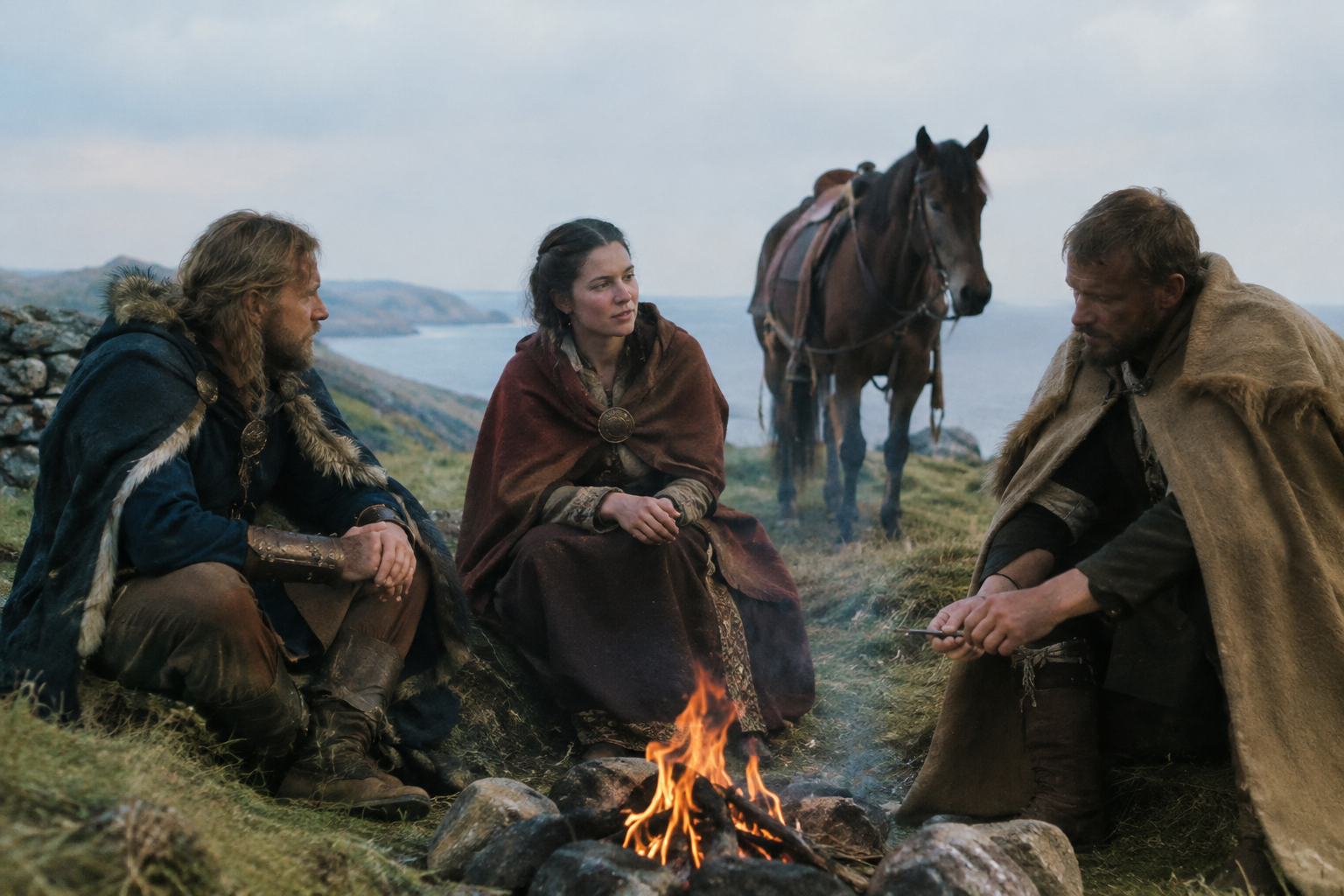
Some Y-chromosome lineages arrive in history with a fanfare. Others appear in quieter ways: a burial in Kent, a grave in the Vienna Basin, an unexpected man on Bornholm whose ancestry did not fit the local pattern. Haplogroup I1a2a1a1a1a2b4b belongs to that second sort of story. It sits within the wider I1 branch of the Y-chromosome tree, a paternal lineage long associated in broad terms with northern Europe, yet the interest of a very specific subclade is not that it explains everything. It is that it reminds us how particular male lines moved, survived, and resurfaced in different historical settings.
That is the first thing worth saying clearly. A Y-DNA haplogroup traces one direct paternal line only: father to father to father. It does not describe a person's whole ancestry, culture, language, or identity. Still, when ancient DNA places related paternal branches in early medieval England, Iron Age Denmark, and a Longobard-period grave in Austria, we are not looking at abstraction. We are looking at clues to the male-line histories that ran through the North Sea world, the Baltic, and the post-Roman lands of central Europe.
The broader haplogroup I1 is one of the best-known paternal lineages in northern Europe. That much is established. What is much harder, and much more important, is not to lazily pour the entire history of I1 into one very narrow downstream branch such as I1a2a1a1a1a2b4b. A subclade like this represents a smaller twig on a large tree. Its own history may be regional, recent, or surprisingly mobile compared with the wider parent lineage.
What the available ancient evidence suggests, cautiously, is that branches related to this paternal line were part of the shifting population world of northern and north-central Europe in late antiquity and the early Middle Ages. That was a world of seaborne contact across the North Sea, movement around the Baltic, and military and family mobility in the lands once held together by Rome. The result is not a neat ethnic label but a map of overlapping contacts.
Readers interested in the larger archaeological background to early northern Europe may enjoy this broader look at Denmark before the medieval period:
The supplied ancient samples are especially useful because they are not all from one place or one neatly bounded people. They show how a paternal lineage can appear in contexts that historians once kept in separate boxes.
Take CGG106748, described as a Uralic Outlier Iron Age Denmark Bornholm Island Slusegard Year:275 AD. Even that label tells a story. Bornholm sits in the Baltic, exposed to trade, migration, and cultural exchange. An "outlier" individual in Iron Age Denmark suggests that this was not a sealed local population. Whatever precise route brought his paternal line there, he stands as a warning against imagining ancient islands as genetic museums. Men moved. Communities absorbed newcomers. The Baltic was busy.
Then there is BUK073, from the Early Anglo Saxon Period Buckland Dover England Year:400 AD. Dover scarcely needs introduction as a gateway. In the early Anglo-Saxon period it was part frontier, part bridge, part landing place. A paternal branch appearing here fits the larger picture of post-Roman Britain, where migrants from across the North Sea mixed with existing populations in ways that ancient DNA has made both clearer and more complicated. A Y-line in an early Anglo-Saxon burial does not prove tribe, language, or personal identity. But it does anchor this branch in the formation of early medieval England.
The third sample, MLE004, comes from a Longobard Grave Austria Moedling-Leinerinnen Vienna Basin Year:550 AD. Now the scene changes again. The Vienna Basin in the sixth century belonged to the unstable political world after the Western Roman Empire, when groups labelled by historians as Longobards, Goths, and others moved through central Europe. A grave in this setting suggests that related paternal lines were present not only in the North Sea sphere but also in the migration-period societies of the Danube region. That does not mean every carrier was "Longobard" in a simple sense. It means that this paternal history touched the mobile military and family networks of post-Roman Europe.
If you want more on that larger upheaval between Roman and early medieval worlds, this related piece is a good companion:
Put these three finds together and a pattern begins to emerge, though not a simplistic one. We can place related paternal branches in Iron Age Denmark, early Anglo-Saxon Kent, and a sixth-century grave in Austria. That distribution points toward a northern European male-line history shaped by mobility across coasts, islands, frontiers, and river corridors.
It also helps explain why such a lineage might later be found, in broader regional terms, among families rooted in Britain and Scotland. Not because an ancient grave "proves" a noble pedigree, but because medieval aristocratic houses grew in regions already layered with centuries of migration, settlement, and reshuffling of male lines. Castles and surnames arrived late in the story. The paternal lines beneath them were older.
For readers interested in how ancient DNA has changed our understanding of that formative English period, this article is especially relevant:
The noble associations supplied here take us into two very different medieval landscapes: northern England and eastern Scotland.
First comes the House of Neville and Raby Castle in County Durham. Raby began as a medieval stronghold of the Neville family in the 14th century and developed into one of the grandest castles in northern England. Built mainly by John Neville and his descendants, it became a statement of noble power in a region where loyalty, warfare, and royal favor were never settled for long. After the Nevilles lost favor with the crown, the estate passed to the Vane family, later Marquesses of Cleveland and then Barons Barnard. The building itself changed over time from fortress to country house while preserving its towers, walls, and great halls.
That matters for a haplogroup article because castles like Raby preserve regional history in visible form. They do not certify a Y-DNA lineage. They do something subtler. They show where later documented families stood within landscapes that had already absorbed Romano-British survival, Anglo-Saxon settlement, Scandinavian pressure, and medieval aristocratic consolidation. A lineage such as I1a2a1a1a1a2b4b, if found in such settings in modern testers or associated family traditions, belongs in that long northern British context, not in a fantasy of one-family genetic destiny.
The second setting is Clan Ouchterlony and Brechin in Angus. Brechin began as an early medieval church settlement and became one of Scotland's important ecclesiastical centers, with a monastery and later a cathedral town. Its famous round tower, probably built around the 11th century, and Brechin Cathedral speak of a place where religion, local power, and older Pictish roots met. Nearby stands Brechin Castle, seat of the Earls of Dalhousie, while the town itself developed as a royal burgh and market center before later becoming a modest industrial town tied to farming, textiles, and trade.
This is an ideal reminder that Scottish history is not only a matter of clans charging across heather. Places like Brechin sat on deep foundations: Pictish, ecclesiastical, burghal, aristocratic. If a paternal lineage connected with northern European male-line history turns up in such a region, that is historically plausible in the broadest sense. But again, plausibility is not proof of descent from any named clan founder.
Readers who want to follow one of these family stories more closely can continue here:
The most interesting thing about I1a2a1a1a1a2b4b is not that it can be draped in grand claims. It is that it forces us to think historically. A narrow Y-DNA branch can connect, at a deep paternal level, men buried in very different worlds: one in Iron Age Bornholm, one in early Anglo-Saxon Dover, one in a Longobard-period grave in the Vienna Basin. That is a serious and useful insight. It shows how paternal lines can persist across shifting identities, frontiers, and political orders.
When we later encounter great houses such as the Nevilles at Raby or historic Scottish settings such as Brechin, genetics and history begin to complement one another. Written genealogy gives names, titles, and castles. Ancient DNA gives older population background, often from centuries before those records begin. Neither replaces the other. Together they make the past bigger, stranger, and more human.
And if Brechin has caught your interest as much as its round tower and medieval setting caught mine, there is a direct follow-up worth reading:
If your Y-DNA belongs to I1a2a1a1a1a2b4b or a nearby branch, ancient DNA can offer an unusually vivid way to think about your paternal past: not as a guarantee of descent from a particular noble house, but as a window into the real populations who lived around the Baltic, crossed into early medieval England, or were buried in the shifting world of post-Roman Europe.
Upload your DNA to MyTrueAncestry to explore ancient samples, historical populations, and archaeological connections that may add fresh context to your family story.






Comments