Haplogroup I1a1b1a4a2f1a1a1
– 4 min read


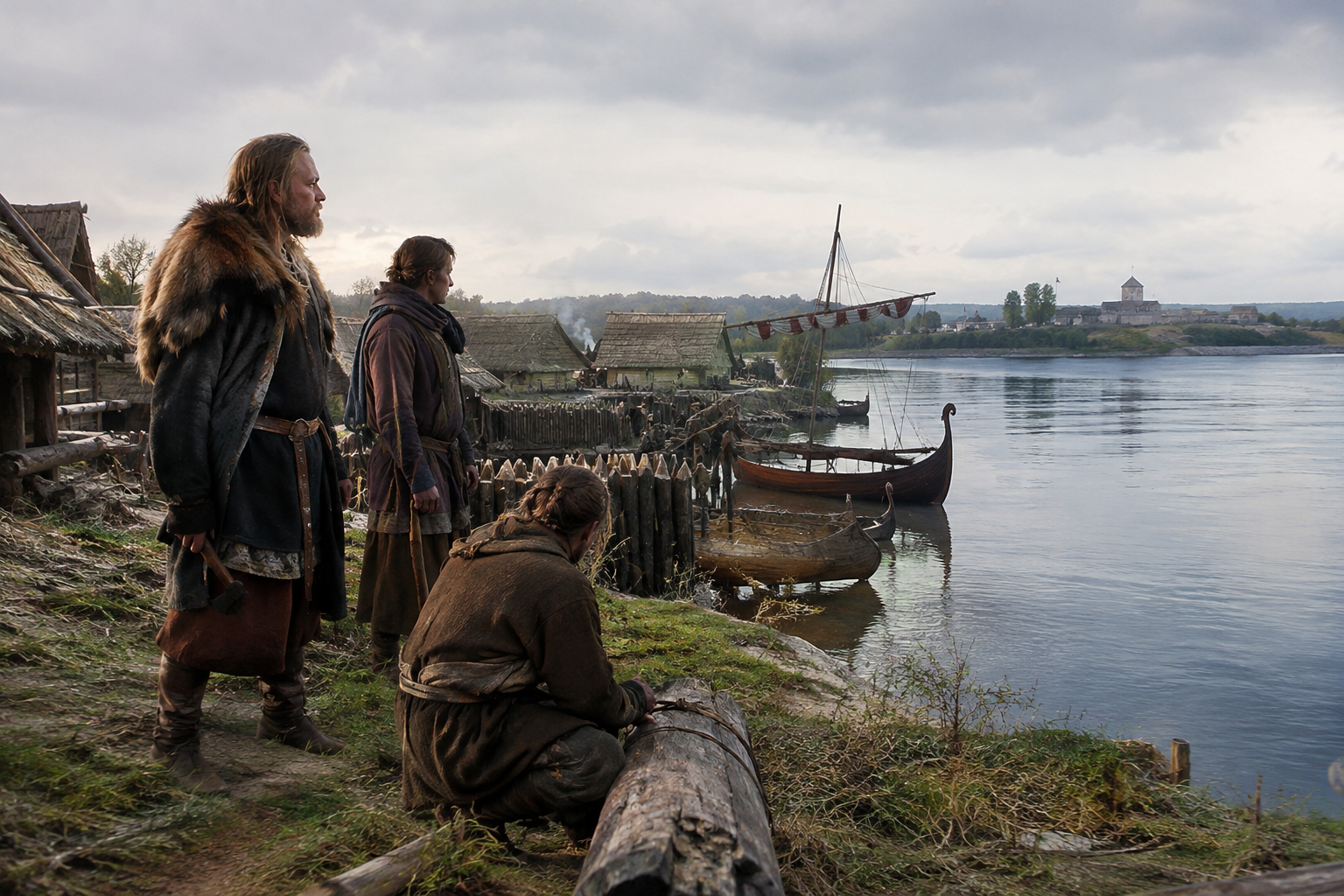
At Staraya Ladoga, on the Volkhov River in northwestern Russia, archaeologists are looking at one of the great hinge-points of the Viking Age. This was no remote outpost. By around AD 1000, the settlement connected the Baltic to the river routes leading deep into eastern Europe and toward Byzantium and the Islamic world. Among the ancient individuals recovered there is sample VK14, associated here with the Y-DNA haplogroup I1a1b1a4a2f1a1a1.
That matters because Staraya Ladoga is exactly the sort of place where paternal lineages stop being abstract labels and start appearing in history's traffic jams: traders, settlers, warriors, boat crews, craftspeople, and families living in a town where Scandinavian, Finnic, and Slavic worlds met. Y-DNA traces one direct paternal line only, not a person's whole ancestry, but in a place like Ladoga even that single line can be revealing. A genetic study connected with Viking Age mobility in this broad region can be found at https://www.biorxiv.org/content/10.1101/703405v1.
Staraya Ladoga often appears in historical discussions as one of the earliest major centres in the Rus' sphere, long before later capitals overshadowed it. It sat at a strategic choke-point between Lake Ladoga and the inland waterways. If you wanted to move goods, people, or influence from the Baltic into the forest zone and beyond, this was one of the places you passed through.
So when a paternal lineage in the broader I1 family turns up here, the interesting point is not that it "proves a Viking" in some simplistic sense. It is that Staraya Ladoga was one of the places where lineages common in Scandinavian-connected populations became part of a more complicated eastern story. By AD 1000, this was already a world of mixed contacts, repeated travel, and settled communities rather than a single clean migration episode.
The exact label I1a1b1a4a2f1a1a1 is a very narrow twig on the much larger Y-chromosome haplogroup I1. That broader haplogroup is strongly associated with northern Europe, especially Scandinavia, in both ancient and modern population history. But that does not mean every tiny sub-branch has the same neatly mapped origin story, nor does it allow us to assign a precise migration route from the label alone.
What we can say more safely is that a lineage of this kind fits well into the northern European paternal landscape that became highly visible during the first millennium AD. In the Viking Age, men carrying branches of I1 appear in settings linked with Scandinavian expansion, settlement, and exchange. The narrower subclade name used here is therefore best understood as a precise descendant branch within that wider northern paternal background, not as a complete identity card.
It is tempting to think that a single ancient man tells us very little. In one sense, that is true: sample VK14 cannot stand in for all of Staraya Ladoga, all Vikings, or all medieval Russians. But archaeology rarely works by finding one grand answer. It works by building context from carefully located lives.
And Ladoga provides unusually rich context even when the personal details of one burial are limited. This was a nodal settlement in a network stretching from the eastern Baltic to the Black Sea and Caspian worlds. A paternal lineage recovered here belongs to a lived environment shaped by river transport, seasonal movement, intercultural contact, and the creation of political authority in the early Rus' period. In other words, the place does much of the explanatory work.
That is also why eastern Viking archaeology matters so much for genetics. It complicates the older habit of imagining the Viking Age only as raids westward to England and the North Atlantic. The eastern routes were just as transformative, and in some ways even more obviously urban and commercial.
Historically, Staraya Ladoga sits in a borderland that was not marginal at all. It was central precisely because it joined different worlds. Scandinavian-linked material culture has long been part of the site's importance, but archaeology across the wider region has shown again and again that cultural identity was not a simple matter of one people replacing another. Communities formed through contact, adaptation, marriage, trade, and political opportunism.
That makes a haplogroup like I1a1b1a4a2f1a1a1 especially interesting here. In western Europe, an I1 branch might be folded too quickly into a broad "Germanic" story. At Ladoga, the same wider paternal background belongs to a more entangled historical setting: Norse-speaking or Scandinavian-connected men moving through a multilingual frontier, interacting with local populations, and taking part in the formation of early medieval eastern European societies.
Recent archaeogenetic work on language spread and mobility has also pushed historians to think less in terms of pure peoples and more in terms of overlapping networks. That does not let us read language straight off a chromosome, of course. But it does help explain why a northern paternal lineage can turn up in a place where identity was political and practical as much as ancestral.
Sample VK14, dated here to around AD 1000, belongs to the late Viking Age - a period when many of the dramatic first movements were already generations old. That timing matters. It places the individual not at the very start of Scandinavian expansion, but in a mature phase when exchange systems and mixed societies were already established.
So the value of VK14 is chronological as well as geographic. He belongs to a period when Staraya Ladoga was part of a durable eastern world of movement, not a fleeting encampment. If you carry this haplogroup today, that does not mean your direct paternal ancestor came from Ladoga specifically. It does mean that one attested bearer of the lineage lived in one of the most consequential contact zones of the Viking Age.
There is also a useful caution here. Ancient DNA often gives us tremendous resolution in lineage naming, but much less in biography. We may know a fine-grained Y-chromosome branch while knowing little about the man's household, language, status, or family role. That is not a weakness so much as the proper discipline of the field: keep what is specific, and do not invent the rest.
Baltic and Finland connections
The most distinctive thing about I1a1b1a4a2f1a1a1 in this article is not a grand claim of dynasty or conquest, but its appearance in VK14 at Staraya Ladoga, around AD 1000. That places this paternal line in a real archaeological setting at the crossroads of Scandinavian, Baltic, and early Rus' history. For someone researching this haplogroup today, the strongest responsible takeaway is that your direct paternal line belongs within the wider northern European story and is now also attested in the eastern Viking world, where trade, migration, and settlement were reshaping medieval Europe.






Comments