Haplogroup I1a1b1a4a2

– 5 min read


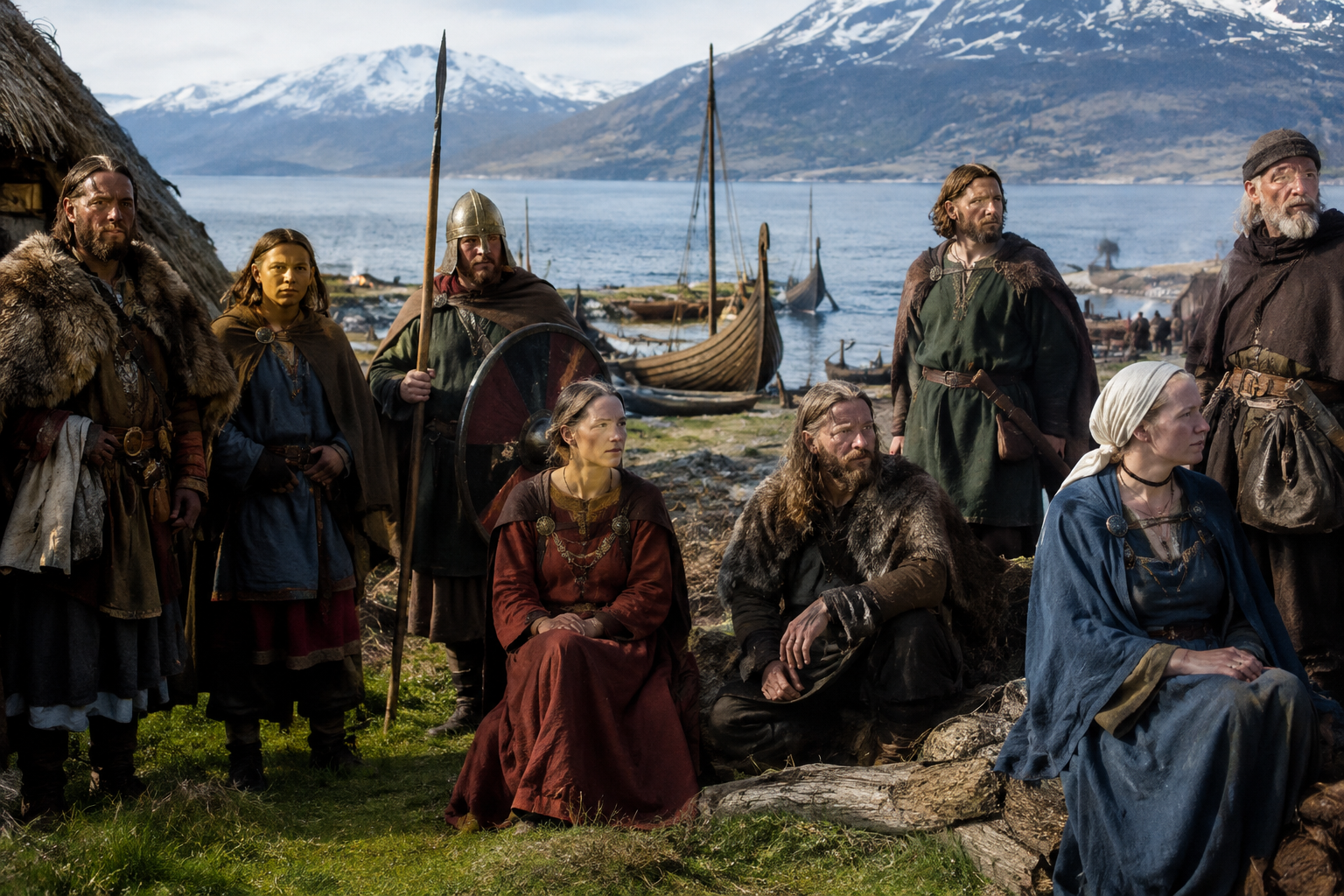
At Romback in Vaesternorrland, on the wooded northern coast of Sweden, two men dated to around AD 475 carry an unusually useful clue for anyone interested in Y-DNA haplogroup I1a1b1a4a2. They appear before the great Viking raids, before the famous longships of saga memory, and yet they already place this paternal line firmly in Scandinavia in the centuries leading into the Vendel period. Their sample IDs, rtp001 and rtp004, matter not because they tell us everything, but because they anchor this branch in a real landscape and a real time.
That is the important point from the start. Y-DNA follows one direct paternal line only, not a person's whole ancestry or identity. But when the same branch turns up again and again in northern European burials from late Iron Age and Viking Age settings, it gives us a historical pattern worth taking seriously. In the case of I1a1b1a4a2, the pattern is overwhelmingly Scandinavian, stretching from pre-Vendel Sweden into Viking Age Norway, the Baltic sphere, and the Norse settlement world of Iceland.
The Romback samples are the earliest signal here. Dated to the pre-Vendel Age, around AD 475, rtp001 and rtp004 place this haplogroup in a northern Swedish setting well before the Viking Age proper. That matters because it cautions against a lazy habit in popular history: assuming every Scandinavian male line found in Viking Age graves somehow appeared only with the raiding age itself.
Instead, these men suggest continuity from earlier Iron Age populations in Scandinavia into the social worlds that later produced Vendel and Viking Age elites, farmers, traders, and seafarers. A major ancient DNA study on Viking Age populations, published in Cell, helped show just how connected and yet regionally grounded these northern populations could be. The paternal story was not one of a single sudden expansion from nowhere, but of older Scandinavian lineages participating in later historical change.
This earlier horizon is especially useful for I1-related branches. Haplogroup I1 is widely associated with Scandinavia in later prehistoric and historic periods, but a precise subclade such as I1a1b1a4a2 should not simply inherit every grand claim made about the broader parent branch. What the Romback evidence gives us is something better than myth: an actual foothold.
By around AD 700, the branch appears again in VK382 from Vendel Age Oland, and by around AD 725 in VK488 from Salme II-VIII on Saaremaa. These are not trivial locations. Oland sat in the Baltic crossroads of movement and exchange, while Salme has become one of the most discussed early martial sites connected with Scandinavian activity east of the Baltic.
The Salme finds are historically important because they belong to a period when Scandinavian connections across the Baltic were already vigorous, even before the classic Viking Age chronology. So when a lineage associated with I1a1b1a4a2 turns up there, it fits a world of mobile seaborne groups moving between Sweden, the eastern Baltic, and beyond. It does not mean every bearer of this branch was an elite warrior, nor that one grave can stand for an entire people. But it does place this paternal line inside the very networks from which Viking Age expansion emerged.
Oland adds a slightly different dimension. This was not some distant frontier but part of the Scandinavian core, a place tied into status, exchange, and Baltic traffic. Taken together, Oland and Salme suggest that the men carrying this branch were present both in homeland settings and in outward-facing zones of contact.
The Norwegian material strengthens the picture. CGG107010 from Lund in Norway, dated to around AD 775, falls right at the threshold of the Viking Age. VK529, an Ancient Individual: Viking Age Warrior Nordland Norway dated around AD 800, brings the branch into the Norwegian north during the opening phase of Norse expansion. And HSJ-A1B, described as a Norwegian Viking in Iceland around AD 950, carries the same line into the settlement diaspora of the North Atlantic.
This sequence is one of the most telling features of the evidence. The branch is not limited to one Swedish district or one cemetery phase. It appears in Norway itself, and then in a Norse colonial setting overseas. That is precisely the sort of distribution one might expect from a paternal lineage embedded in Scandinavian populations during the centuries when maritime mobility became historically transformative.
Research on ancient and modern Icelandic genomes has drawn attention to the mixed roots of early Iceland, where Norse settlers and people of Gaelic background both contributed to the population. A more recent preprint on Icelandic material, available here, continues that line of inquiry. For a lineage such as I1a1b1a4a2, the Icelandic sample is a reminder that one paternal line can travel far while still representing only one thread in a much larger ancestral fabric.
Lund, Nordland, and Iceland also suggest something else that often gets lost. "Viking" was not an ethnicity stamped into bone. It was a historical world: coastal, mobile, opportunistic, regional, and changing. A Y-line like this one helps us see who was present within that world, but not reduce the world to genetics alone.
One especially evocative sample is wes005 from Vasterhus, Jamtland, Sweden, dated around AD 1016. This is late Viking Age Scandinavia, a period when older local traditions were increasingly intersecting with Christian institutions, new political formations, and tighter regional kingdoms. Jamtland itself sat in an interesting position between Norwegian and Swedish spheres, and Vasterhus has become well known in medieval archaeological discussion.
That makes wes005 more than just another point on a map. It shows that this paternal branch did not disappear with the first age of raids and voyages. It remained present into the eleventh century, in a Scandinavian society already changing its religious and political grammar. The men who carried such lineages could have lived through the tail end of the pagan age, the expansion of royal power, and the spread of church burial customs.
For family historians, this is a useful correction to fantasy. If your paternal line falls within I1a1b1a4a2, the ancient evidence does not point to a single famous raider or saga hero. What it does suggest is something more historically substantial: a lineage at home in Scandinavian populations before, during, and after the classic Viking Age.
If we stand back from the individual graves, the pattern is remarkably consistent. The current sample set runs from pre-Vendel Age northern Sweden to Vendel Age Oland, across the Baltic to Saaremaa, into Viking Age Norway, and out into Iceland. That is not proof of one dynasty, one tribe, or one unbroken family tradition. It is, however, strong evidence that this branch belonged to the Scandinavian paternal landscape that fed directly into the historical Viking world.
In practical terms, I1a1b1a4a2 looks like a branch whose known ancient footprint is concentrated in the Norse orbit of the first millennium AD. The most distinctive insight is its depth: not merely Viking Age presence, but roots visible before the Viking Age and continuity after it. For someone tracing this paternal line today, that makes it less a badge of a single episode and more a sign of belonging to a long northern continuum.






Comments