Haplogroup I1a1b1a4a1a

– 5 min read


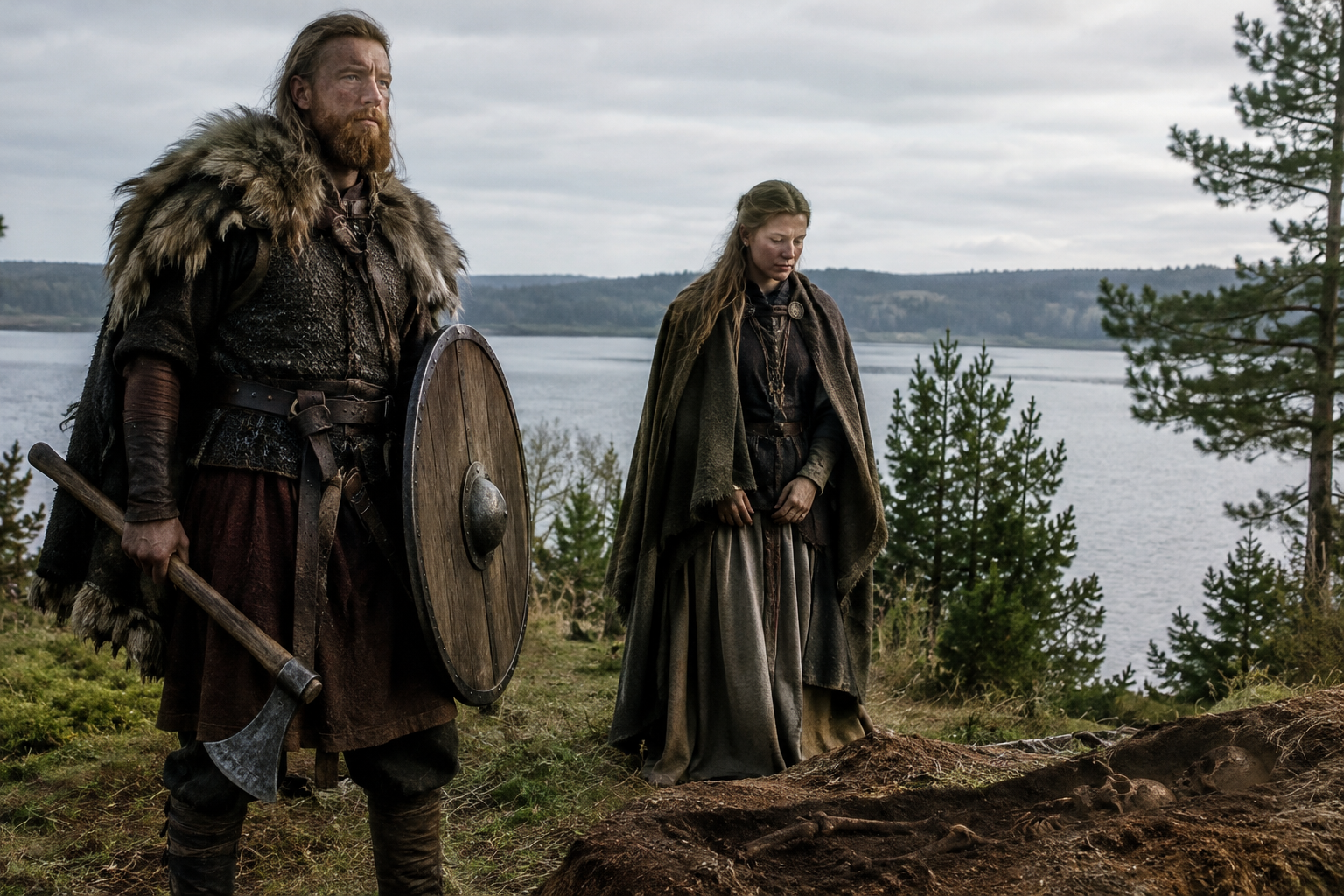
In medieval Finland, one of the more arresting ancient DNA signals comes not from a king or a grand saga hero, but from a named burial context: the so-called Medieval Axe Warrior from Hame, at Ylojarvi Mikkola. Dated to around AD 1175 and recorded as sample MYI002, he offers a rare glimpse of a paternal line associated here with I1a1b1a4a1a in a region where archaeology, language, and population history do not line up in any simple way.
That matters because Finland in the late 12th and 13th centuries was no isolated corner. It sat in the middle of Baltic movement: trade, warfare, marriage, mission, and settlement all crossed these waters. A Y-DNA lineage traces one direct paternal line only, not a person's whole ancestry, but when a branch such as I1a1b1a4a1a appears in medieval southwestern and inland Finnish material, it becomes part of a larger question: how strongly were Scandinavian-linked male lines represented in the making of medieval Finland?
The Ylojarvi Mikkola individual is interesting precisely because the setting is historically charged. Hame, or Tavastia, was a region pulled between inland Finnish traditions, Baltic contacts, and expanding Swedish influence during the centuries when Christian institutions were gaining firmer ground. By around AD 1175, local communities were not living in some prehistoric fog; they were part of a changing northern world with real political consequences.
What we can say carefully is this: sample MYI002, identified as the Medieval Axe Warrior from Hame Finland Ylojarvi Mikkola, places the article's branch in a documented medieval Finnish context. The "axe warrior" label is evocative, but it should not tempt us into overreach. Without adding unverified grave detail, the significance lies in the combination of date, place, and paternal assignment: a branch within the wider I1 family appearing in inland southern Finland during a period of intense cross-Baltic interaction.
A genetic study of early and medieval Finland has helped frame exactly these questions of continuity, mixture, and regional difference in the ancient population of the country. The broader research context can be found in this ancient DNA study of Finland's past, which is relevant because it treats Finland not as a fixed ethnic block but as a landscape of changing biological and cultural ties.
The second ancient individual linked with this article is very different in tone and context. Sample PKN006 comes from a Medieval Finland Double Burial Woman in Tavastia, Paelkaene, dated to around AD 1250. Because this is a woman, she does not herself carry a Y chromosome, so she cannot directly bear haplogroup I1a1b1a4a1a. Her importance here is contextual rather than paternal: she belongs to the same medieval Tavastian world in which such paternal lines were circulating.
That distinction is worth making clearly. Ancient DNA articles are sometimes written as though every sample says the same kind of thing, but they do not. A male Y-DNA call such as the one associated with MYI002 tells us about one paternal line. A female burial such as PKN006 instead helps anchor the social and biological landscape around that line: the communities, cemeteries, and regional populations among whom these male branches existed.
Paelkaene is especially useful for reminding us that medieval Finland was made up of households and burial communities, not just isolated "types." Even where the paternal story is our focus, the surrounding women, children, and unrelated men are what turn a haplogroup from an abstract label into part of lived history. The branch did not move through history on its own; it moved through communities like those of Tavastia.
The wider haplogroup I1 is strongly associated with northern Europe, especially Scandinavia, in both modern and ancient discussions. But this article concerns the narrower branch I1a1b1a4a1a, and it would be wrong to dump the whole history of I1 onto this precise subclade without sample-specific evidence. What the Finnish material supports is a grounded medieval occurrence, not a complete origin story.
Still, even that limited evidence is historically revealing. Medieval Finland was one of the places where Scandinavian, Finnic, and broader Baltic histories overlapped most intricately. A branch under I1 showing up in this setting is compatible with that northern maritime world: a world of movement across the Gulf of Bothnia and the Baltic, of local adoption and adaptation, and of male lineages that may have arrived at different times by different routes.
In other words, I1a1b1a4a1a in Finland should not be reduced to a slogan like "Viking DNA," still less to a claim of single-origin identity. The better reading is subtler. It points toward participation in the northern European networks that shaped medieval Finnish populations, especially in the southwest and inland southern regions where contact with Scandinavian polities and settlers was historically important.
Medieval Finland Archaeogenetics
If one wants the historical backdrop for this haplogroup in Finland, the Baltic is the real stage. By the 12th and 13th centuries, that sea connected rather than separated people. Traders, raiders, missionaries, and local elites all moved through a zone that joined eastern Sweden, the Aland islands, coastal Finland, Tavastia, Karelia, and the eastern Baltic.
This helps explain why a paternal lineage associated with a Scandinavian-heavy branch can appear in medieval Finland without requiring any melodramatic migration tale. Some carriers may have had recent western connections; others may have descended from lines established generations earlier. By the High Middle Ages, the same haplogroup could belong to men who spoke different languages, followed different local customs, or understood themselves through region and kin rather than through anything like modern nationality.
The laboratory side of this work also matters, even if it is less glamorous than the historical picture. The sequencing project tied to these Finnish remains is part of a recoverable research trail, including the associated ancient DNA data release at PRJEB88970. That does not by itself settle every interpretive question, but it shows that the medieval Finnish evidence for these individuals belongs to the increasingly solid archaeogenetic record rather than to folklore or guesswork.
One of the striking things about Finnish ancient DNA is that it keeps complicating older historical habits. Earlier scholarship often leaned too heavily either on written chronicles from outside Finland or on neat maps of language and ethnicity. The burials are less obedient. They show regional diversity, overlapping ancestries, and communities that were neither sealed off nor simply replaced.
That is where a branch like I1a1b1a4a1a becomes useful. Not because it gives a grand single answer, but because it adds one more concrete paternal thread to the fabric of medieval Tavastia and Hame. MYI002 anchors the branch in a male burial from around AD 1175; PKN006 helps place that same historical world into a broader cemetery and community setting by around AD 1250.
For someone carrying I1a1b1a4a1a today, the most defensible takeaway is not a promise of heroic descent, but a historically rich northern context. This branch is represented here in medieval Finland, particularly in a period when Tavastia and neighboring regions were tied into wider Baltic and Scandinavian worlds. That makes it a lineage worth exploring through regional history as much as through raw phylogeny.
The real value of these ancient finds is that they place a paternal line in recognizable human settings: a man from Ylojarvi Mikkola around AD 1175, and the burial communities of Tavastia a little later. That is modest evidence, but good evidence - and in ancient DNA, good evidence is always more interesting than grand invention.






Comments