Haplogroup I1a1b1a2a2
– 4 min read


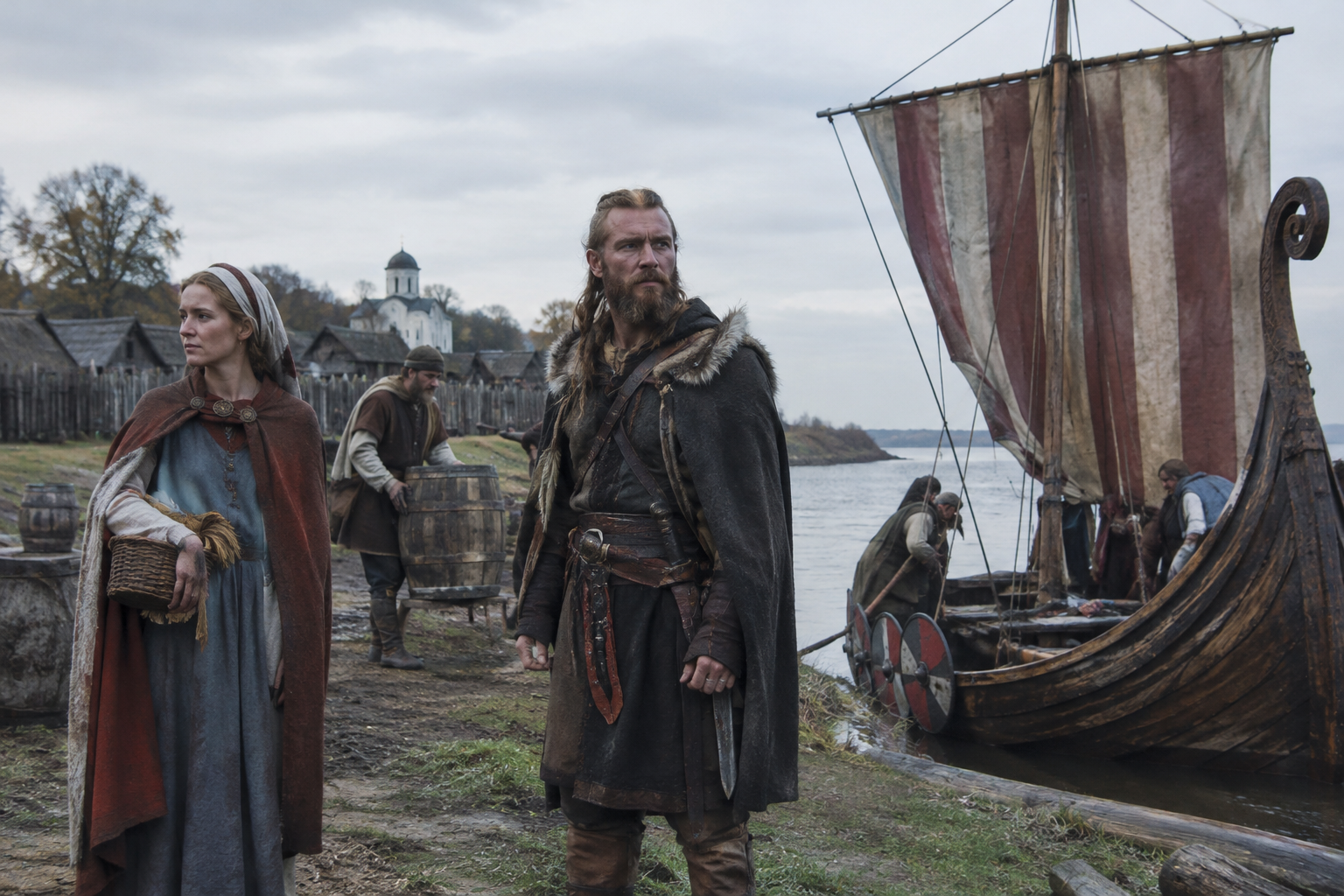
At Staraya Ladoga, on the Volkhov River in northwestern Russia, archaeologists are looking at one of the great hinge-points of the Viking Age. This was not some remote outpost at the edge of the story. Around AD 1000, it sat on the route that linked the Baltic to the river systems of eastern Europe, and from there to the worlds of Novgorod, the steppe, and Byzantium. Among the ancient individuals recovered from this setting is sample VK20, dated to about AD 1000 and associated here with the Y-DNA haplogroup I1a1b1a2a2.
That matters because I1 is a paternal lineage strongly associated with Scandinavia and the wider Germanic-speaking north, while I1a1b1a2a2 is a much narrower branch within that larger family tree. Y-DNA traces one direct male line only: father to father to father. It does not sum up a whole person's ancestry, identity, or language. But in a place like Staraya Ladoga, even one paternal line can help pin down something very concrete: the presence of northern male ancestry within a famously connected trading and settlement zone.
Staraya Ladoga has long occupied a special place in early medieval history. Written sources later tied the region to the Varangians, the Scandinavian-linked groups active in the river networks of eastern Europe, and archaeology has repeatedly shown that Ladoga was no provincial backwater. It was a settlement where objects, people, and ideas moved in several directions at once.
Sample VK20, dated around AD 1000, belongs in that historical landscape. With only a single sample named here, caution is essential: one man is not a population, still less a dynasty. Yet a paternal lineage within I1 is exactly the kind of finding one would expect to encounter in a place shaped by Viking Age mobility across the Baltic and into the east.
An ancient DNA study examining Viking Age populations in this broader world is linked here in research on ancient genomics. Without over-claiming what one unpublished or preprint-era source can tell us on its own, the larger scholarly pattern is clear enough: the Viking Age east was built not simply by raiders appearing and disappearing, but by sustained networks of movement, settlement, exchange, and local integration.
The important thing here is scale. The broad haplogroup is I1, a lineage with deep roots in northern Europe and especially strong modern associations with Scandinavia. The article haplogroup, I1a1b1a2a2, is a much more specific twig on that branch. It should not automatically inherit every historical claim ever made about I1 as a whole.
That distinction can be annoyingly technical, but it is exactly where good archaeogenetics parts company with myth-making. If a man at Staraya Ladoga carried a narrow I1 branch, that does not mean we can identify his language, social rank, or precise homeland from Y-DNA alone. What we can say, more soberly and more usefully, is that his paternal line fits well within the northern genetic signatures that appear in Viking Age contexts around the Baltic world.
This is also why Staraya Ladoga is such a good setting for thinking about paternal ancestry. It was a place where Scandinavian-linked lineages could arrive, stay, mix with local populations, and become part of a new social landscape. The river route was not merely a road out of Scandinavia; it was a corridor of repeated contact.
It is tempting to collapse everything into one word, Viking, and leave it there. But Ladoga asks for something more precise. The site belongs to the eastern sphere of Viking Age activity, where Scandinavian connections met Finnic, Slavic, and other local populations in a frontier of commerce and politics. The result was not a simple transplant of one people into another land.
That is where VK20 becomes historically interesting. A lineage like I1a1b1a2a2 in this setting is not just evidence of "a Viking" in the cinematic sense. It speaks instead to the durable male-line presence of northern ancestry in a settlement deeply involved in the formation of early Rus' networks and Baltic-to-Black Sea exchange.
In other words, the paternal line is part of a bigger archaeological argument. Staraya Ladoga was one of the places where identities were made in practice: by travel, marriage, trade, military service, and local settlement. A Scandinavian-linked Y-line at the site fits that story rather neatly, though not exclusively.
Germanic languages and genomics
For a haplogroup like I1a1b1a2a2, the real historical backdrop is the Baltic and Scandinavian zone rather than some vague idea of "northern blood". By the late first millennium AD, movement across the Baltic was ordinary, if hardly easy. Ships, river craft, trading stations, and seasonal routes created a world in which men from the Scandinavian north could end up settled or buried far to the east.
That broader setting helps explain why a northern paternal lineage in northwestern Russia is historically plausible without being trivial. Staraya Ladoga was connected not only to Sweden and the eastern Baltic, but to inland exchange systems that reached astonishing distances. A Y-line associated with the Scandinavian sphere at this site therefore belongs to a known archaeological pattern of contact, not to a fantasy of isolated heroic migration.
Readers interested in how these northern networks affected nearby regions may find useful context in work on early medieval Finland and Baltic connections, where genetics and archaeology together show just how entangled the northern world could be.
There is a pleasing stubbornness to ancient DNA. It gives you something solid, but rarely everything you want. With VK20, we have a documented ancient individual from Viking Age Staraya Ladoga and an association here with I1a1b1a2a2. That is enough to place this paternal branch within a real archaeological context: around AD 1000, in one of the best-known contact zones of the eastern Viking world.
It is not enough to identify a named family, a profession, or an unbroken line to any later noble house. Nor should it be. The value of the sample lies precisely in its specificity. It anchors this haplogroup in a place where Scandinavian-linked ancestry was historically meaningful and archaeologically credible, and where paternal lines from the north became part of a larger eastern European story.
For someone researching haplogroup I1a1b1a2a2, the most useful insight is not a grand claim of heroic descent, but a well-grounded historical setting. The ancient sample VK20 places this paternal branch in Viking Age Staraya Ladoga, a settlement at the crossroads of Scandinavian, Baltic, and eastern European worlds around AD 1000. That makes this haplogroup a particularly interesting marker of the northern male-line presence that helped shape the eastern Viking sphere.






Comments