Haplogroup I1a1b

– 6 min read


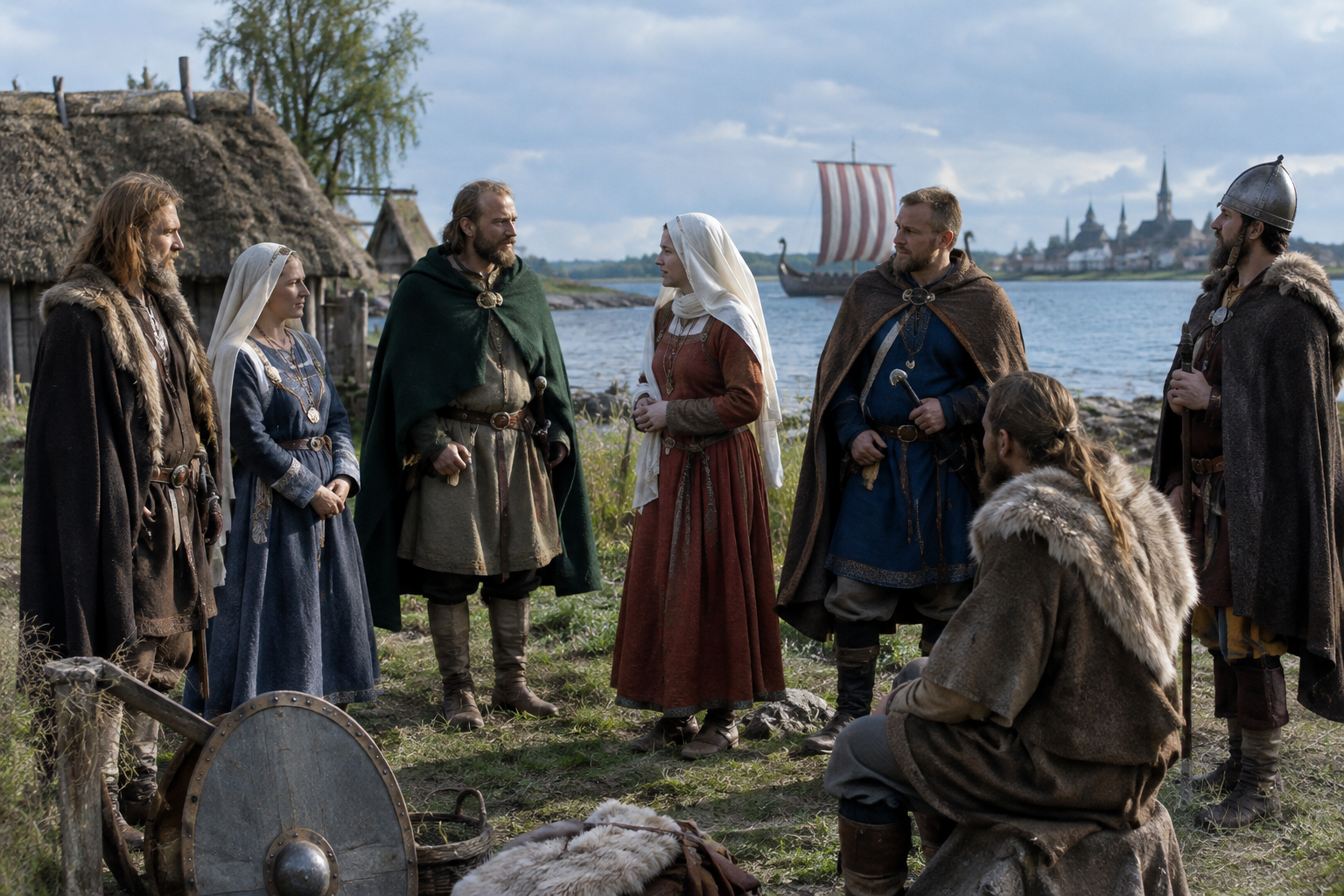
At Varnhem in Sweden, one Viking Age man identified as VK404 helps make an awkwardly simple point that ancient DNA keeps forcing on us: lineages do not live inside neat textbook boxes. Around AD 1050, in a landscape famous for early churches, burials, and the changing world of late Viking Age Scandinavia, this man carried the Y-DNA haplogroup I1a1b, a paternal branch that turns up again in several early medieval and medieval individuals scattered around the northern European world.
That pattern matters because I1a1b is not appearing here as a single heroic founder or a royal badge. Instead, the evidence we have places it in ordinary and important historical settings alike: Bavaria in the Merovingian period, Lower Saxony in the Carolingian era, Viking and medieval Sweden, Jutland in Denmark, and even early medieval Croatia. Y-DNA traces one direct paternal line rather than a person's total ancestry, but even that narrow line can be revealing when it keeps reappearing in the right places and periods.
The broader haplogroup I1 is well known in northern Europe, especially in Scandinavia and regions tied to North Sea and Baltic history. The more specific label in this article, I1a1b, is narrower than that parent branch, and the safest thing to say is that the ancient individuals listed here show it, or a reported association with it, in a distinctly early medieval and medieval northern context.
What is striking is not a single spectacular burial, but the spread of settings. The branch appears in Sweden at Sigtuna, Fjalkinge, and Varnhem-Skara; in Denmark at Aalborg; in Germany at Altheim in Bavaria and Drantum in Lower Saxony; and in Croatia at Velim-Velistak. That is a map of contact zones: kingdoms forming, trade expanding, Christianity advancing, and populations moving through war, service, marriage, colonization, and settlement.
The Swedish material is especially useful because it is not all from one moment. VK404 comes from Viking Age Varnhem near Skara, dated around AD 1050. Another individual, fjk534, comes from Viking Age Fjalkinge and is dated around AD 975. Then there is mbs072 from medieval Sigtuna, around AD 1100, placing the same paternal branch in one of the most important early urban and royal centers of Christian Sweden.
Those sites represent different kinds of Scandinavian history. Varnhem sits within the story of western Sweden's early Christian landscape. Sigtuna belongs to the growth of kingship, minting, ecclesiastical power, and urban life. Fjalkinge, in Scania, lies in a region that connected Denmark and Sweden and was deeply involved in Baltic exchange. The same Y-line appearing across these sites does not mean the men were close relatives, but it does suggest that I1a1b was part of the male population moving through the political and religious transformation of late first-millennium Scandinavia.
Research on medieval Swedish burials has increasingly shown how much kinship and local community structure can be recovered from genomes, even where archaeology alone cannot settle the question. A project on medieval Swedish multiple burials gives a sense of that wider context for reading Scandinavian ancient DNA evidence without forcing every burial into a saga-shaped narrative: https://www.rj.se/en/grants/2016/biological-and-social-kinship-reflected-in-genomes-from-medieval-swedish-multiple-burials/.
There is also a social point worth making. People often want a haplogroup to behave like a tribal label. But Sigtuna alone should cure us of that habit. A lineage found in a medieval town is already part of a crowded human world: traders, clergy, craftsmen, migrants, families, and newcomers. By the time we see I1a1b there, we are not looking at some untouched ancestral isolate. We are looking at history in motion.
The German finds give the branch a rather different setting. Alh_236, from Altheim in Bavaria and dated around AD 600, belongs to the Merovingian period, when post-Roman western Europe was being reorganized through new kingdoms, military elites, and local communities whose identities were often more mixed than older historical writing liked to admit. DRU011, from Drantum in Lower Saxony and dated around AD 750, falls in the Carolingian world that followed.
These are not interchangeable contexts. Merovingian Bavaria stood on the frontier between Roman inheritance and new political formations. Carolingian Lower Saxony belonged to a zone that would become central to Frankish expansion and the long integration of Saxon territories. Seeing I1a1b in both places suggests a paternal line at home not only in Scandinavia but in the northern continental sphere tied to it by migration and exchange across the North Sea and Baltic worlds.
This is also where readers should be cautious in the right way. A Y-line in Bavaria does not automatically make its bearer a "Scandinavian," just as a northern-looking haplogroup in Saxony does not by itself prove a recent migrant. Early medieval Europe was full of lineages with longer regional histories than the political labels attached to them. Still, the repeated appearance of I1a1b in Germany and Scandinavia together is historically intelligible. It fits a world in which male lines circulated across coastal and inland networks long before modern national borders tried to tidy them up.
A broader ancient DNA study of early medieval population formation in northwestern Europe is useful background here, especially for understanding how migration and local continuity could coexist in the same regions: https://www.researchgate.net/publication/363736520_The_Anglo-Saxon_migration_and_the_formation_of_the_early_English_gene_pool.
One of the most quietly revealing samples in this set is CGG100498 from Vor Frue Kirkegard, Aalborg, in Jutland, dated around AD 1400. This is late enough to remind us that haplogroups are not just about migrations and dramatic turning points. They are also about continuity. By the late medieval period, a paternal lineage like I1a1b could be embedded in settled Christian communities, parish cemeteries, market towns, and agricultural landscapes far removed from the excitement people usually attach to "Viking DNA."
Aalborg was no backwater. It was a significant Danish town with maritime links and a role in regional trade. The presence of I1a1b there does not tell us that one man's family had stayed put since the Iron Age. That would be fantasy. But it does show the branch surviving and reproducing within the lived social fabric of medieval Denmark.
This later evidence is important for another reason. It stops us from treating haplogroups as one-off flashes in the record. When a branch appears in Viking Age Sweden and is still visible in later medieval Denmark, it looks less like an episode and more like part of the enduring male background of the Scandinavian world.
The sample VEM057 from Velim-Velistak in Croatia, dated around AD 775, is perhaps the most provocative find in the group. Not because it proves a dramatic migration tale by itself; it does not. Rather, it places I1a1b in an early medieval eastern Adriatic setting, where imperial frontiers, Slavic-speaking communities, older Roman populations, and long-distance contacts overlapped.
This is exactly the sort of case where ancient DNA is most useful when it is least theatrical. A northern-associated paternal lineage turning up in Croatia does not by itself identify ethnicity, language, or a named people. What it does show is that the male genetic landscape of early medieval Europe was mobile and entangled. The Adriatic was not a sealed cultural basin. Soldiers, settlers, merchants, clerics, and captives all helped move lineages about, sometimes over considerable distances and sometimes across generations too compressed for archaeology alone to separate.
For readers interested in how ancient DNA is reshaping the Croatian picture more generally, one helpful comparison is this related discussion of changing paternal patterns in the region:
Croatia's shifting paternal lines
If your paternal line falls under I1a1b, the ancient evidence here points most clearly toward a history rooted in the northern European world of the early Middle Ages, especially Scandinavia and its neighboring regions, but not confined to them. The strongest impression is not of a single tribe or dynasty, but of a lineage present in the Scandinavian sphere, established in parts of Germany, and capable of appearing farther south in the wider circulation of early medieval Europe.
That is, in its way, more interesting than a tidy legend. I1a1b looks like the sort of paternal branch that followed real historical processes: settlement, political consolidation, trade, conversion, and movement around the Baltic, North Sea, and beyond. Ancient DNA does not turn that into a family saga, but it does place the lineage squarely inside the making of medieval northern Europe.






Comments