Haplogroup G2a2b2b1a1b1a1

– 5 min read


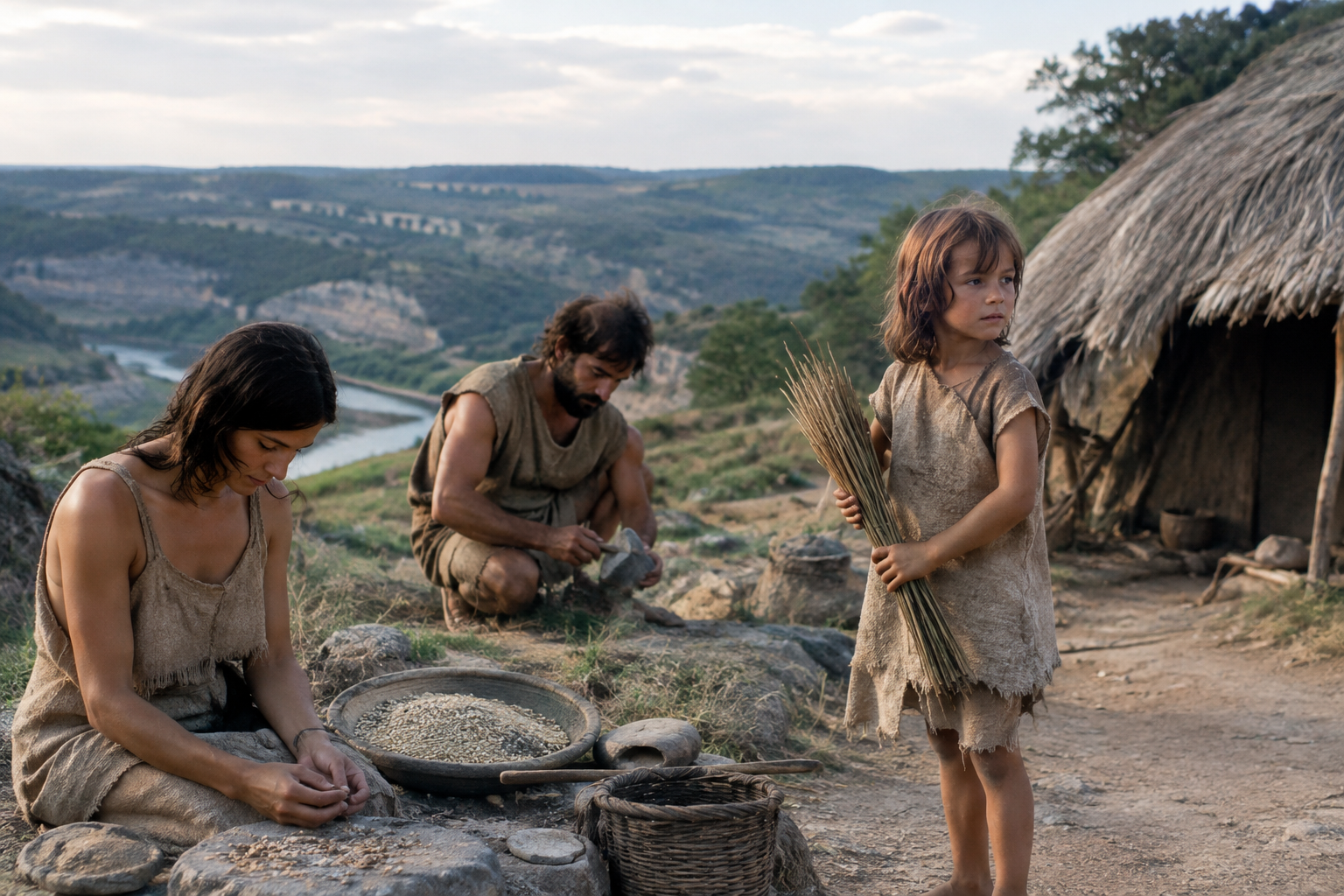
At Dzulyunitsa in what is now Bulgaria, archaeologists recovered an early farming individual dated to around 5550 BC: sample I2521, identified here as belonging to Y-DNA haplogroup G2a2b2b1a1b1a1. That is a very long label for a very old paternal line, but the setting matters more than the code at first glance. We are in the Chalcolithic Balkans, at a time when village life, farming, herding, and new social worlds were already firmly established.
This is what makes I2521 interesting. He does not belong to the age of kings, empires, or written chronicles. He belongs to a much earlier Europe, when some of the most important changes in human history were happening in settlements rather than palaces. A Y-DNA lineage traces one direct paternal line only, not a whole ancestry, but in this case it points us toward one of the most consequential episodes in European prehistory: the spread and development of early farming societies in southeastern Europe.
Dzulyunitsa sits in northern Bulgaria, in a region that became one of the key corridors of the Neolithic and Chalcolithic Balkans. By the mid-6th millennium BC, communities here were not tentative pioneers scratching out a living at the edge of the wild. They were part of an established agricultural landscape, linked to neighboring settlements by exchange, shared technologies, and probably marriage networks as well.
Sample I2521 comes from this deep prehistoric setting. The haplogroup assignment to G2a2b2b1a1b1a1 places him within a wider paternal family, haplogroup G2a, that is frequently associated in ancient DNA studies with early European farmers. That broader pattern is important, but it should be handled carefully: the long terminal branch in this article is more specific than the better-known parent lineage, and the detailed history of the narrow subclade is not the same thing as the full history of G2a as a whole.
An ancient DNA study of early European populations helped establish just how prominent G2a-related paternal lines were among the continent's first farmers, especially in southeastern and central Europe. The research trail connected to this sample includes genetic work on ancient European populations that has been central to understanding these early agricultural expansions.
If one paternal lineage has become almost emblematic of Europe's first farmers in ancient DNA, it is G2a in its various branches. That does not mean every early farmer carried it, nor that every later bearer of G2a descends from one simple migration stream. But it does mean that when a Chalcolithic male from Bulgaria falls within this broader family, he fits a pattern seen repeatedly in the archaeology and genetics of early farming communities.
The Balkans were crucial because they were not merely a stopping point. They were one of the main theaters in which farming lifeways took root in Europe and diversified. Villages expanded, local traditions formed, and communities interacted over generations. A lineage like G2a2b2b1a1b1a1 in this context is best understood not as a label floating in abstraction, but as part of the male ancestry carried within those settled agricultural populations.
There is also a useful historical caution here. It is tempting to turn a Y-haplogroup into a people, a language, or a culture. Archaeology is less tidy than that. The man behind I2521 lived in a community with its own local material culture and social rules; his Y-DNA tells us about one paternal thread within that world, not the full identity of everyone around him.
The date attached to I2521, around 5550 BC, places him near the beginning of a long southeastern European story that would eventually lead into the spectacular Copper Age societies of the Balkans. Northern Bulgaria and neighboring regions later became famous for tells, cemeteries, long-lived settlements, and some of the earliest striking evidence for social differentiation and metal use in Europe.
That broader setting helps explain why a single early male lineage from the region matters. By the Chalcolithic, these were not isolated households but communities shaped by inheritance, local continuity, and repeated contact with nearby groups. Paternal lines could persist, branch, disappear, or be absorbed into new population mixtures. Finding a G2a-derived lineage here fits the picture of strong continuity from the earliest farming expansions into later prehistoric Balkan societies, even though no single sample can stand in for the whole population.
In other words, I2521 belongs to a period when southeastern Europe was already one of the great laboratories of social change. Farming had arrived earlier; now communities were elaborating it, adapting it, and building durable local histories around it.
Balkan hunter-gatherers and early Europe
There is only one ancient individual supplied here, and that fact ought to discipline the story. We should not pretend that I2521 proves a dynasty, a tribe, or a direct line into any named later people. Nor should we manufacture a heroic biography out of a sample number. What we can say is more modest and, in its way, more valuable: this is a documented paternal line in a real early farming community of the Balkans, anchored in time and place.
That anchoring matters because ancient DNA has changed the scale of the question. Instead of asking vaguely where a lineage is found today, we can ask where it appears in securely dated prehistoric contexts. In this case, the answer takes us to Chalcolithic Bulgaria and into the orbit of Europe's first agricultural societies.
The Balkans also matter in wider regional studies because they sit at the intersection of several major prehistoric processes: the movement of early farmers from Anatolia into Europe, interaction with local hunter-gatherer groups, and the later reshaping of populations in the Copper and Bronze Ages. For readers interested in how deep Balkan ancestry developed over the long term, that larger background is worth keeping in view.
Deep Balkan roots from ancient DNA
G2a2b2b1a1b1a1 looks forbidding, but the important point is simple. This is a fine-grained branch nested inside a much older paternal framework. The parent clade G2a is well known in Neolithic Europe; the exact downstream branch in this article is a narrower designation, and its own detailed distribution through time is not yet something we should exaggerate from a single published ancient case.
That distinction is often where good history parts company with wishful thinking. A broad lineage may have one well-established prehistoric pattern, while a smaller sub-branch has a thinner evidential trail. For I2521, the value lies precisely in adding one securely ancient data point to that narrower branch, from a place and period where early farming ancestry is historically meaningful.
The wider archaeological picture from southeastern Europe has repeatedly shown how much these early communities contributed to later European population history. If you want a neighboring case study in the region's later complexity, Bulgaria appears again in work on post-classical burials and mobility, though in a very different era.
Later ancient DNA from Bulgaria
The most distinctive thing about haplogroup G2a2b2b1a1b1a1, on the evidence here, is its appearance in an early settled farming context in Chalcolithic Bulgaria. For someone researching this paternal line today, that does not guarantee descent from one excavated man, nor does it compress thousands of years of history into a single origin story. But it does place this branch, or a reported association with it, in one of prehistoric Europe's formative agricultural heartlands.
That is a rather good place to begin: not with fantasy pedigrees, but with a real ancient individual, I2521, in a real Balkan community, at a moment when farming societies were helping to remake Europe.






Comments