Haplogroup G2a2b2a4a3

– 5 min read


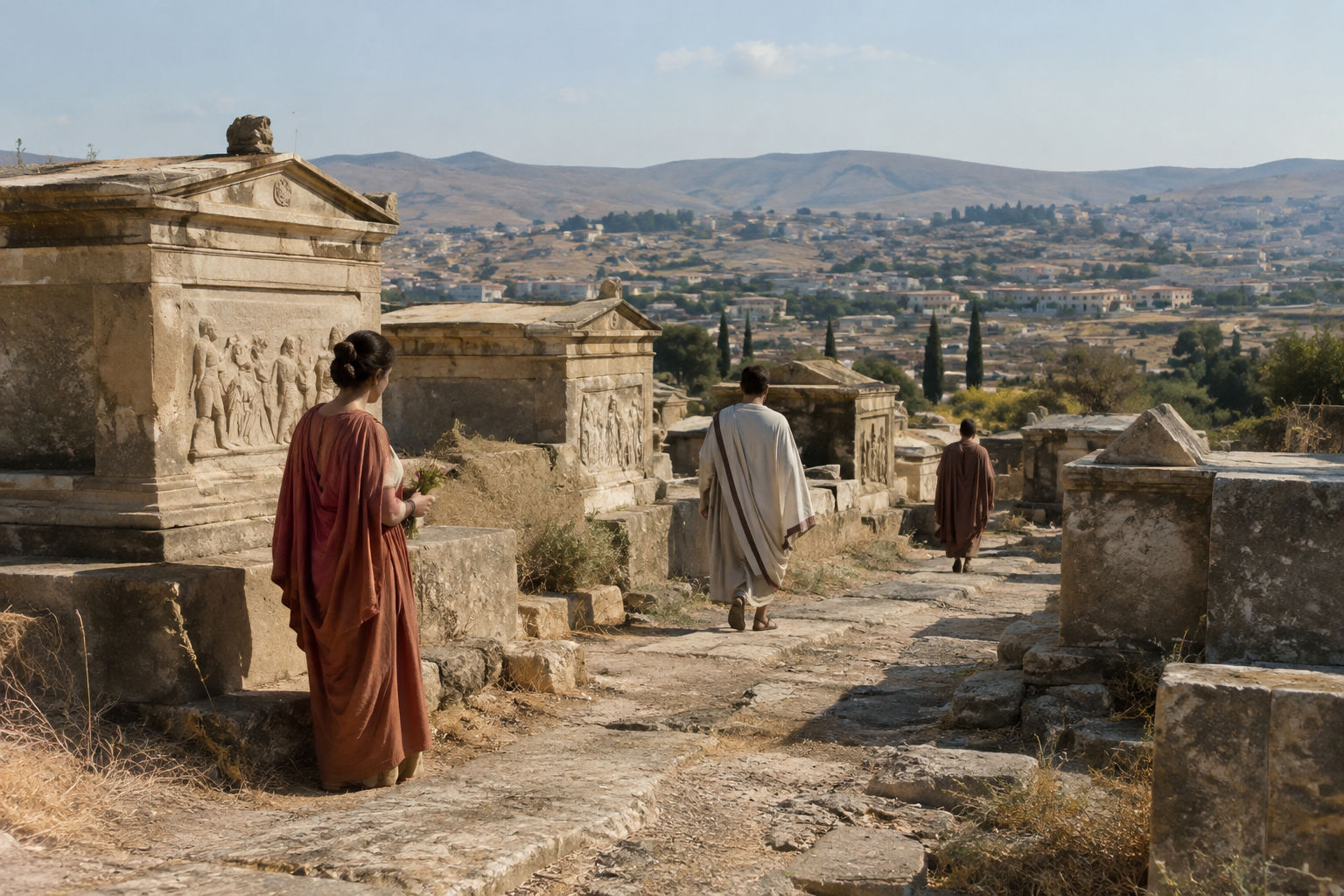
In Roman Algeria, at the Necropolis Orientale of Sitifis, one excavated individual stands out for anyone interested in paternal ancestry: sample R10766, dated to around AD 204. The site belongs to a North African city deeply tied to the Roman world, yet also firmly rooted in the older landscapes of the Maghreb. That combination is exactly what makes this sample so interesting. It places the Y-DNA haplogroup G2a2b2a4a3 in a real, documented human setting: not in a map of abstract arrows, but in a burial ground used when Roman rule was part of daily life in inland Algeria.
That matters because G2a2b2a4a3 is a very specific paternal branch. Y-DNA follows one direct male line only - father to son across the generations - so it does not describe a person's whole ancestry, language, or identity. But when a branch like this turns up in an ancient burial from Roman North Africa, it gives us a concrete point on the historical map and raises a serious question: how did this paternal line fit into the mixed and mobile society of a Roman provincial city?
Sitifis, modern Setif, was no remote outpost. Under Rome it became an important urban center in Mauretania, linked by administration, trade, military movement, and agriculture to the wider empire. Cemeteries like the Necropolis Orientale are valuable because they show us the people who actually lived in that urban world, rather than only the emperors, governors, and inscriptions that dominate written history.
Sample R10766, dated around AD 204, belongs squarely within that imperial setting. Yet one of the great lessons of ancient DNA is that "Roman" was never a single biological type. Across the empire, communities under Roman rule could include long-established local families, incomers from other provinces, soldiers, merchants, freed people, and descendants of earlier regional populations. A Y-line such as G2a2b2a4a3 should therefore be read as evidence of one paternal thread within that varied population, not as a shortcut to ethnicity.
For North Africa, this is especially important. The region had already seen millennia of movement and mixture before Rome arrived: prehistoric foragers, early farmers, later Mediterranean contacts, Punic networks, and then imperial incorporation. A Roman-period burial at Sitifis sits at the meeting point of all those histories.
North Africa's Deep Genetic History
The broader Y-DNA family G is an old and important branch in West Eurasian prehistory. In ancient DNA, branches of haplogroup G are often associated with early farming populations in parts of Europe and the Near East, though different subclades had different later histories. That broad background is useful, but it should not be lazily pasted onto every much later descendant branch.
The article haplogroup here is G2a2b2a4a3, a much narrower twig on that larger tree. With the evidence at hand, the safe historical claim is not that this exact subclade "came with the first farmers" to Roman Algeria. Rather, it shows that by the early 3rd century AD, one man in the cemetery at Sitifis belonged to this paternal line. The value lies in anchoring the branch to a place and period where Roman institutions and North African local history were tightly entangled.
This is one of those cases where precision matters. The parent haplogroup has a long prehistoric story, but the exact subclade in a named Roman-era burial gives us a much more specific historical snapshot. It reminds us that lineages can persist for long periods while moving through very different social worlds.
When people imagine the Roman Empire, they often picture movement from Italy outward. The reality was messier and far more interesting. North Africa was not merely receiving Roman influence; it was an active and wealthy part of the empire, supplying grain, producing urban elites, sustaining military zones, and participating in Mediterranean exchange. People moved in several directions at once.
That wider imperial mobility makes a burial like R10766 especially useful. A paternal lineage found at Sitifis might represent long local continuity, earlier Mediterranean connections, or mobility within the Roman world. The present evidence does not let us choose confidently among those possibilities for this one individual, and good history should resist pretending otherwise. But it does let us say that men carrying this branch were present in Roman Algeria in a documented cemetery context.
Research on Roman-period populations repeatedly shows that imperial communities were biologically diverse, often in ways that do not line up neatly with modern assumptions. Readers who want to explore how Roman rule could leave durable genetic signals in the western Mediterranean may find it helpful to compare this North African case with work on the Iberian Peninsula in Roman Hispania's Lasting Genetic Legacy.
At first glance, a single ancient Y-DNA result may seem frustratingly slight. No family tree. No grand dynasty. No crowd of close paternal matches from the same cemetery. But archaeology is full of cases where one well-dated individual changes the map. R10766 does exactly that for G2a2b2a4a3, because it gives the lineage a secure foothold in Roman North Africa.
That is more valuable than a vague modern distribution list. Ancient DNA ties a lineage to an actual person at an actual site, within a known historical framework. Sitifis in the early 3rd century AD was part of a provincial Roman world shaped by taxation, roads, military structures, urban burial customs, and older local traditions. Whatever longer journey this paternal branch had taken, by AD 204 it was part of that lived environment.
This is also a useful corrective to a common misunderstanding. A haplogroup is not a badge of civilization, tribe, or empire. The man buried as R10766 may have identified with local civic life, regional kinship networks, Roman institutions, or several of these at once. His Y-DNA simply tracks one male-line inheritance through that complicated human reality.
North Africa has become one of the most revealing regions in ancient DNA because it resists simple stories. Genetic evidence from the Maghreb often shows continuity layered with episodes of contact: deep local ancestry, links across the Mediterranean, and shifting contributions from neighboring regions over time. Roman-period cemeteries belong to that long history, not to a separate chapter detached from what came before.
For that reason, even a single Roman-era sample with haplogroup G2a2b2a4a3 is worth attention. It suggests that this paternal branch had entered, survived within, or developed inside the population networks of North Africa well before the end of antiquity. A reader interested in how archaeogenetics approaches such layered histories may also enjoy Archaeogenetics: Using Ancient DNA to Decode Human History, which gives a broader sense of how these puzzles are approached.
An ancient DNA study examining populations of the broader region is linked through this research paper. Even without leaning too heavily on one publication, the larger lesson fits what archaeologists increasingly see across Roman and North African contexts alike: mobility and continuity existed side by side.
For someone researching the haplogroup G2a2b2a4a3, the most distinctive point here is not a sweeping migration tale but a precise historical anchor: this paternal branch appears in sample R10766 from the Necropolis Orientale at Sitifis in Roman Algeria, around AD 204. That places the lineage within a cosmopolitan but distinctly North African Roman provincial setting.
It does not prove descent from this individual, nor does it assign the branch to a single ancient people. What it does offer is something better than myth: evidence that this direct male line was present in the human mixture of Roman North Africa, where local histories and imperial connections met in the same cemetery ground.






Comments