Haplogroup G2a2b2a1a1b1a1a2a5

– 7 min read


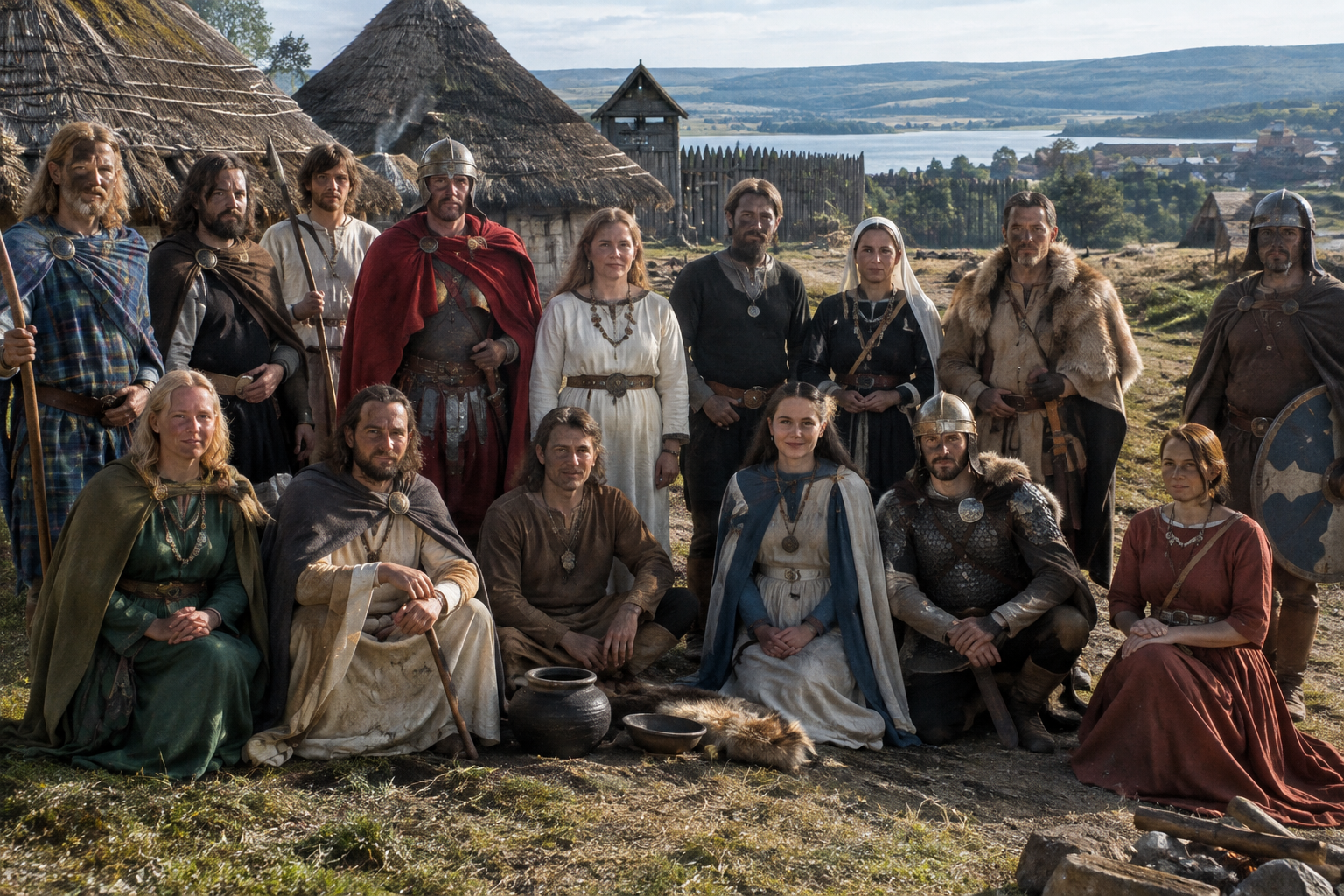
Some Y-DNA haplogroups announce themselves with grand frequency maps and neat modern distributions. G2a2b2a1a1b1a1a2a5 does not. It is a very specific paternal branch, deep down the Y-chromosome tree, and that is precisely what makes it interesting. Narrow branches like this often come into view not through modern surname legend, but through ancient burials: a grave in Celtic Germany, a man in Iron Age Yorkshire, a burial in Roman Pannonia, a Viking Age individual in Denmark. Suddenly, a lineage that might look obscure on paper begins to appear in some of the most lively historical settings in Europe.
It is worth saying clearly what a Y-DNA haplogroup can and cannot do. Y-DNA traces one direct paternal line only: father to son to son across generations. It does not represent a person's whole ancestry, still less their culture, language, or social identity. But because that paternal line can sometimes be followed across archaeological periods, it gives us a remarkable tool for asking how male lineages moved, persisted, and mixed within ancient societies.
The broader haplogroup G has deep roots in the prehistoric story of western Eurasia and is especially well known to ancient DNA researchers because branches of G appear prominently in early farming populations. For a highly specific downstream clade such as G2a2b2a1a1b1a1a2a5, however, caution matters. We should not simply pour the entire history of haplogroup G into this one twig of the tree. What we can say, based on the sample set here, is that lineages associated with this branch or its close paternal neighborhood appear across Iron Age and early medieval Europe in contexts linked with Celtic, frontier Roman, Wielbark, post-Roman, and Viking Age worlds.
Explore How Ancient DNA Rewrites History
If we begin where the evidence is especially vivid, we find this paternal signature in the orbit of early Celtic Europe. One striking example is I16327, from Celtic Hallstatt Stradonice Czech Bohemia, dated 675 BC. Hallstatt culture has long stood near the center of debates about early Celtic Europe, and this sample places the lineage in that central European sphere at an early point.
Another dramatic appearance comes from elite burial culture. At Eberdingen-Hochdorf Biegel in Germany, the individuals HOC002 and HOC002b, both dated 515 BC, are described as Elite Celtic. Hochdorf is exactly the kind of site that reminds us how ancient DNA can sharpen social history. We are no longer speaking only of "the Celts" as a broad archaeological label; we are looking at men buried in high-status settings, whose paternal lines can now be compared with those found elsewhere across Europe.
France adds two more important points on the map. CGG023724, from Gallic France Sequani Tribe Iron Age Les Moidons dated 500 BC, and CGG023644, from Celtic Iron Age France Tumulus de La Forat de Chatillon dated 500 BC, show this lineage in Iron Age Gaul. Together with the German and Bohemian examples, they suggest that this paternal branch was not confined to one valley or one tribal group. It appears across the wider zone of central and western European Iron Age societies.
Then there is Britain. I21981, from Celtic Parisi Iron Age England East Yorkshire Pocklington dated 225 BC, places the lineage among the Iron Age communities of eastern Yorkshire. That is historically tantalising, though not mystical. It does not prove a direct genealogical thread from Hallstatt chiefs to Yorkshire riders. But it does show that closely related paternal lines were present in both continental Celtic and British Iron Age settings.
The story becomes even more interesting when the lineage turns up beyond clearly Celtic contexts. In the Wielbark cultural world of northern Poland, we have a cluster of finds from Kowalewko: PCA0063 dated 45 AD, PCA0027 described as Iron Age Pommerania Kowalewko Rugii Tribe dated 100 AD, PCA0036 dated 115 AD, PCA0015 described as Gothic Wielbark Poland Kowalewko Oborniki dated 153 AD, and PCA0062 dated 200 AD. That is not a single isolated occurrence. It looks more like repeated evidence for related paternal lines in a northern European community over time.
This is exactly the sort of evidence that complicates simple ethnic storytelling. The old habit was to try to assign one lineage to one people: Celtic, Gothic, Germanic, Roman, and so on. Ancient DNA is much less obedient. A paternal branch found in elite Celtic Germany also appears in the Wielbark world, often discussed in relation to groups later associated with Gothic movements. That does not mean "Celts became Goths" or that Y-DNA can solve ethnic identity by itself. It means that male lineages travelled through social worlds that were more entangled than older nationalist histories liked to imagine.
The Roman frontier adds another layer. GYS041, from Late Antique Roman Pannonia Arrabona Szechenyi Square Hungary dated 425 AD, places this paternal line in the late Roman Danube region, one of the great crossroads of the fading empire. And I25516, from Iron Age Zamardi Somogy Hungary dated 200 BC, hints that related paternal ancestry was already present in the Carpathian Basin well before late antiquity. The significance here is not that one family marched uninterrupted from one cemetery to another, but that this branch appears in regions repeatedly shaped by mobility, military movement, and local continuity.
Read About Goths as a Multi-Ethnic Community
By the early medieval period, the lineage is still visible. CGG020724, from Post-Roman Britain Randwick Long Barrow dated 437 AD, is especially evocative because it sits in the centuries when Roman rule had ended and Britain was being reshaped by migration, local survival, and political fragmentation. Again, a single Y-line cannot tell us whether this man thought of himself as Briton, local Roman, newcomer, or something else entirely. But it does show paternal continuity or reappearance in western Britain during a period of profound transition.
Farther north, CGG106833 from Viking Age Trelleborg Kingdom of Denmark dated 965 AD places the lineage within the fortified and militarised landscape of the Viking Age. The contrast with the Hallstatt and Gallic samples is delightful. The same deep paternal branch that once appears in Iron Age central Europe also turns up in a Danish stronghold centuries later. Not proof of direct descent; very much proof that this branch had become part of a broad European patchwork.
And in the Low Countries, ST1039 from Medieval Belgium Outsider Sint-Truiden Onze-Lieve-Vrouwekerk dated 900 AD suggests yet another historical setting: a medieval ecclesiastical town where mobility, trade, and regional movement all mattered. The label "outsider" is itself a reminder that medieval communities were rarely as closed as we once imagined.
If you want a wider look at just how mixed early medieval and Viking-linked populations could be, the broader Scandinavian picture is well worth exploring.
So where do noble families enter this story? Carefully.
The supplied historical association points to the House Clinton and Maxstoke Castle in Warwickshire. Built in the 1340s by William de Clinton, a powerful noble close to Edward III, Maxstoke began as a fortified manor, with moat, gatehouse, and curtain wall, rather than as some giant border fortress. That detail matters. It places the castle in the world of landed aristocratic power, display, and local control in medieval England, not in a fantasy of endless siege warfare.
Over time the castle passed through other prominent families, including the Staffords and the Dilkes. England changed around it, but Maxstoke survived unusually well, and it is now known as one of the best preserved moated castles in England. As an object of historical memory, it is a gift: a medieval structure that still carries the shape of aristocratic life in the English Midlands.
What we must not say is that an ancient Celtic burial in Yorkshire or a Viking Age man at Trelleborg somehow proves the paternal ancestry of the Clintons, the Staffords, or every later holder of Maxstoke. That would be bad history and worse genetics. A noble family's association with a haplogroup may be reported in community context, but it does not automatically establish the exact Y-DNA of every documented member, still less a direct line back to any one ancient sample.
What we can say is more interesting than fantasy genealogy. Maxstoke stands in a region of Britain where ancient paternal lineages, continental contacts, and later medieval lordship all meet. Ancient DNA gives us the long background that charters and pedigrees cannot: the deep male-line history of Europe before surnames, before heraldry, before castles. Written genealogy starts late. The Y-chromosome starts much earlier.
Readers interested in the medieval family side of the picture may want to compare this genetic context with the community's feature on the Clintons themselves.
For G2a2b2a1a1b1a1a2a5, the most striking lesson is not a neat origin story but a wide historical range. In the evidence supplied here, the lineage appears in Hallstatt Bohemia, elite Celtic Germany, Iron Age Gaul, Iron Age Britain, the Wielbark world of Poland, late Roman Hungary, post-Roman Britain, Viking Age Denmark, and medieval Belgium. That is a serious span of time and place.
It suggests that this paternal branch belonged to men who lived in very different political and cultural worlds, yet remained part of a connected European population history. Ancient DNA does not flatten those worlds into one tribe. Quite the reverse: it shows how one paternal lineage could move through many identities and landscapes.
That is why haplogroups are so valuable when used properly. They do not hand us a ready-made coat of arms. They do something better. They show how the direct paternal line in one family today may have deep links to forgotten communities, long before the documentary record begins, and far beyond the boundaries of later kingdoms and surnames.
If your own Y-DNA or autosomal results point toward ancient Europe, MyTrueAncestry can help you explore whether your DNA shows affinities with archaeological samples like HOC002, I21981, GYS041, or CGG106833. Those comparisons do not prove direct descent from a particular ancient individual or membership in a noble house, but they can open a wonderfully concrete view into the populations who shaped your deeper past.






Comments