Haplogroup G2a2b2a1a1b1a1a2a12

– 5 min read


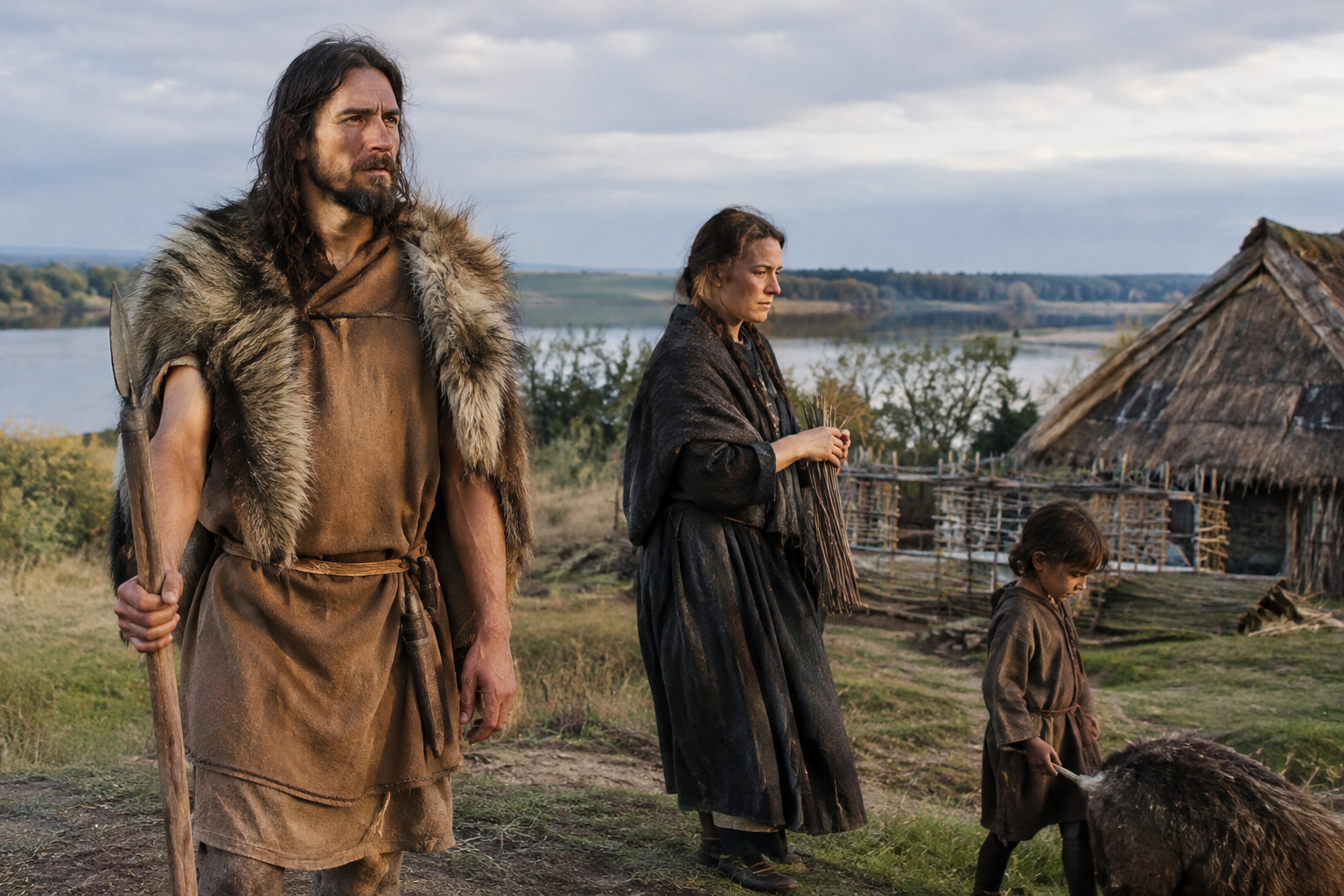
At Komarno in present-day Slovakia, one Iron Age man has become a useful fixed point for a very long paternal story. He is sample I12099, dated to around 575 BC and associated with the Vekerzug cultural horizon of the Carpathian Basin. In MyTrueAncestry terms, he is linked to the Y-DNA haplogroup G2a2b2a1a1b1a1a2a12, an extraordinarily narrow branch that appears here not in a Neolithic farming village, where many people first meet haplogroup G in European prehistory, but in an Iron Age frontier world of movement, exchange, and cultural mixing.
That contrast is the interesting part. Y-DNA traces one direct paternal line only, not a person's whole ancestry, but even so it can be startlingly revealing. A lineage with deep roots in the wider history of early European farmers turns up here in a later setting shaped by steppe contacts, local continuity, and the shifting political geography north of the Danube. Rather than offering a grand fantasy of unbroken tribal identity, I12099 gives us something better: a real man, in a real archaeological landscape, showing how old paternal lines could survive into very different historical worlds.
The Vekerzug culture occupied parts of the eastern and northern Carpathian Basin during the Early Iron Age, especially in what is now Slovakia and Hungary. Archaeologists have long treated it as a contact zone culture, one shaped by interactions among local European communities and influences from the steppe. That matters because Komarno was not some isolated backwater. It sat within a region where goods, people, and ideas moved across wide distances.
Sample I12099 belongs to that setting. With the evidence supplied here, we should not embroider his burial with imaginary horses, weapons, or tribal labels. But even without such detail, the date and place are enough to make him historically vivid. Around the sixth century BC, communities in this region were living between worlds: tied to older Bronze and Iron Age traditions in Central Europe while also participating in networks reaching eastward into the steppe zone.
A large ancient DNA study of Iron Age and later populations in the region, published in Nature, helped sharpen this broader picture by showing that the Carpathian Basin was repeatedly populated by groups of mixed ancestry rather than by any single, simple biological bloc. That is the right backdrop for understanding I12099. His paternal line is precise, but his world was anything but simple.
The wider haplogroup G, and especially branches of G2a, is famous in archaeogenetics because it appears so often among early farmers of Neolithic Europe. That does not mean every later G lineage can simply be read as a surviving "first farmer" population in pure form. Thousands of years separate the Neolithic spread of farming from the Iron Age date of I12099, and countless episodes of admixture, local survival, expansion, and social change lie in between.
Still, the appearance of a very narrow G-derived branch in Iron Age Slovakia is a reminder that paternal histories do not always follow the most visible cultural labels. By the first millennium BC, the Carpathian Basin was home to communities shaped by Urnfield legacies, Hallstatt-period developments, and steppe-facing connections. Yet some male lines in those populations descended from much older layers of European prehistory. That is exactly the sort of continuity that Y-DNA can illuminate when archaeology alone cannot.
The branch name G2a2b2a1a1b1a1a2a12 is much narrower than the parent haplogroup G2a, and caution is needed here. We can discuss the broader history of G2a as context, but we should not pretend that every movement of G2a across prehistoric Europe belongs specifically to this one tiny terminal branch. What I12099 securely offers is evidence that this paternal line, or a lineage reported as associated with it, was present in the Iron Age Carpathian Basin.
Popular accounts of ancient Europe love invasions. They like arrows on maps, dramatic arrivals, and tidy replacement stories. But the Carpathian Basin nearly always resists that sort of simplification. Again and again, archaeology and genetics show a region where newcomers arrived, certainly, yet where older populations also endured and were folded into new cultural arrangements.
That makes I12099 valuable beyond the narrow question of one haplogroup label. He stands for the stubbornness of local ancestry in a landscape usually described through mobility. The Vekerzug horizon is often discussed because of eastern connections, but eastern connection is not the same thing as total eastern replacement. A man buried in that milieu could carry a paternal line with much deeper roots in Europe's prehistoric population history.
This is a useful corrective for family-history enthusiasts. If your paternal line sits under an uncommon G branch, the temptation is to search for a single origin story and cling to it. The ancient evidence suggests a messier, more human reality: old lineages can persist through new languages, new burial customs, new trade networks, and new political identities.
It is worth pausing over the map. To say "Komarno, Slovakia" is necessary for orientation, but of course no one in 575 BC thought in those terms. This was a riverine and frontier zone within the middle Danube world, linked southward into the basin, westward into Central Europe, and eastward toward the steppe. The importance of such places is that they collect histories. People living there often embody older and wider processes than the labels on modern maps suggest.
In that sense, I12099 belongs to a long central European story. The Carpathian Basin had already seen millennia of farming, metallurgy, mobility, and cultural turnover before he lived. By the Iron Age it was a densely historical landscape, though without written local archives to tell us how people named themselves. Genetics cannot supply those missing names. What it can do is reveal that the men and women of the region were not biologically uniform and that some paternal lines had astonishing staying power.
That is one reason Iron Age genomes are so useful: they sit late enough to touch historically recognizable worlds, but early enough to show us populations before Roman imperial organization and long before medieval kingdoms. They let us see continuity and change before later state traditions flattened the picture.
For someone researching G2a2b2a1a1b1a1a2a12, the Komarno sample does not provide a royal pedigree or a neat ethnic badge. It does something more grounded. It places this lineage in the Early Iron Age of the middle Danube, in a Vekerzug-associated context, showing that this paternal branch was part of a population living in one of Europe's great crossroads.
That matters because many people meet haplogroup G through the Neolithic and stop there, as if the story ended with the first farmers. It did not. The evidence from I12099 shows a later chapter: one in which an old paternal line was still present in a culturally mixed Iron Age society. If you carry this branch today, the safest historical lesson is not that you descend from a single famous tribe, but that your direct paternal line belongs to one of those durable threads that survived Europe's repeated reinventions.
So the significance of I12099 is not grandeur but persistence. In an Iron Age community at Komarno, amid the restless history of the Carpathian Basin, this lineage was already old. That is often how paternal ancestry works in the ancient record: not as a banner waving above a people, but as a quiet continuity running through changing worlds.





Comments