Haplogroup G2a2b1b1a
– 5 min read


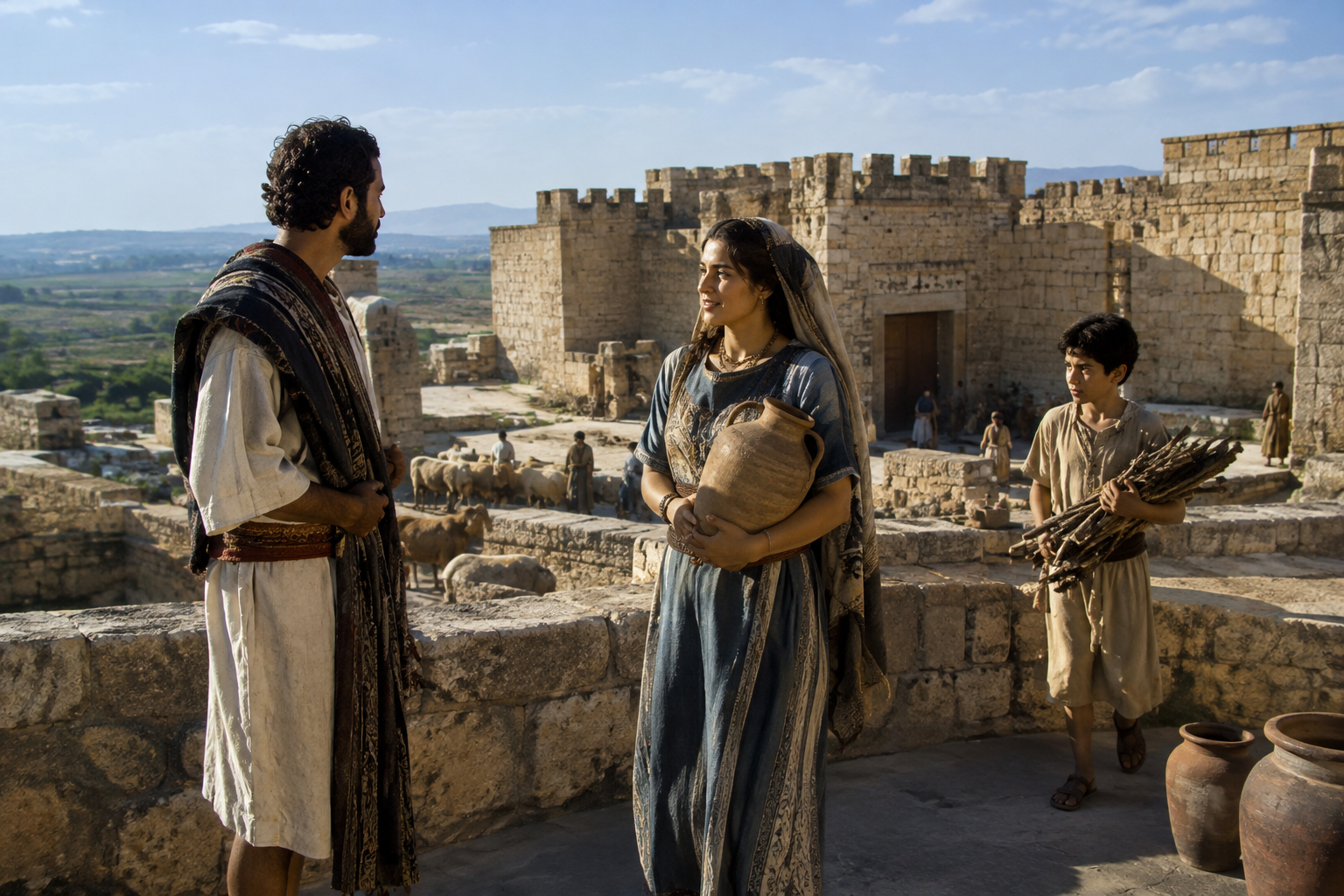
One of the clearest ancient anchors for Y-DNA haplogroup G2a2b1b1a in this set is a man identified as I14785, dated to around 1750 BC and associated with the Yamhad Kingdom in the Kilis region of southeast Anatolia. That is already enough to make him interesting. He lived not in some remote prehistoric village, but in a borderland tied to one of the important Amorite kingdoms of Bronze Age northern Syria and southeast Anatolia, a world of fortified towns, caravan movement, palace politics, and constant contact between regions.
That matters because haplogroups are often discussed far too abstractly. Here, by contrast, we can place a paternal line in a real historical landscape. G2a2b1b1a is a sub-branch within the broader Y-DNA haplogroup G, a lineage long associated in ancient DNA with parts of the Near East, Anatolia, and the spread of early farming into Europe. But a specific branch like G2a2b1b1a is not the same thing as the whole haplogroup. What the Kilis individual gives us is something more precise: a documented Bronze Age example of this paternal line in a region that sat between Anatolia, Syria, and northern Mesopotamia.
The ancient kingdom of Yamhad, centered on Aleppo, was one of the major powers of the Middle Bronze Age in the northern Levant. By around 1750 BC, its influence reached across a patchwork of cities, estates, and agricultural territories that linked inland Syria with routes into Anatolia. Kilis, close to the modern Turkish-Syrian frontier, belonged to exactly this kind of connected zone: politically contested, economically active, and culturally mixed.
So when a man like I14785 turns up in this setting with Y-DNA assigned to G2a2b1b1a, the result fits a broader historical picture of long-established male lines living in the northern Fertile Crescent rather than some neat one-migration tale. Bronze Age states did not emerge over empty ground. They sat on older local populations, drew in newcomers, and folded both into new political systems. A paternal lineage surviving in this landscape may reflect deep regional continuity, local elite integration, ordinary settlement history, or several of these at once.
An ancient DNA study of populations from this wider region, published in Science, helped sharpen that larger picture by showing how interconnected yet locally rooted Bronze Age communities in the Near East could be. Even without forcing I14785 into a grand dynastic narrative, the value of the sample is considerable: it places this branch in a historically literate kingdom at a meaningful moment in Bronze Age state formation.
Anyone researching G2a2b1b1a will quickly notice a problem familiar to archaeogenetics: the deeper parent lineage, haplogroup G, has a much longer and better-known history than many of its narrower branches. Broadly speaking, haplogroup G appears again and again in ancient remains from Anatolia, the Caucasus, Iran, and early farming communities that spread westward into Europe. It is one of those lineages that turns up early and persistently in West Eurasian prehistory.
But that does not mean every branch of G followed the same route or had the same historical career. G2a2b1b1a is one twig on a very large tree. It should not be used as shorthand for all Neolithic farmers, all Anatolians, or all Bronze Age Near Eastern men. The safer point is narrower and stronger: this branch was present in the Bronze Age northern Levant-Anatolian frontier, and that presence fits a region where older agricultural populations, urban polities, and interregional mobility all overlapped.
In other words, if your own paternal line belongs to G2a2b1b1a, the ancient comparison here is not telling you that you descend from Yamhad royalty, or from one named people in the texts, or from one migration episode. It is telling you that this paternal branch has credible roots in the wider Near Eastern world that fed the Bronze Age kingdoms of Syria and Anatolia.
There is also a useful historical lesson in the location itself. Southeast Anatolia is often treated, especially in popular writing, as if it were simply an edge between civilisations. In reality it was one of the places where civilisations were made. Empires and kingdoms met there, certainly, but so did languages, farming systems, trade networks, and family histories. A paternal lineage found in Kilis in around 1750 BC belongs to that busy, entangled world.
This is why archaeologists are wary of turning Y-DNA directly into ethnicity. A Bronze Age man buried in the orbit of Yamhad may have lived under Amorite rule, spoken one language or several, worshipped at local shrines, traded across frontiers, and married into families with different backgrounds. His Y chromosome tracks only one direct male line out of many ancestral lines. Yet even that one line can be revealing when it appears in a place as historically dense as this.
The point, then, is not to flatten I14785 into a label, but to see him properly: as evidence that G2a2b1b1a belonged to the human fabric of a Bronze Age frontier kingdom. That is far more interesting than any simplistic claim about bloodlines and tribes.
The broader haplogroup background does, however, help explain why this branch appearing in Kilis is plausible. Much earlier ancient DNA has shown that haplogroup G was especially important among early farming populations expanding through Anatolia and into Europe. That does not identify the exact path of G2a2b1b1a, but it does place this subclade inside a paternal family with deep Near Eastern and Anatolian antiquity.
By the Bronze Age, the old village worlds of the Neolithic had long since given way to kingdoms, urban institutions, and more complex social hierarchies. Yet the people inhabiting these states were not wholly new. Ancient DNA increasingly suggests that many Bronze Age societies were built from layers of continuity mixed with pulses of movement and exchange. The Kilis evidence suits that pattern rather well: an established West Asian paternal lineage present within a political system that was highly connected to neighboring regions.
That makes G2a2b1b1a historically intriguing in a very specific way. Rather than symbolising a dramatic steppe-style expansion or a famous conquest horizon, it may represent one of the quieter lines that persisted through the making of cities and kingdoms in the Near East. Such lineages are often harder to dramatize, but they are essential to real history, because most of the past was built by continuity as much as by upheaval.
Neolithic Expansion in the Aegean
With only one named ancient individual in this article's evidence set, caution is important. I14785 is a valuable data point, but not a whole population. He does not prove that G2a2b1b1a was dominant in Yamhad territory, nor that all men of the kingdom shared closely related paternal ancestry. Nor can we turn a single Y-DNA result into a map of language, class, or identity.
Still, single samples do matter when they come from good archaeological contexts. They pin a lineage to a time and place. In this case, the time is the Middle Bronze Age, and the place is a crossroads between Anatolia and Syria. That combination gives genealogists something solid: a historically situated example of G2a2b1b1a in a region central to early urban and state development in western Asia.
For readers interested in how genetics and historical identity can align only imperfectly, another useful comparison comes from work on ancient Iranian material, where paternal and maternal lines, burial context, and historical interpretation do not always line up in tidy ways.
The distinctive value of haplogroup G2a2b1b1a here is not grandeur but placement. It appears in I14785, a man from the Kilis region around 1750 BC, inside the orbit of the Yamhad Kingdom. That puts this paternal line in one of the most important contact zones of the Bronze Age Near East, where local continuity and long-distance connection worked side by side.
For someone researching this haplogroup today, that is a meaningful clue. It suggests that at least one branch of your direct paternal heritage was present in the historical landscapes of ancient Anatolia and northern Syria during the age of Bronze Age kingdoms, not merely in vague prehistoric time but in a world we can begin to describe.






Comments