Haplogroup G2a2b1a1a1

– 5 min read


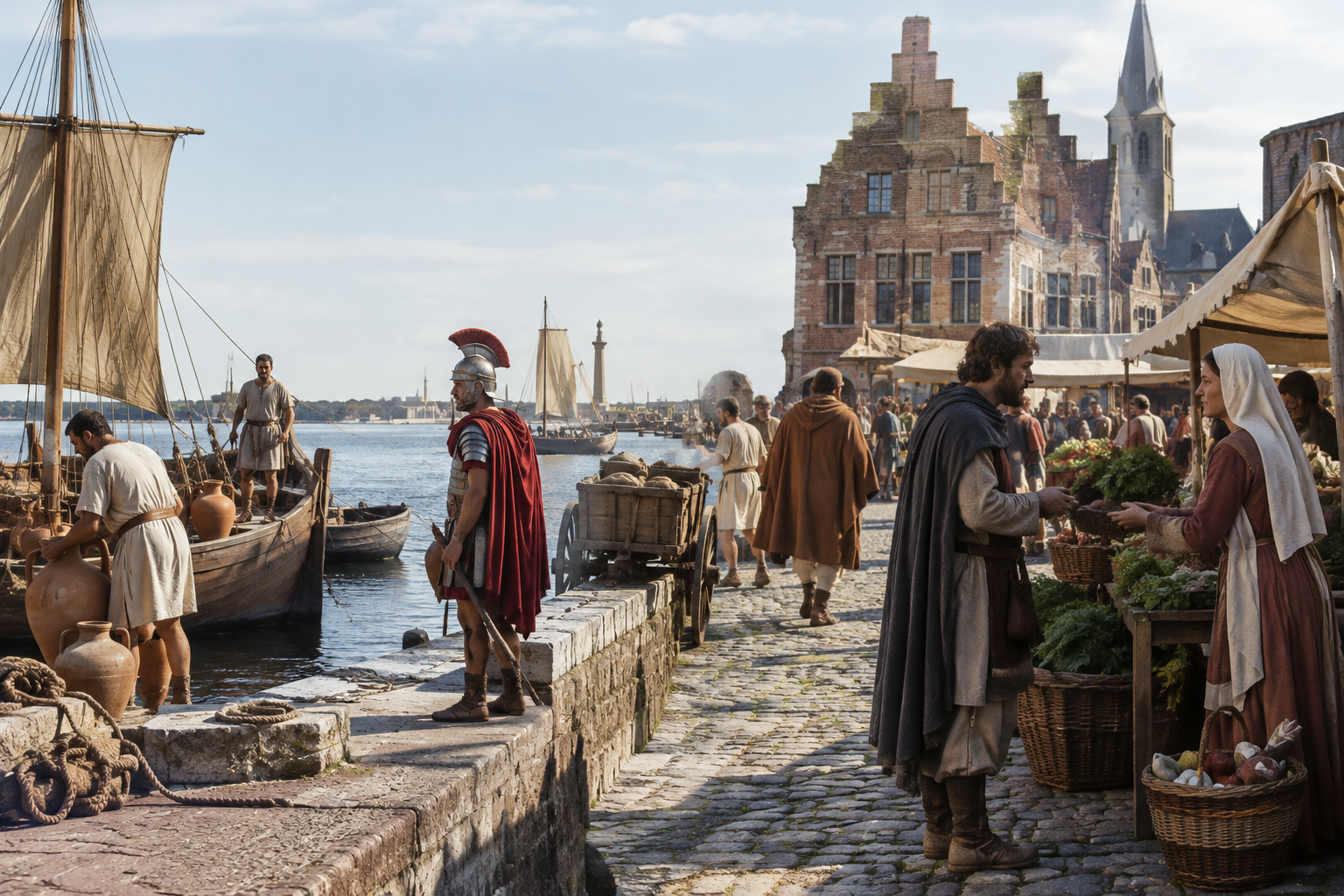
In medieval Sint-Truiden, in what is now Belgium, one excavated individual stands out for a rather modern reason. Sample ST2552, dated to around AD 1090 from the Groenmarkt area, carries the Y-DNA haplogroup G2a2b1a1a1. That may sound like a string of letters and numbers fit only for laboratory spreadsheets, but in archaeological terms it is interesting because it places a distinctly traceable paternal line inside a growing medieval town of the Low Countries.
Sint-Truiden matters because it was not an isolated village cemetery at the edge of Europe. It was an urbanizing religious and commercial centre. So when a paternal lineage like G2a2b1a1a1 turns up there, the question is not simply where one man came from, but how older European male lines persisted, mixed, and reappeared inside towns shaped by trade, lordship, pilgrimage, and everyday mobility.
The medieval burial from Groenmarkt belongs to a broader picture now coming into focus for towns in the central Low Countries. Research on the ancient population of Sint-Truiden has explored how urban communities formed and how genetically mixed - or locally continuous - they could be over time. A recent study on the site can be found here.
What makes ST2552 useful is not that it "proves" a dynasty or a migration all by itself. It does something more modest and more valuable. It shows that the paternal branch G2a2b1a1a1, a sublineage within the broader haplogroup G, was present in a documented medieval urban setting north of the Alps. Y-DNA traces one direct paternal line only, not a person's whole ancestry, but that single line can still tell us how deep-rooted male branches survived into the Middle Ages.
In historical terms, Sint-Truiden sat in a world of abbeys, market exchange, and regional movement between the Meuse basin and neighbouring territories. A lineage found there could represent long local continuity, movement from nearby regions, or the accumulated mixing that made medieval towns what they were. The archaeological importance lies precisely in that ambiguity: the town was connected enough that paternal history need not be purely local, yet stable enough to preserve older regional lines.
If Sint-Truiden gives us a medieval northern European appearance of G2a2b1a1a1, the other two ancient samples pull the story toward the Roman Mediterranean. One is R11112 from Isola Sacra, Ostia Antica Port, dated around AD 200. The other is R131 from Via Paisiello, dated around AD 100. Both belong to Imperial Rome's world, though to rather different urban contexts.
That is worth pausing over. Ostia was Rome's harbour city, the great maritime threshold through which food, goods, and people flowed. Via Paisiello, by contrast, belongs to the metropolitan burial landscape of Rome itself. Finding the same named paternal branch in both settings suggests not a single family saga we can reconstruct, but a lineage present within the very mixed male population of the imperial capital and its port system.
Rome in the first two centuries AD was famously cosmopolitan. Ancient DNA has repeatedly shown that the city and its connected settlements drew people from across Italy and far beyond it. A major study of ancient Rome and central Italy that helped reshape this conversation is available here. Within that vast movement of people, G2a2b1a1a1 appears as one paternal thread among many.
The broader haplogroup G, and especially some of its sub-branches, has deep associations with early farming populations in Europe and western Eurasia. But one must be careful here. That broad prehistoric story belongs to the parent haplogroup and some of its ancient branches; it should not be lazily pasted onto the exact subclade G2a2b1a1a1 without specific evidence.
What the present samples do support is narrower and clearer. They place this paternal branch, or reported association with it, in two quite different historical settings: Imperial Rome and medieval Belgium. That is already enough to make the haplogroup historically vivid. It was not confined to one remote pocket, nor is it appearing here in a purely prehistoric context. Instead, it turns up in lived urban worlds shaped by empire, commerce, religion, and local community.
For someone researching this Y-line today, that combination is telling. It hints at a paternal ancestry that may have participated in long-running European population histories rather than one dramatic, single migration event we can name with confidence.
Among the three samples, R11112 from Isola Sacra is perhaps the most evocative historically, simply because ports concentrate movement. Ostia linked Rome to the wider Mediterranean: North Africa, the eastern provinces, the Tyrrhenian coast, and inland Italy through redistribution networks. A Y-line found there could have arrived by many routes, and that is exactly the point. Roman connectivity did not erase lineages; it redistributed them.
It is tempting, of course, to demand a clean origin story. Was this paternal line "really" Italian, Balkan, Anatolian, or something else? Ancient DNA is often less obliging than that. A port cemetery is a place where ancestry categories blur, not because evidence fails, but because history itself was complicated. Men carrying the same Y-haplogroup could have quite different full ancestries, languages, and life histories.
That complexity makes Ostia particularly useful for understanding G2a2b1a1a1. The lineage was present in an environment where imperial logistics and personal mobility overlapped. That does not make it a "Roman haplogroup" in any exclusive sense; it simply shows that this paternal branch had found a place inside one of antiquity's most connected urban systems.
The leap from first- and second-century Italy to eleventh-century Belgium is large, and no honest historian should pretend we can draw a neat genealogical arrow from R131 or R11112 to ST2552. Yet the repetition matters. It shows that G2a2b1a1a1 was present in western and central European settings across a long span of time, from the Roman imperial age into the high medieval period.
That is often how paternal history works in the archaeological record. We do not get a tidy family tree running across a millennium. We get glimpses: a man in the burial ground of imperial Rome, another at the port of Ostia, another in a medieval town square at Sint-Truiden. The power lies in the pattern. A lineage survives not as legend, but as recurring evidence in real places.
G2a2b1a1a1 is not made interesting by royal glamour or by claims of belonging to a single famous people. It is interesting because the ancient evidence places it in two of history's most revealing social environments: the mixed population of Imperial Rome and the developing urban world of medieval northwestern Europe.
For family historians, that means this is a paternal line with documentary-era visibility in settings shaped by movement and continuity at once. It may connect you, in a strictly paternal sense, to men living in the Roman world and to later medieval townsmen of the Low Countries - not as proof of direct descent from any named ancient individual, but as evidence that your Y-line belonged to the long human traffic of European history.
So the real value of haplogroup G2a2b1a1a1 is not that it offers a single grand origin myth. It offers something better: a grounded archaeological record of persistence across very different worlds, from imperial cemeteries near Rome to a medieval market town in Belgium. That is often how the past survives in DNA - fragmentary, specific, and all the more convincing for being real.






Comments