Haplogroup G2a1a1a1a1a1

– 5 min read


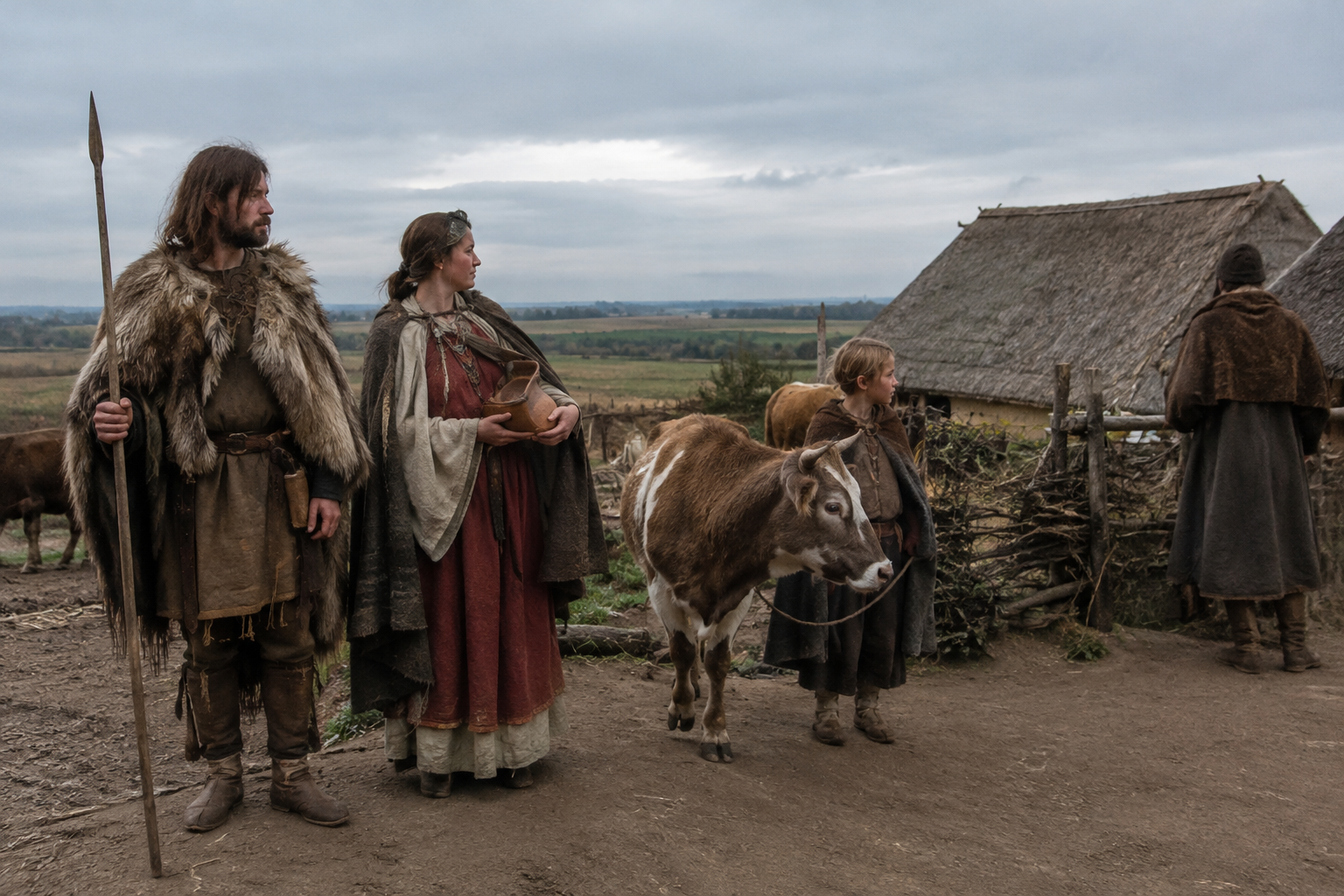
At Hajdúnánás-Fürj-halom-dűlő in Hungary, one man from around AD 400 stands out because his Y-DNA has been associated with the branch G2a1a1a1a1a1. He is recorded as sample A181025, dated to the Gepidic era. That is already enough to make him interesting. The Gepid world sat in the restless zone between the late Roman frontier, the fading power of the Huns, and the new political formations that would reshape the Carpathian Basin in the 5th and 6th centuries.
There is a temptation, when a haplogroup turns up in a burial from the Migration Period, to start drawing huge arrows across the map. Better to slow down. What this sample gives us is something more valuable than a dramatic slogan: a fixed point. It shows that a paternal line classified here as G2a1a1a1a1a1, or very close to it in reporting, was present in an early post-Roman community in eastern Hungary. For anyone exploring this lineage today, that is not the whole story of the branch, but it is a real ancient appearance in a historically important setting.
The site name alone places us in the Great Hungarian Plain, a landscape that was anything but empty in late antiquity. This was a corridor of movement, alliance, warfare, and settlement. By the early 5th century, the old Roman order nearby had weakened, but communities did not simply vanish. They reorganized, adapted, and in many cases absorbed newcomers.
Sample A181025 belongs to what is described as the Gepidic era. That label matters historically, but it should be handled carefully. A burial in a Gepidic-period cemetery does not mean Y-DNA can tell us whether someone "was Gepid" in the way a late antique chronicler might have meant it. Y-DNA follows one direct paternal line only. Still, the archaeological context tells us that this man lived in a world associated with the peoples who came to dominate parts of the Carpathian Basin after the collapse of Hunnic power.
An ancient DNA study examining post-Roman communities in this region, published in Cell, helped show just how mixed and historically layered these populations could be. That wider finding is important here. A181025 should not be read as a lonely ethnic marker, but as one strand in a society formed by mobility, local continuity, and new political identities.
The broader haplogroup G is one of the old and well-traveled Y-chromosome lineages of western Eurasia. It appears in ancient DNA from very different times and places, including early farming contexts and later historic populations. But that broad history should not simply be poured into the much narrower vessel of G2a1a1a1a1a1. A deep subclade is not a synonym for its parent branch.
So what can we safely say? First, this is a highly specific paternal signature, the sort of designation that matters because it can distinguish one male line from many others hidden under the umbrella of haplogroup G. Second, with the evidence provided here, the firm archaeological anchor is A181025 in Gepidic-era Hungary. That is useful because it places this lineage, or a reported assignment to it, in the social churn of the 5th-century Carpathian world rather than in a neat, single-origin legend.
In other words, if you carry G2a1a1a1a1a1 today, this ancient match does not turn you into a Gepid, nor does it map your entire ancestry. But it does place your direct paternal line in conversation with a documented man from a frontier zone where Roman, post-Roman, and steppe-linked histories overlapped.
The Gepids are familiar from late Roman and early medieval texts, usually as one of the major groups active in the Middle Danube after the Hunnic empire fractured. Archaeology, though, tends to be messier than the written labels. Cemeteries from this period often preserve a mixture of local traditions and outside influences, and genetics has increasingly shown that communities linked with "Gothic," "Gepidic," or other Migration Period names were rarely biologically uniform.
That is precisely why A181025 matters. A lineage like G2a1a1a1a1a1 appearing in this setting reminds us that Migration Period groups were not simple tribes marching about with sealed biological identities. They were confederations, client networks, households, and communities created under pressure. Men with different paternal backgrounds could find themselves buried within the same cultural horizon.
This fits a broader pattern seen in work on Germanic-language expansion and post-Roman mobility: language, material culture, political allegiance, and paternal ancestry do not always line up neatly. The old habit of treating archaeology as a set of tidy ethnic boxes has taken a real pounding from ancient DNA, and rightly so.
Eastern Hungary is not just a backdrop here. It is one of the classic contact zones of European history. Over many centuries, the Carpathian Basin connected the Balkans, the north Pontic region, central Europe, and the steppe. That makes it exactly the sort of place where a rare-looking paternal lineage may surface in an unexpected historical context.
By the time of A181025, the region had already seen Roman influence, Sarmatian presence, Hunnic domination, and then the rise of successor powers including the Gepids. Later still it would be folded into Avar and then Hungarian political worlds. A single Y-line found there can therefore tell us something important even when it tells us only a little: the paternal history of Europe was repeatedly layered, not replaced in one clean sweep.
This is one reason the Carpathian Basin keeps turning up in archaeogenetics. It is a place where continuity and disruption sit side by side. Some lineages disappear from view; others persist through changing archaeological cultures; still others arrive, settle, and are absorbed into new populations. G2a1a1a1a1a1, as represented by A181025, belongs to that complicated historical theatre.
With sparse evidence, good history depends on proportion. We do not have a grand series of ancient G2a1a1a1a1a1 burials spread across centuries in the material provided here. We have one clearly named ancient individual: A181025 from Hajdúnánás-Fürj-halom-dűlő, around AD 400, in a Gepidic-era context. That may sound modest, but in ancient DNA modesty is often where the real value lies.
Because this man is fixed to a place and period, he gives the haplogroup historical texture. He shows that the lineage was present in a community living through the political disintegration of Roman power and the remaking of central Europe. That is a better kind of evidence than vague claims about timeless origins.
It also helps frame the haplogroup in the right way. Not as a badge of a single people, but as a paternal thread passing through a world of mixed ancestries and shifting identities. In that sense, A181025 is not merely a datapoint. He is evidence that one branch of haplogroup G was woven into the human reality of the Migration Period plain.
If your direct paternal line falls under G2a1a1a1a1a1, the strongest insight here is not a claim to royal descent or a romantic tribal identity. It is the more solid and more interesting fact that this lineage has a documented ancient appearance in Gepidic-era Hungary, in the unsettled centuries after Rome's power receded from the region. That places your Y-line within a real archaeological landscape shaped by migration, survival, and political reinvention.
And perhaps that is the proper lesson of A181025. The past was not tidy, and neither are lineages. A haplogroup can survive across very different worlds, carried by men whose languages, loyalties, and communities changed long before their Y-chromosome label ever existed.






Comments