Haplogroup G2

– 5 min read


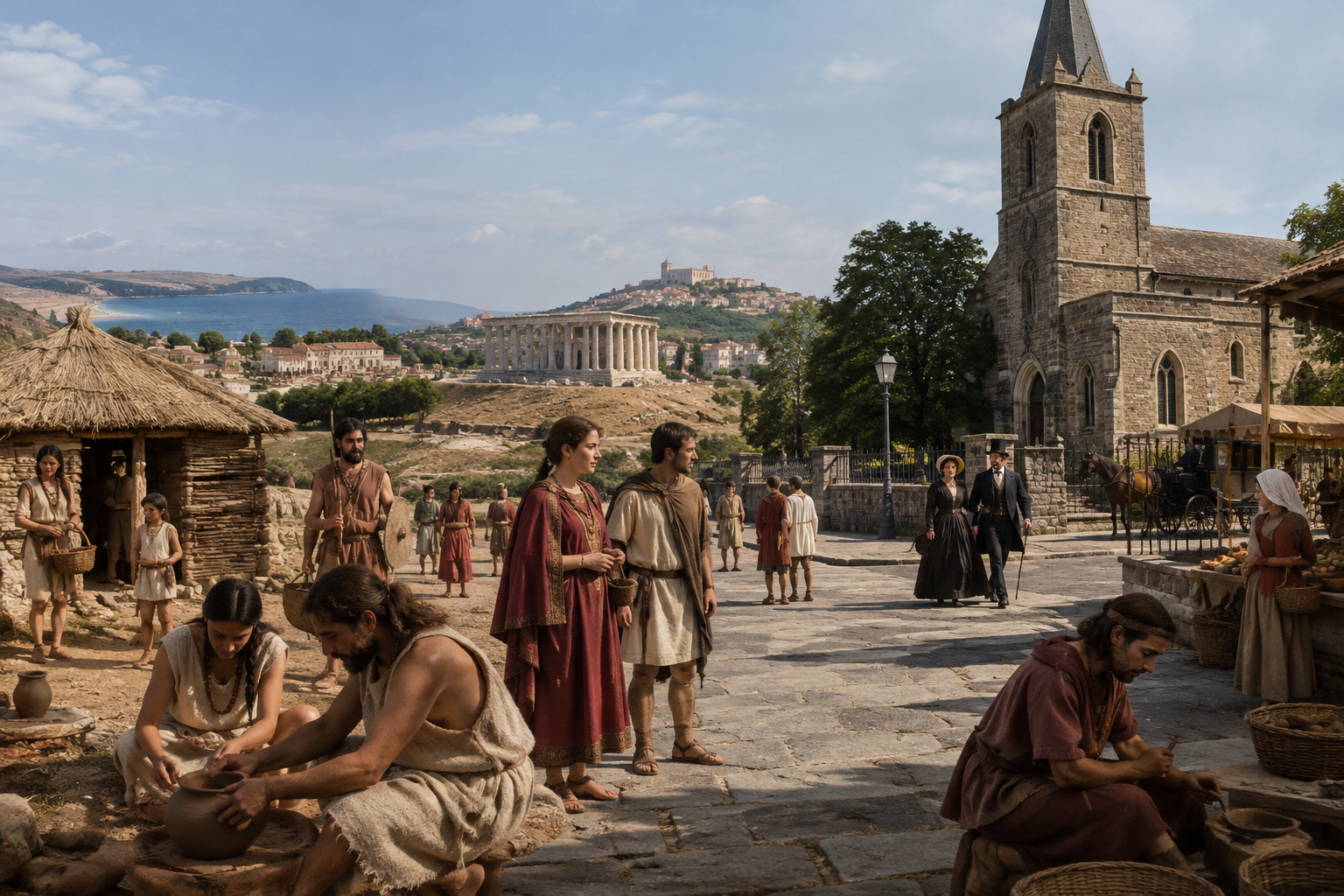
At Catalhoyuk in central Anatolia, one of the best known Neolithic settlements in the world, ancient DNA has now put a paternal label on at least one man from that deep farming past: sample cch097, dated here to around 5200 BC, is associated with Y-DNA haplogroup G2. That matters because Catalhoyuk is not just any prehistoric site. It stands near the heartland of the early farming world, where dense village life, house-based communities, and long-settled agricultural traditions were already well established.
For people researching haplogroup G2, this is exactly the kind of evidence that gives the lineage historical weight. G2 is a Y-chromosome branch, so it tracks one direct paternal line rather than a person's whole ancestry. Even so, the appearance of G2 in Neolithic Anatolia, and then again in early European farming contexts and much later historical burials, helps show why this haplogroup keeps turning up in discussions of the spread and persistence of early farmer lineages across Europe and the eastern Mediterranean.
Catalhoyuk has long occupied a special place in archaeology because it offers a sustained picture of settled life in prehistoric Anatolia: packed mudbrick houses, repeated rebuilding, and communities living for generations in the same place. To find G2 there in sample cch097 is not some decorative extra. It links this haplogroup to one of the great Neolithic population zones from which farming lifeways spread westward.
We should be careful, though, about what that means. One male lineage at one site does not define all Catalhoyuk men, still less all Anatolian farmers. But G2 has repeatedly been associated with early farming populations in western Eurasia, and Catalhoyuk provides an excellent archaeological setting for understanding why. Research on Neolithic and post-Neolithic genomes in the region has helped underline Anatolia's importance in the population history of early farmers, including the westward movements that transformed Europe after the Mesolithic; one broad genetic study of ancient populations in this sphere can be found here.
Another Anatolian appearance in the supplied evidence comes from IKI006 at Ikiztepe on the Black Sea coast, dated to around 3300 BC. That is a very different setting from Catalhoyuk: later in time, in another region, and part of a wider Anatolian world already changing through the Chalcolithic and Bronze Age transition. Even without forcing a direct line of descent between the two men, the recurrence of G2 in both central and northern Anatolia suggests durability as well as depth.
If Catalhoyuk gives us the older Anatolian background, FO130 from Fellbach-Oeffingen in Baden-Wuerttemberg, dated here to about 5100 BC and identified with the LBK horizon, places G2 in one of the classic archaeological contexts for Europe's first farmers. The Linearbandkeramik culture was part of the early agricultural expansion into central Europe, with villages, crop cultivation, and stock-keeping appearing in landscapes previously occupied by hunter-gatherers.
This is where G2 becomes historically vivid. In public discussions of ancient DNA, people often want a single dramatic migration. Real history is messier. What the presence of G2 in both Neolithic Anatolia and LBK Germany suggests is not a cartoon arrow across the map, but a chain of communities, marriages, movements, and settlements through which some paternal lines endured while others disappeared.
FO130 is valuable precisely because it anchors the haplogroup in an archaeological culture that has been central to debates about how farming spread into Europe. It does not mean every LBK man was G2, nor that later Europeans with G2 descend from this exact individual. But it does place the haplogroup squarely inside the first great farming expansion north of the Alps.
The Iberian evidence in this set is especially useful because it comes from more than one period. I0825, from north-east Iberia, Barcelona, Paris Street, is dated to around 2346 BC. By then, the social and genetic landscape of western Europe had already become more complicated than the earliest farming phase. Steppe-related ancestry had entered many parts of Europe, old Neolithic populations had mixed with newcomers in different ways, and local histories were diverging sharply from region to region.
So a G2-associated male in Bronze Age north-eastern Spain is a reminder that early farmer paternal lines did not simply vanish when later population shifts arrived. Some survived, sometimes in reduced proportions, sometimes in very local pockets, and sometimes within communities that were already genetically mixed in ways invisible to older archaeology. Iberia is particularly important here because it preserves both strong evidence for prehistoric change and strong evidence for regional continuity.
That longer Iberian background helps make sense of a later case too: I23163, a man from Visigothic Spain at Malaga Estepona Arroyo Vaquero, dated here to 558 AD. It would be quite wrong to call him simply "Visigothic" in a biological sense because that label is political and archaeological, not genetic shorthand. But his presence shows G2 still turning up in post-Roman Iberia, in a world shaped by Roman rule, migration-period movements, and local survivals. A study-focused introduction to these long Iberian developments appears in this research on Roman and post-Roman Iberia.
Roman Hispania's Genetic Legacy
Another revealing sample is GYS016 from Arrabona, Szechenyi Square, Hungary, dated to around 425 AD in Late Antique Pannonia. This is a fascinating historical zone: a former Roman frontier region where imperial administration, local provincial populations, soldiers, migrants, and post-Roman powers overlapped uneasily. If Neolithic evidence shows the deep roots of G2, Pannonia shows how such old paternal lines could persist into periods usually narrated in terms of dramatic invasions.
Late Antique cemeteries in the middle Danube often reveal precisely that sort of complexity. One grave does not identify a people; one Y-line does not define a kingdom. But GYS016 demonstrates that G2 was present in the human mix of post-Roman central Europe, not just in the early farming horizon from which it is most famously known.
That matters because public imagination tends to divide the past into tidy boxes: Neolithic farmers, Romans, Goths, Huns, medieval Europeans. Ancient DNA keeps interrupting this habit. The same broad paternal lineage can appear in very different historical settings, not because history stood still, but because lineages travel through changing languages, loyalties, and social worlds.
The latest sample in this set, ATP_PSN_411 from Trinity Church, England, dated 1844 AD, is a useful reminder that haplogroups are not trapped in prehistory. By the modern period, a G2 paternal line could appear in an ordinary English burial context, far removed from the first farmers of Anatolia in time, culture, and social setting. Yet the direct paternal thread still exists.
That is perhaps the most interesting thing about G2 in this collection. It is not merely ancient, nor merely regional. It appears here in a chain of settings that includes Neolithic Anatolia, early farming Germany, Bronze Age Iberia, Late Antique Hungary, Visigothic Spain, and modern England. The individuals are not one people in any simple sense. They are evidence that a paternal line can survive immense historical change while the societies around it are repeatedly remade.
On the evidence here, haplogroup G2 is best understood as a lineage with deep roots in the world of early farming, especially in Anatolia and the Neolithic expansions that followed, but with a history that did not end there. It persisted into later European populations and appears in Roman, post-Roman, and much more recent contexts. If G2 is part of your paternal ancestry, the strongest supported story is not a single tribe or dynasty, but a line that was already present in some of the earliest farming communities we can test and that continued, sometimes quietly, through thousands of years of upheaval.






Comments