Haplogroup G1a1a
– 5 min read


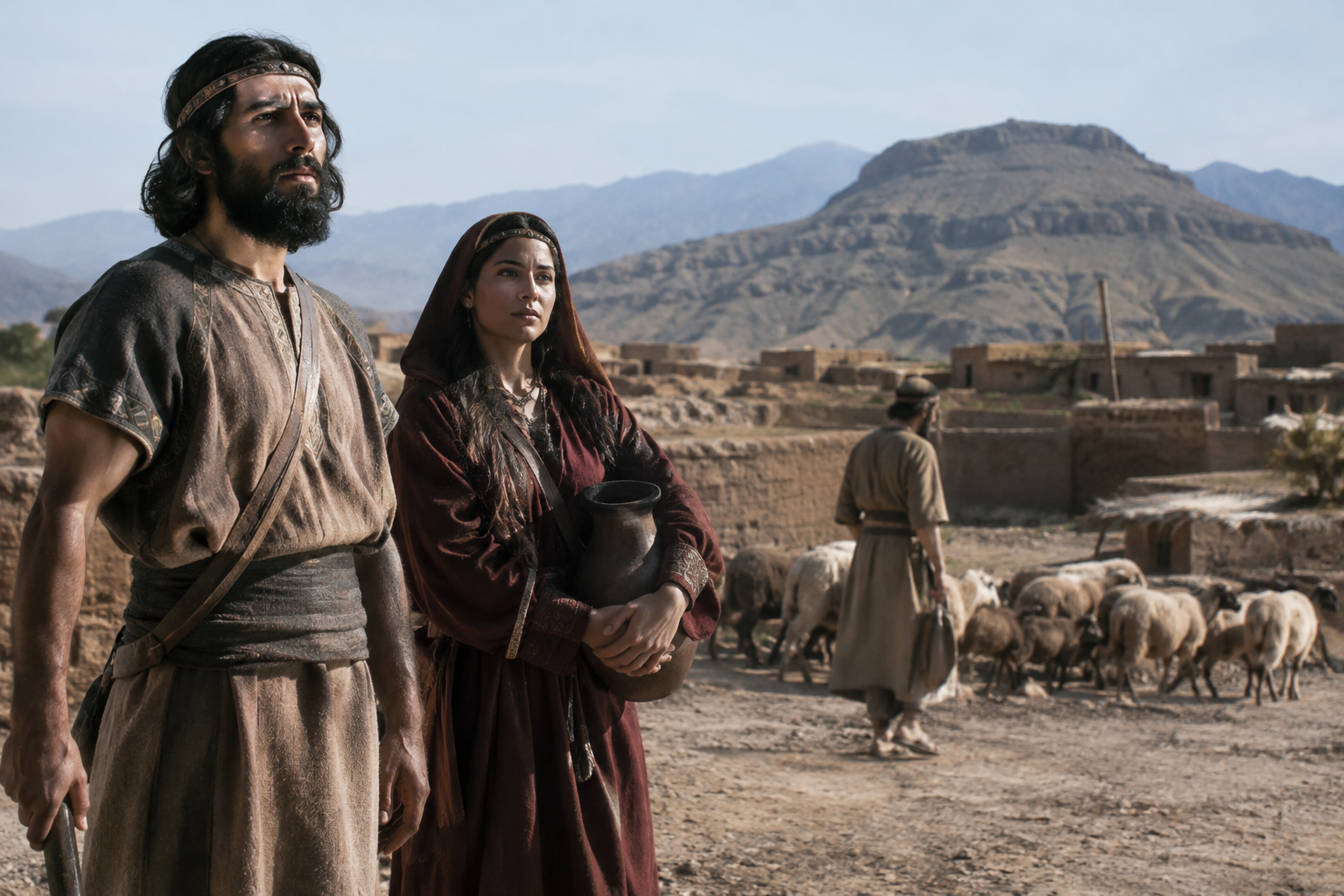
At Dinkha Tepe, near the great archaeological landscapes of northwestern Iran, one ancient male identified as I3912 offers a rare and useful anchor point for the Y-DNA haplogroup G1a1a. He is dated here to around 1836 BC, in the broader world of the Bronze Age into the early horizon of later Iranian societies. That matters because G1a1a is not one of the loud, over-represented paternal lines of popular ancient DNA storytelling. It appears instead in quieter, more regionally informative ways.
That quietness is precisely the point. A Y-DNA haplogroup traces one direct paternal line only, not a person's whole ancestry, language, or identity. But when a branch like G1a1a turns up in an ancient individual from Iranian Azerbaijan, it helps pin a paternal history to a real place, a real burial population, and a real archaeological setting rather than to modern speculation.
Dinkha Tepe sits in a region that has long been a corridor rather than a cul-de-sac: the highland zone linking the Iranian plateau, the Zagros, the South Caucasus, and routes stretching toward northern Mesopotamia. That is one reason ancient DNA from this area is so valuable. It gives us a way to examine continuity and movement without collapsing every change into a single migration story.
The individual I3912 is associated here with Iron Age Iran in the Hasanlu cultural sphere, although the date supplied, around 1836 BC, falls much earlier than the classical Iron Age. That kind of tension in labeling is exactly why caution matters in archaeogenetics. The safest reading is that this is an ancient male from the Dinkha Tepe sequence in northwestern Iran, and that his reported paternal line is relevant to G1a1a or its immediate ancestry. We should resist turning one sample into a tribal badge or a neat ethnic label.
A broader ancient DNA study of populations from the region, published in Science, helped frame how long-term population history in Iran and neighboring zones included both continuity and periodic admixture. That is the right scale at which to think about a lineage like G1a1a: not as a banner for one people, but as one paternal thread surviving through changing archaeological cultures.
Haplogroup G is an old West Eurasian Y-chromosome lineage with a long and complicated history. Yet the branch G1a1a is not the same thing as haplogroup G as a whole. That distinction is easy to blur in online genealogy, where parent branches often attract grand claims borrowed from much wider and older lineages.
For this article, the defensible point is narrower. G1a1a belongs to a paternal family tree that has meaningful roots in parts of Inner and Western Asia, and the Dinkha Tepe individual shows that this branch, or a very close reported association with it, was present in ancient northwestern Iran. That does not make every later bearer of G1a1a "Iranian" in a simple sense, and it does not mean the branch originated at Dinkha Tepe. It means that ancient Iran is one of the real places where the lineage enters the archaeological record in a concrete way.
This is often where the archaeology is more helpful than mythology. The northern Iranian plateau was home to communities shaped by farming, herding, exchange, local political change, and contact with neighboring regions. Paternal lines moved through all of that. Some expanded, some dwindled, and some lingered in scattered pockets. G1a1a looks very much like one of those quieter survivors whose history is best reconstructed sample by sample.
Northwestern Iran is one of those regions that historians and archaeologists have always known was important, but ancient DNA has made that importance easier to measure. It is a meeting ground: upland and lowland, plateau and frontier, local continuity and outside contact. Sites in this zone can reflect influences from the Caucasus, Mesopotamia, and the Iranian interior without being reducible to any one of them.
That makes a sample like I3912 valuable beyond its single paternal line. Even one Y-chromosome result can remind us that ancient populations in Iran were not genetically uniform and were certainly not frozen in place. The paternal landscape, like the cultural one, was varied. Some lineages familiar from steppe discussions appear elsewhere; others, including branches within haplogroup G, speak more strongly to older and regionally grounded histories.
If you want a wider look at how ancient genomes complicate easy ideas about Iranian ancestry, MyTrueAncestry has also covered related work on long-term regional history.
One of the pleasures, and frustrations, of ancient history is that site names, period labels, and political identities do not always line up neatly. Dinkha Tepe is often discussed within the archaeological orbit of nearby Hasanlu, one of the best-known sites in the region. But archaeological phases, database tags, and genetic sample summaries can compress long sequences into shorthand that looks more precise than it really is.
So when reading I3912, it is better to think like an archaeologist than like a collector of labels. The important thing is not to force the man into a ready-made story of Medes, Persians, or any later historically named group. The important thing is that his paternal line helps document the diversity present in ancient communities of northwestern Iran well before the classical empires that dominate popular memory.
That is also a useful corrective to the old habit of treating the ancient Near East as if it were genetically explained by imperial history alone. Long before the great imperial capitals, there were already deeply rooted local populations in the Iranian world, connected to one another in complicated ways. G1a1a, in this context, is less a conquering signature than a surviving local strand within that complexity.
Because G1a1a is comparatively uncommon in broad popular discussions, it is tempting to over-interpret every appearance. Better to do the opposite. Its presence in ancient Iran suggests that some paternal branches now perceived as rare or geographically patchy may once have been better established in the highland zones between West and Central Asia.
That matters historically because northwestern Iran was never isolated. Goods, people, and ideas moved through it for millennia. Some of those movements were dramatic; many were ordinary and cumulative. A paternal lineage can persist through both sorts of history. The man at Dinkha Tepe does not prove a grand migration route by himself, but he does place G1a1a in one of Eurasia's most important contact regions at a very early date.
And that broader contact-zone perspective is often where MyTrueAncestry readers gain the most from a haplogroup article. A lineage is not a passport to one ancient nation. It is a clue about where one direct paternal thread can be securely observed. In the case of G1a1a, one of those observations comes from the northwestern Iranian world, where archaeology and genetics alike show layered histories rather than simple replacements.
If your paternal line belongs to G1a1a, the most responsible historical takeaway is not a claim to one dynasty or one named ancient people. It is something subtler, and in many ways more interesting: your direct male line belongs to a branch that appears in the archaeological record of ancient Iran, in a region that sat at the meeting point of major cultural worlds. The sample I3912 from Dinkha Tepe is a small but solid reminder that these quieter haplogroups can preserve deep regional histories that the big imperial narratives often miss.
Comments