Haplogroup G1a
– 5 min read


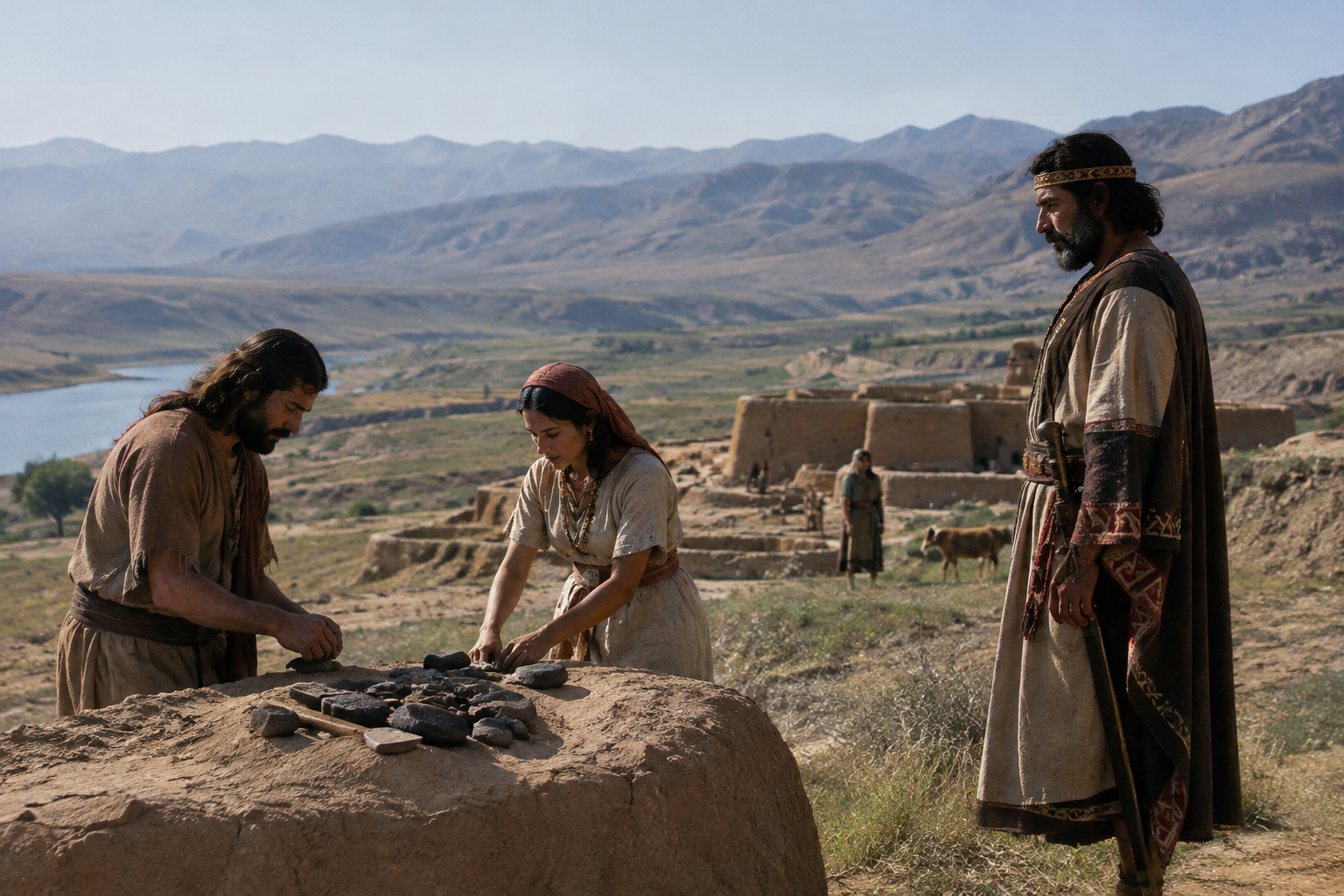
At Dinkha Tepe in northwestern Iran, one ancient male sample stands out for anyone interested in Y-DNA haplogroup G1a. Sample I3915, dated to around 920 BC in the Hasanlu period, places this paternal line in the Iron Age world of the Iranian plateau, in a region that sat between highland Iran, the Caucasus, and the Mesopotamian sphere. That matters because G1a is not one of the loudest lineages in popular discussions of ancient DNA, yet here it appears in exactly the sort of crossroads zone where long-term population continuity and movement often overlapped.
A second clue comes from much earlier and slightly to the north: ALX002 from ancient Alkhantepe in Azerbaijan, dated to around 3720 BC. With only two ancient sample points, caution is essential. But together they give G1a a strikingly eastern Near Eastern and southern Caucasus setting, spanning from the Chalcolithic or early Bronze Age horizon into the Iron Age. For a paternal lineage article, that is already a real story: not a grand empire, not a celebrity king, but a durable male line showing up in places that were crucial to the making of western Asia.
Y-DNA traces one narrow line of descent: father to son to son across generations. It is therefore powerful for tracking a particular paternal branch, but it is not the same thing as a person's whole ancestry, language, or identity. Someone carrying G1a in Iron Age Iran could have had a genome shaped by many older and neighboring populations, just as a modern tester with G1a may have family roots that are culturally and geographically much broader than the paternal line alone.
That distinction matters especially for haplogroup G. The wider haplogroup has a deep history across parts of western Eurasia, but this article is about G1a, a narrower branch. The safest reading of the present evidence is not that G1a explains everything about ancient Iran or the Caucasus, but that it had a place there across a long stretch of time.
Dinkha Tepe belongs to the wider archaeological world of Hasanlu, one of the best-known Iron Age cultural settings in northwestern Iran. This was a landscape of fortified settlements, agricultural communities, exchange routes, and shifting political powers. Sample I3915, assigned here to G1a, anchors the lineage in that historical environment rather than in abstract phylogenetic charts.
That is useful for two reasons. First, northwestern Iran was never an isolated pocket. It was connected westward toward Assyria and eastward into the Iranian plateau, while also maintaining links to the South Caucasus. Second, Iron Age communities in this region often preserve evidence of both local continuity and broader contact, making any Y-chromosome finding there potentially relevant to larger discussions of how male lines persisted through periods of political change.
A broad ancient DNA framework for the region was explored in research on southwestern and southern Central Asia published in Science, which helped clarify how varied and long-lived the population history of this wider zone could be. That does not turn one man from Dinkha Tepe into a spokesman for the whole plateau, but it does place him in a region where genetic continuity and mixture both mattered.
The earlier sample, ALX002, from Alkhantepe in Azerbaijan around 3720 BC, is valuable precisely because it is earlier. It suggests that whatever local branch or cluster carried G1a in this part of the world was not simply an Iron Age arrival. Instead, the lineage was present in the broader southern Caucasus-Araxes frontier long before the first millennium BC.
Alkhantepe sits in a region that archaeologists treat as a meeting ground rather than a border in the modern sense. Communities here participated in networks that linked the Caucasus with the Iranian plateau and, at times, with eastern Anatolia and northern Mesopotamia. A G1a-bearing male in that setting hints at a paternal history rooted in these interaction zones.
One of the most useful things about an early sample like ALX002 is that it stops us telling overly neat stories. It becomes harder to imagine G1a as belonging to one single historic people, one migration episode, or one language family. The evidence instead points toward a lineage present in complex local populations well before many later ethnic names appear in written history.
Ancient DNA articles often tempt us into chasing the dramatic first appearance of a lineage. But with G1a, the more interesting point may be persistence across time in an interconnected region. Alkhantepe in the fourth millennium BC and Dinkha Tepe in the Iron Age are not the same site, not the same culture, and not proof of direct descent from one excavated individual to the other. Yet the pairing does suggest that this paternal branch belonged to the human background of the southern Caucasus and northwestern Iranian world for a very long time.
That kind of pattern is historically important. Western Asia was not shaped only by sudden invasions or elite replacements. It was also shaped by local communities who endured, adapted, intermarried, traded, and absorbed newcomers. A lineage such as G1a may therefore be one of the quieter signatures of continuity in a region more often described through imperial events.
Research on ancient populations across Inner Eurasia, published in Cell, helped show how genetic landscapes across steppe, oasis, and adjacent settled regions were structured by repeated episodes of contact rather than a single simple expansion. That wider lesson fits the cautious reading of G1a here: a branch present in places where worlds met.
South Caucasus Genomic History
There is a strong temptation to leap from ancient DNA to named peoples: Medes, Persians, Hurrians, Scythians, or later Caucasian groups. The evidence here does not allow that. I3915 lived in the Hasanlu-period world of Iron Age Iran; ALX002 lived much earlier in ancient Azerbaijan. Those are secure archaeological and geographic descriptions. Anything more specific would need separate evidence from archaeology, texts, and broader genetic context.
Still, the regional context is worth stressing. Northwestern Iran and the southern Caucasus formed one of Eurasia's great hinge zones. Metal, animals, crops, styles, and people moved through it for millennia. A paternal lineage turning up there in different periods is not accidental trivia. It is a reminder that some Y-lines were woven into these local societies long before later states and ethnic histories took shape.
If your direct paternal line falls within G1a, these ancient samples offer something modest but meaningful. They place the branch in real archaeological settings in Azerbaijan around 3720 BC and northwestern Iran around 920 BC, showing that G1a was present in the wider southern Caucasus-Iranian world across a very long span of prehistory and history. That does not prove a modern family's exact homeland, still less descent from any single excavated man, but it does give the haplogroup a grounded ancient context: one tied to frontier zones, long continuity, and the dense human history of western Asia.






Comments