Haplogroup E2b

– 4 min read


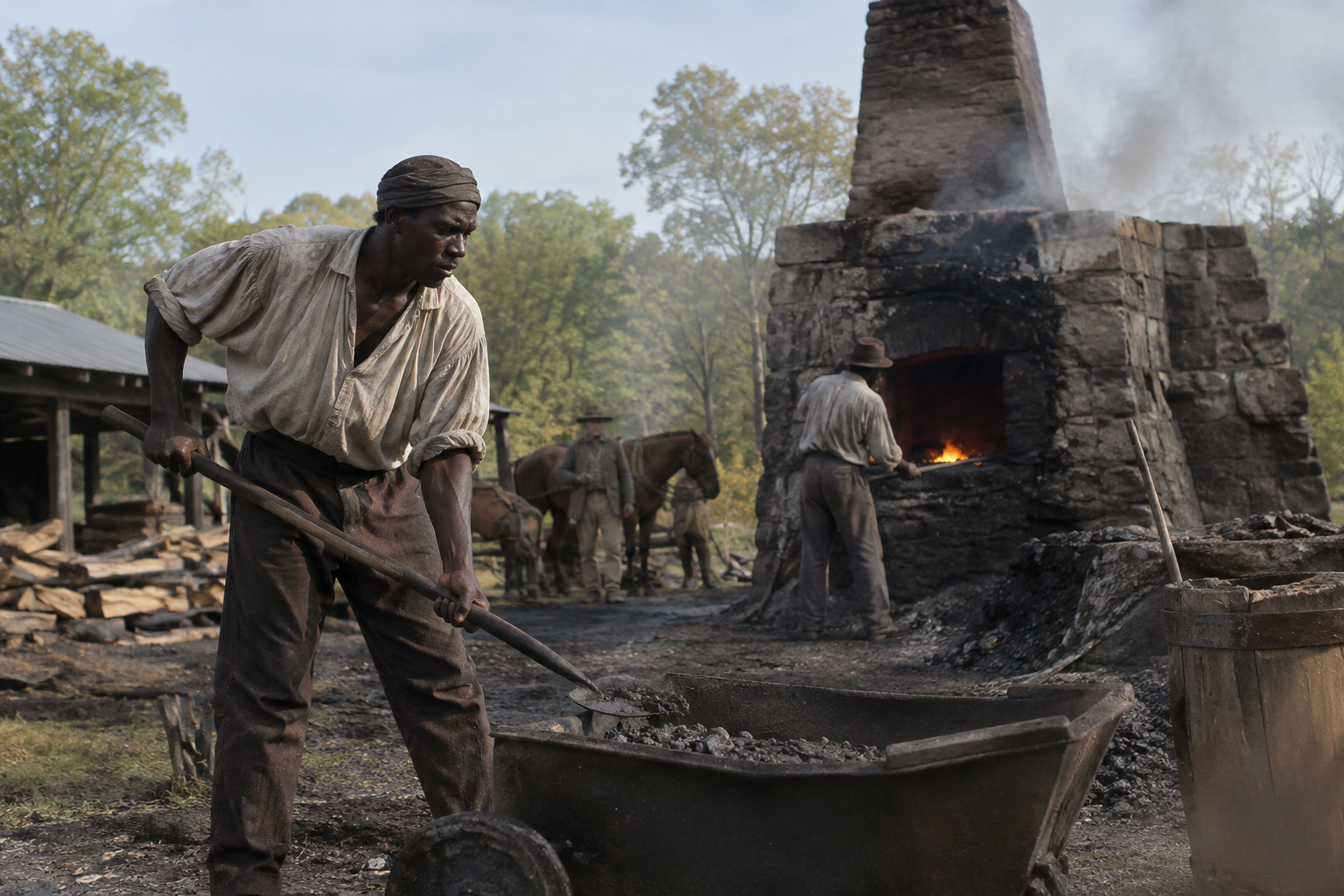
One of the most arresting recent Y-DNA matches for haplogroup E2b does not come from a pharaoh, a warlord, or a medieval prince. It comes from I8090, an enslaved laborer associated with the Catoctin iron-working furnace in antebellum Maryland, dated around 1810 AD. That alone tells us something important. A paternal lineage can survive not only across continents, but across systems of coercion, displacement, and forced labor, leaving behind a trace that is at once biological and historical.
In this case, the haplogroup is E2b, a branch within the wider E haplogroup family. Y-DNA follows a direct paternal line, so it does not describe a person's whole ancestry or identity. But when a lineage like E2b appears in an excavated individual from the early United States, it opens a very specific historical question: how do we place that paternal line within the longer movements of African and African-descended men in the Atlantic world?
The Catoctin Furnace site in Maryland has become one of the most important archaeological landscapes for studying early American industry and slavery together. The workers there were part of an iron-producing enterprise that depended heavily on enslaved labor. Ancient DNA from burials associated with that community has begun to restore individual histories that written records often blurred, minimized, or erased.
Sample I8090 matters precisely because he was not buried in a celebrated royal mausoleum. He was part of the laboring population that made industrial wealth possible. A genetic study connected with these remains, available as research on the Catoctin Furnace community, helped show how archaeology and genomics can recover ancestry, kinship, and origins from a setting shaped by enslavement.
For readers with E2b, that is a more sober and more historically useful point than any grand tale of conquest. This branch appears here in a man living in the early nineteenth-century Chesapeake world, where African-descended communities were formed through the violence of the transatlantic slave trade, local slave markets, and generations of life under bondage in North America.
DNA and the Industrial Revolution
E2b is not a shorthand for a single people, kingdom, or language. It is a paternal branch within the wider E haplogroup complex, a family of lineages strongly associated with Africa in deep time. That wider background matters, but it should not be lazily collapsed into claims about one exact sub-branch. Without a securely published terminal subclade for I8090 beyond the article's assigned branch, the careful thing is to stay with E2b and not pretend to more precision than the evidence allows.
That restraint is not a weakness. It is how archaeogenetics stays useful. A Y lineage can point toward paternal descent patterns, but it cannot by itself identify an ethnic label, reconstruct an exact pre-Atlantic homeland, or tell us what language a man spoke. At Catoctin, the real historical force comes from combining the genetic result with the site's documented place in the slave-based industrial economy of early America.
For an enslaved man in Maryland around 1810, an E2b paternal line most plausibly belongs within the broader history of African ancestry carried into the Americas through the slave trade. That does not mean we can name his precise region of origin from the haplogroup alone. West and west-central Africa fed large numbers of captives into British North America and, later, the United States, but the genetic histories of those regions are complex and overlapping.
What archaeology can do, however, is return scale and humanity to that story. Instead of treating the Atlantic slave trade as an abstraction of ships and numbers, sites like Catoctin Furnace put us in contact with named or at least identifiable individuals. I8090 was not a statistic. He was a man whose paternal line endured into the archaeological record despite the deliberate disruption of family continuity that slavery imposed.
It is tempting, when writing about haplogroups, to want a whole chain of ancient burials stretching back neatly through millennia. But sometimes a single well-contextualized sample is enough to make a point. I8090 anchors E2b in a documented archaeological setting where race, labor, technology, and power met in a brutally practical way: the furnace economy of the early republic.
That also gives this lineage a distinctly American archaeological setting. The furnace was part of an industrial landscape, not a battlefield cemetery or elite church burial. So E2b here is not merely a marker of ancestry; it is part of the biological history of people who built early American infrastructure while denied freedom, property, and often even family security.
There is a wider lesson in that. Ancient DNA does not only illuminate prehistory or aristocratic descent. It can also recover histories of the modern era that archives recorded unevenly. In communities shaped by enslavement, genomics becomes one more tool for restoring personhood to those whom the written system treated mainly as labor units.
Many paternal lineages are historically underdescribed not because they were rare, but because the people who carried them were excluded from literate institutions that preserved genealogy. Enslaved communities in the Americas are a grim example of that problem. Men could pass on a Y chromosome while having their surnames changed, their marriages unrecognized, and their children sold away.
That is why a sample like I8090 deserves to be read carefully. The significance of E2b here is not that it proves some dramatic ancient title or singular migration route. Its significance is that it survives in a context where continuity itself was under attack. The archaeology of Catoctin Furnace, alongside genetic work, shows how lineages persisted through extraordinary historical violence.
DNA and Slavery in Early America
If your paternal line is E2b, the most responsible historical takeaway is not a single origin myth but a set of possibilities framed by evidence. This haplogroup belongs within a broader African paternal history, and in the case of sample I8090 it appears in an enslaved laborer from early nineteenth-century Maryland. That makes E2b, in this article, a lineage tied not to pageantry but to endurance: a direct male line carried through the Atlantic world and preserved in the archaeology of one of America's slave-worked industrial sites.






Comments