Haplogroup E2a1

– 5 min read


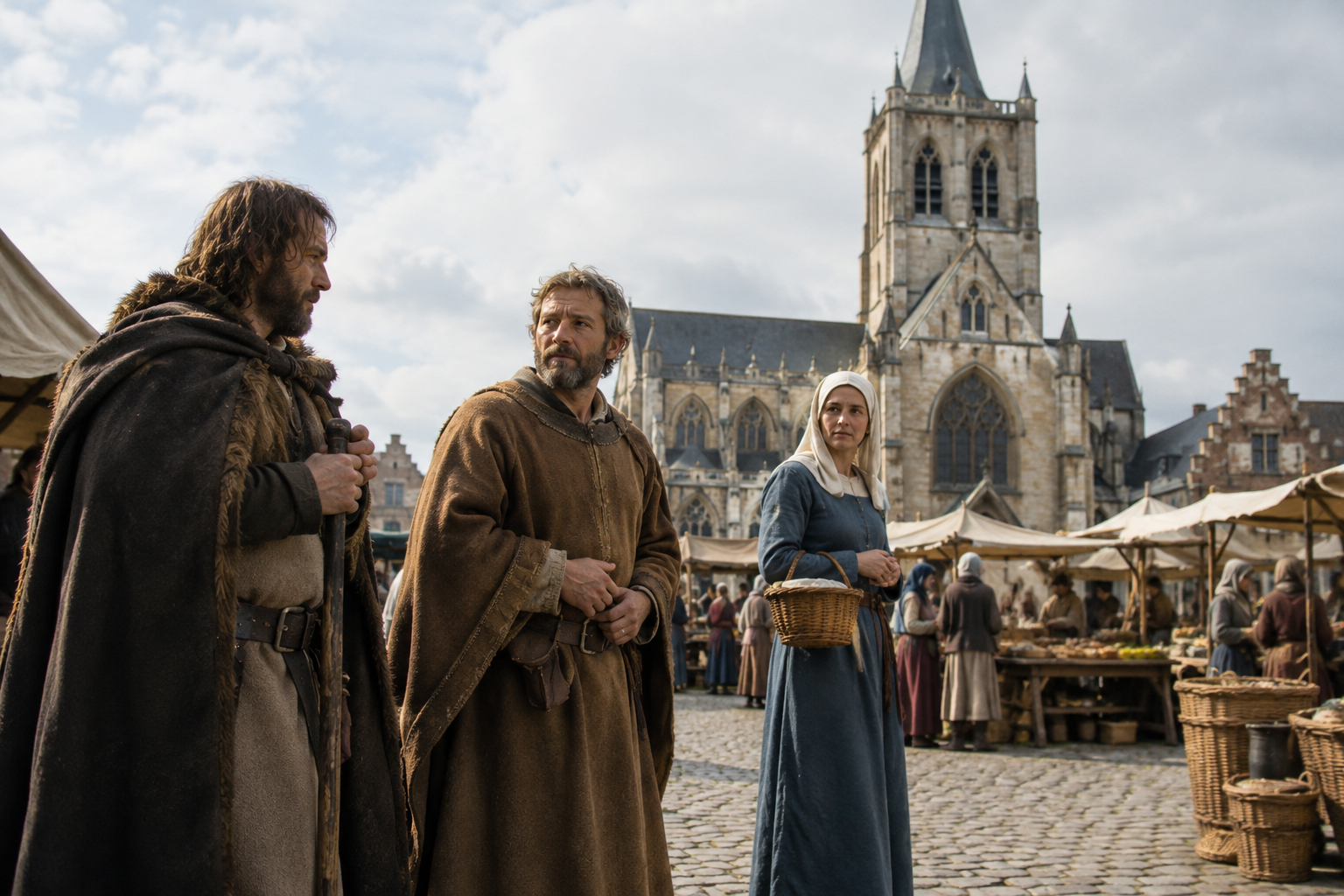
At Sint-Truiden in medieval Belgium, three men buried within little more than two centuries - ST1484 around AD 900, ST2207 around AD 1050, and ST0031 around AD 1090 - have been associated with the Y-DNA haplogroup E2a1. That is immediately striking, not because one paternal lineage can explain a whole town, but because Sint-Truiden was a busy religious and urban center where movement, marriage, and status were constantly reshaping the population. To find the same paternal branch there more than once hints at continuity in one male line within a community that was anything but static.
The most intriguing of the three may be ST1484, labelled an "outsider" from Sint-Truiden Onze-Lieve-Vrouwekerk and dated to about AD 900. Even that short description tells us something important. Medieval burial grounds often preserve not just locals, but people whose lives touched a place through travel, service, trade, pilgrimage, or marriage. Y-DNA tracks only one direct paternal line, not a person's whole ancestry, yet in a town like Sint-Truiden it can reveal how particular male lines persisted or arrived within a changing social landscape.
Sint-Truiden was no obscure village. In the early and high Middle Ages it grew around a major abbey and ecclesiastical institutions in what is now Belgian Limburg, within a region linked to the wider world of the Meuse basin, the old Carolingian heartlands, and the North Sea commercial zone. Burials at places such as Onze-Lieve-Vrouwekerk and Groenmarkt therefore belong to an urban setting where population history is likely to be more complicated than any neat label like "local" or "foreign" suggests.
The three E2a1-linked samples fit neatly into that historical setting. ST1484 comes from Onze-Lieve-Vrouwekerk and is dated around AD 900; ST2207, from Sint-Truiden Groenmarkt, around AD 1050; and ST0031, again from Onze-Lieve-Vrouwekerk, around AD 1090. On present evidence, these are best treated as medieval individuals associated with the article's haplogroup branch, rather than as proof of one documented family tree.
An ancient DNA study examining medieval Sint-Truiden has helped frame this wider picture of urbanization and biological diversity in the town, and it is the clearest scientific backdrop for these individuals: research on medieval Sint-Truiden. The broader point matters. The genetics of medieval towns often show both continuity and mixture at the same time.
Haplogroup E is a large and ancient Y-chromosome family with deep roots far beyond medieval Belgium. But that larger history should not be carelessly poured into the much narrower vessel of E2a1. The branch in this article is a specific paternal subclade, and the safe claim is simply that it appears in these medieval Sint-Truiden males.
That may sound modest, but modesty is exactly what makes archaeogenetics useful. If a rare or less commonly discussed branch turns up repeatedly at one site cluster, that can matter more than a grand, unsupported migration story. Repetition suggests that this paternal line was present within the town's social fabric across several generations, whether through one extended lineage, several related lines, or multiple men from a broader regional population carrying the same branch.
ST1484 deserves special attention because of that one loaded description: outsider. In medieval cemetery studies, such labels usually reflect some combination of burial context, isotopic evidence, archaeology, or population-genetic comparison. Without overreaching beyond the information at hand, the term implies that this man did not fit neatly into the local background expected by the researchers.
That makes E2a1 especially interesting here. It would be tempting to imagine a dramatic long-distance migrant, but the evidence does not require that. "Outsider" in a medieval town could mean someone from a nearby but distinct region, someone who had moved during his lifetime, or simply someone whose ancestry stood out in the local sample. What matters is that the same haplogroup branch also appears in later Sint-Truiden burials, so the paternal signal is not confined to a single unusual individual.
In other words, ST1484 is not just an exotic exception dropped into the record. He may instead represent one edge of a local-to-regional network of male ancestry that became part of the town's population over time.
The later two men, ST2207 and ST0031, bring the story into the eleventh century, when Sint-Truiden was firmly part of the densely connected world of high medieval northwestern Europe. ST2207 was buried at Groenmarkt around AD 1050, while ST0031 came from Onze-Lieve-Vrouwekerk around AD 1090. Different burial locations within the same town matter because they show that this was not a one-grave curiosity.
We should be careful here. Shared Y-DNA does not automatically mean father and son, brothers, or even close cousins, especially in a settlement with many inhabitants. Yet the recurrence of E2a1 at both Groenmarkt and Onze-Lieve-Vrouwekerk does suggest a paternal presence that crossed at least part of the town's internal social geography.
That is one of the most useful things ancient DNA can do for medieval urban history. It takes places we know from charters, churches, and market growth, and adds an intimate biological dimension. Beneath the masonry and the institutions were actual lineages - some common, some uncommon - living through the expansion of towns, parishes, and burial grounds.
One reason these Sint-Truiden men are so revealing is that they fit a wider pattern seen in ancient DNA from medieval Europe: Christian burial grounds were often far more diverse than older national stories once allowed. Towns, frontier regions, and church centers drew in people from different backgrounds, while still maintaining strong local continuities.
The Low Countries in particular were a zone of routes rather than barriers. Rivers, markets, lordships, monasteries, and pilgrimage networks tied communities together. A paternal lineage like E2a1 appearing in medieval Sint-Truiden does not need a single heroic migration tale behind it. It may reflect the ordinary, cumulative movement of men and families over generations.
That larger point has parallels elsewhere in Europe. Studies of early medieval cemeteries increasingly show that burial communities could combine locals, newcomers, and people of mixed background. The social story is less about isolated "tribes" than about communities assembled over time.
Diverse Origins in Medieval Burials
If only ST1484 were known, E2a1 in Sint-Truiden might look like an isolated footnote. With ST2207 and ST0031 added, the picture changes. Now we are looking at a branch that appears in more than one burial place and more than one generation within the same medieval town.
That does not prove dominance, prestige, or a named dynasty. What it does suggest is steadier and, in some ways, more interesting: a paternal line present within the lived population of Sint-Truiden across the transition from the earlier medieval period into the high Middle Ages. In a community shaped by religion, commerce, and mobility, that is exactly the kind of evidence that turns abstract haplogroups into local history.
For someone researching haplogroup E2a1 today, the medieval Sint-Truiden burials offer a grounded historical clue rather than a grand origin myth. This branch was present in an urban ecclesiastical center in what is now Belgium by around AD 900 and remained visible there into the late eleventh century. The distinctive lesson is one of persistence within movement: a paternal line can endure in one place even while that place itself is being reshaped by migration, trade, and changing institutions.






Comments