Haplogroup E1b1b1b2a1a6d1a1b

– 5 min read


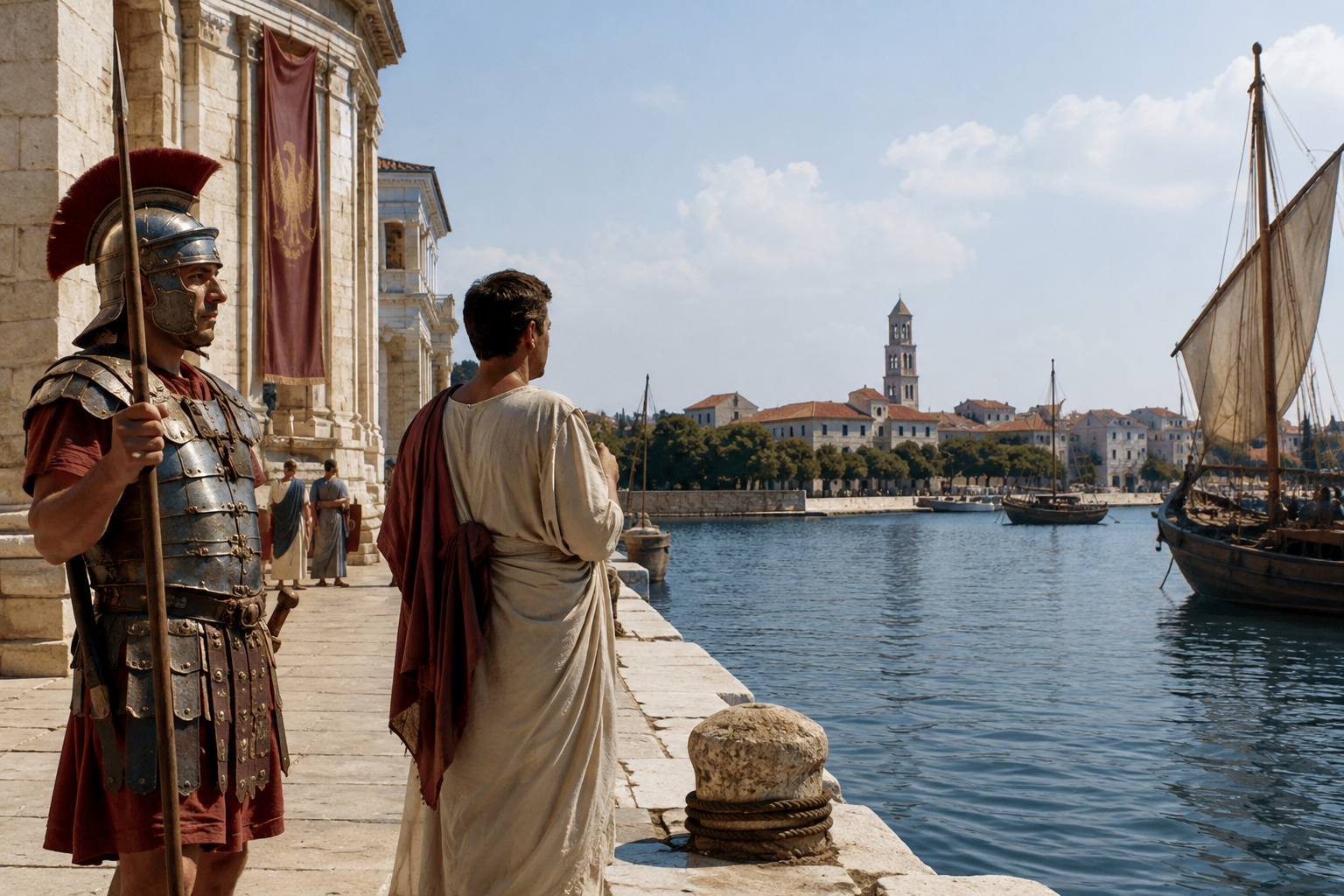
At Zadar-Relja on the Dalmatian coast of Croatia, one man from the Imperial Roman period offers a small but intriguing clue to the deep history of a paternal line: sample R3742, dated to around AD 175. He is associated here with the Y-DNA haplogroup E1b1b1b2a1a6d1a1b, a very specific terminal branch within the much broader E1b1b family. That matters because Roman Dalmatia was not an isolated edge of empire. It was a busy Adriatic zone of ports, roads, veterans, merchants, local communities, and long-distance movement.
With only one named ancient individual in view, caution is essential. Y-DNA traces one direct paternal line only, not a person's whole ancestry, language, or identity. Still, a branch as specific as E1b1b1b2a1a6d1a1b becomes historically interesting precisely when it appears in a clearly dated archaeological setting like Roman Zadar: not as a grand answer, but as a firmly placed point on the map of the ancient Mediterranean and Balkans.
Zadar, ancient Iader, sat in one of those regions the Romans were especially good at tying into wider systems. The eastern Adriatic was a corridor rather than a fringe. Troops moved through it, trade crossed it, and towns along the coast linked the Balkan interior with Italy and the broader Mediterranean. In that world, a male line found at Relja in the second century AD immediately raises useful historical possibilities: local continuity, movement within the provinces, or ancestry arriving through earlier Mediterranean connections.
What makes R3742 valuable is not celebrity or lavish burial detail; none is needed. The importance lies in context. An Imperial Roman individual from coastal Croatia carrying a lineage under E1b1b reminds us that Roman-period populations in the Balkans were not genetically simple blocs. They were layered communities shaped by earlier prehistoric inheritances and by the circulation of people under empire.
An ancient DNA study examining population history in Croatia has helped frame exactly this larger picture, showing that the region's paternal lineages shifted over time even where other forms of continuity remained visible. That broader background is reflected in MyTrueAncestry's own discussion of long-term maternal continuity and shifting paternal lineages in Croatia.
The exact label here, E1b1b1b2a1a6d1a1b, is a narrow twig on a very large paternal tree. The parent haplogroup E1b1b has a long and complicated history across parts of Africa, the Mediterranean, and southeastern Europe, but that does not mean every sub-branch shared the same route or timing. One of the common mistakes in popular genetics is to borrow the whole biography of a major haplogroup and paste it onto a tiny descendant branch. That would be far too confident here.
What we can say more responsibly is that a branch within this wider family appears in Roman-period Dalmatia. That places this paternal line within a landscape where Mediterranean and Balkan histories overlapped for centuries before AD 175. The man at Relja need not have been a recent migrant from anywhere dramatic. He may just as well represent a lineage already established in the region before the high empire, or one circulating regionally through ordinary patterns of marriage, service, and settlement.
The Roman province did not begin history in Dalmatia; it reorganized an older one. Coastal Croatia had already seen millennia of contact between inland Balkan communities, Adriatic islanders, and seaborne networks connecting the eastern and western shores. By the Roman era, that older complexity had been folded into imperial administration, urban life, taxation, and military logistics. A paternal lineage found in Zadar therefore sits at the intersection of several timescales at once.
That is one reason Roman-period Y-DNA from the Balkans is so useful. It does not merely tell us who was present under Roman rule; it helps us test whether imperial populations were largely local, heavily mobile, or some mixture of both. In many regions of the empire, the answer is the mixed one. The archaeological and genetic record keeps showing communities that were neither frozen in place nor endlessly replaced, but continuously reshaped.
For readers interested in how Roman-period genomes can leave durable marks in later populations, the Iberian case offers a useful comparison in Roman Hispania's Lasting Genetic Legacy. The Adriatic and Iberia were very different provinces, of course, but both illustrate how empire moved people without producing a single uniform genetic outcome.
If one steps back further, the Balkans are among the most important regions in European population history. They were central to post-Ice Age recolonization, early farming dispersals, and later Bronze and Iron Age interactions. That very long prehistory matters because Roman individuals did not appear from nowhere; they inherited lineages already shaped by thousands of years of demographic change.
For a lineage under E1b1b, southeastern Europe is especially relevant as part of a broader zone where several branches of this paternal family became established over time. That does not let us assign R3742 to any neat ethnic box. But it does make Roman Dalmatia a plausible place to encounter such a lineage, because the region drew together older Balkan substrata and newer imperial-era mobility.
MyTrueAncestry's post on Balkan hunter-gatherers and post-Ice Age Europe is a good reminder that the peninsula was already a major human crossroads long before written history. Roman-period DNA becomes more meaningful when set against that much deeper background.
There is a temptation, when only a single ancient sample is available, to dismiss it as too small to say anything at all. That is too harsh. One sample cannot define a population, but it can anchor a lineage in time and place. In this case, R3742 shows that a paternal branch identified here as E1b1b1b2a1a6d1a1b had reached, or persisted in, Roman Dalmatia by the mid-second century AD.
That is exactly how ancient DNA often works best: not by producing instant sweeping stories, but by adding fixed points. Enough fixed points, over time, begin to change the map. A Roman-era man from Zadar may eventually help connect modern testers with broader patterns of Adriatic settlement, Balkan continuity, or Mediterranean movement that written sources alone could never resolve at this level.
A research preprint on ancient population history in Croatia is one of the relevant scientific leads for this setting: https://www.biorxiv.org/content/10.1101/2022.05.15.491973v1. Even without leaning on claims that go beyond the evidence here, it reflects the growing effort to place Croatian burials into a longer genomic history.
The most responsible lesson from this branch is not a fantasy pedigree but a setting: E1b1b1b2a1a6d1a1b can be placed, at least in one documented case, in the Roman Adriatic world of second-century Zadar. For someone researching this paternal line today, that points toward a history tied to the Balkans and the Mediterranean's interconnected shores rather than to a single simple origin story. The value of the evidence is its precision of place and period: one man, one Roman coastal community, and one paternal line already part of that ancient world.






Comments