Haplogroup E1b1b1b1b1a2a

– 5 min read


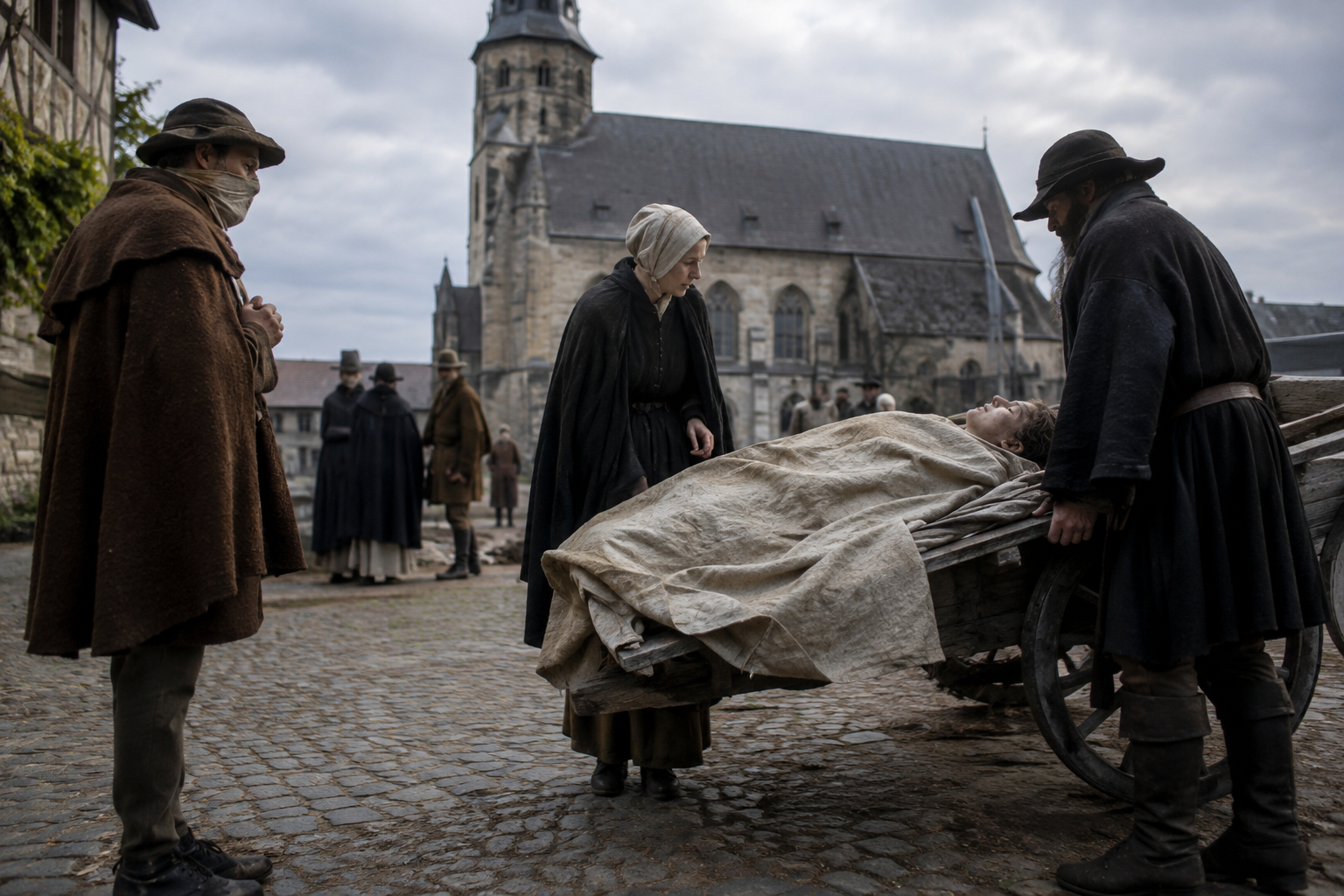
In Ellwangen, in southwestern Germany, one of the most arresting ancient DNA discoveries comes not from a royal tomb or a warrior grave, but from a post-medieval plague burial. The individual known as ELW029, dated to around 1550 AD, belonged to the Y-DNA haplogroup E1b1b1b1b1a2a. That is a very specific paternal line turning up in a moment of epidemic crisis, in a German town better known for confessional conflict, imperial politics, and disease than for any grand migration legend.
That matters because Y-DNA follows one direct paternal line only: father to son, and so on. It does not define a person's whole ancestry, language, or identity. But when a lineage like E1b1b1b1b1a2a appears in an excavated and dated individual such as ELW029, it gives us a firm historical foothold. Suddenly this haplogroup is not just a string of letters and numbers in a test result; it is attached to a real man who lived and died in plague-era central Europe.
Ellwangen was an important ecclesiastical center in the Holy Roman Empire, and by the 16th century it stood inside a Europe repeatedly battered by epidemic disease. A plague victim from this setting is historically interesting even before genetics enters the picture. Burials from epidemic contexts can reveal who was present in a town at a given moment, whether communities were locally rooted, and how much biological diversity existed within populations that older histories once imagined as stable and homogeneous.
ELW029 belongs to that world. With only one named sample in view, caution is essential: we cannot build a whole migration narrative around a single paternal lineage. Yet one sample can still be revealing. It shows that by the mid-16th century, a branch associated with the wider E1b1b paternal family was part of the lived population of southern Germany, present not in theory but in a documented human being recovered archaeologically.
A broader ancient DNA study of Germanic-speaking regions and their historical formation has helped underline just how mixed and mobile central European populations could be over long periods, even when language histories later make them look tidier than they were. For readers interested in that wider backdrop, see Tracing the spread of Germanic languages using ancient genomics.
The wider haplogroup E1b1b is one of the best known Y-chromosome families in parts of Africa, the Mediterranean, and southwest Eurasia. But that does not mean every narrow descendant branch had the same route, timing, or historical role. The article haplogroup here is the much more specific E1b1b1b1b1a2a, and responsible interpretation means keeping that distinction clear.
In practical historical terms, a fine-grained subclade like this often reflects many centuries of branching, movement, and local settlement before it ever appears in an excavated individual. By the time we meet ELW029 in 1550 AD, the paternal line had long since become part of Europe's intricate demographic fabric. The interesting question is therefore not whether this lineage was somehow "foreign" to Germany in a simplistic sense, but how central Europe came to contain so many different paternal threads.
That is precisely where archaeology and genetics work best together. They stop us telling fairy tales about pure origins. Instead, they show towns, frontiers, kingdoms, monasteries, military zones, and trade routes full of people whose family histories had been crossing regions for generations.
A plague burial from 16th-century Ellwangen sits late in the story, but it belongs to a very old central European pattern. Roman expansion, post-Roman migration, medieval commerce, ecclesiastical networks, mercenary service, and urban growth all moved people across the continent. Southern Germany in particular was tied into Alpine passages, the Danube corridor, the Rhineland, northern Italy, and the wider imperial world.
So a lineage within the E1b1b sphere appearing in this region should not be treated as an anomaly demanding melodrama. It is better understood as one piece of Europe's long demographic entanglement. The same historical lesson turns up again and again in ancient DNA studies: burial grounds that once looked culturally uniform often prove biologically varied, and places near imperial, commercial, or religious networks are especially likely to show that complexity.
Research published on ancient populations has increasingly reinforced this point, including work on mobility and genetic diversity in historically connected European communities. One study linked with this sample material is available here: https://academic.oup.com/mbe/advance-article/doi/10.1093/molbev/msab147/6277411. Without overstating any one paper's conclusions for ELW029 specifically, the broader lesson is sound: central Europe was shaped by repeated human movement, not by isolation.
Readers who want a parallel case from a very different setting may find it useful to compare this with Ancient DNA reveals diverse origins at a 7th-century Madrid burial site, where a cemetery also complicates any easy story about local sameness.
There is a temptation, with epidemic burials, to focus entirely on the disease. That would miss the more human and more historical point. ELW029 was not only part of a plague event; he was also part of a local society. His Y-line places one paternal thread of E1b1b1b1b1a2a inside a community living through the upheavals of Reformation-era Europe, in a German landscape already shaped by centuries of settlement and contact.
Plague cemeteries are powerful because they often preserve ordinary people who would otherwise vanish from the record. Not counts, not bishops, not dynastic founders, but townsmen, laborers, clerics, servants, and families caught in disaster. Ancient DNA gives some of them back a measure of historical presence. In this case, that presence includes a paternal lineage with deeper connections beyond the immediate locality, now visible in a tightly dated archaeological context.
For those drawn to the disease side of the story, MyTrueAncestry's broader plague coverage gives useful context, especially Ancient Plagues and Epidemics: DNA Insights from 35,000 Years of History.
The wider E1b1b family often draws attention because of its importance in Mediterranean, Balkan, and North African population history. That bigger frame is useful, so long as it is handled carefully. A post-medieval German carrier of E1b1b1b1b1a2a does not, by himself, map a single route from one ancient homeland to Ellwangen. But he does remind us that paternal lines commonly associated with southern or southeastern zones were thoroughly woven into European history farther north.
That fits a growing body of archaeogenetic work showing that Europe was made through contact zones rather than sealed blocks. Roman-period mobility, medieval trade, church structures, frontier service, and later population mixing all created opportunities for lineages to travel and settle. In that sense, ELW029 belongs to the same broad historical world explored in articles such as Roman Hispania's Lasting Genetic Legacy, where empire and movement left durable biological traces.
For someone researching the haplogroup E1b1b1b1b1a2a today, ELW029 offers one solid and memorable point of contact: this paternal branch was present in plague-era Ellwangen around 1550 AD, in the heart of the Holy Roman Empire. That does not turn every modern carrier into a German, nor does it erase the lineage's deeper history within the wider E1b1b family. What it does show is that this branch had already entered the complicated social world of central Europe by the early modern period, where epidemic burial has preserved one man's place in that story.






Comments