Haplogroup E1b1b1a1b2a4b

– 5 min read


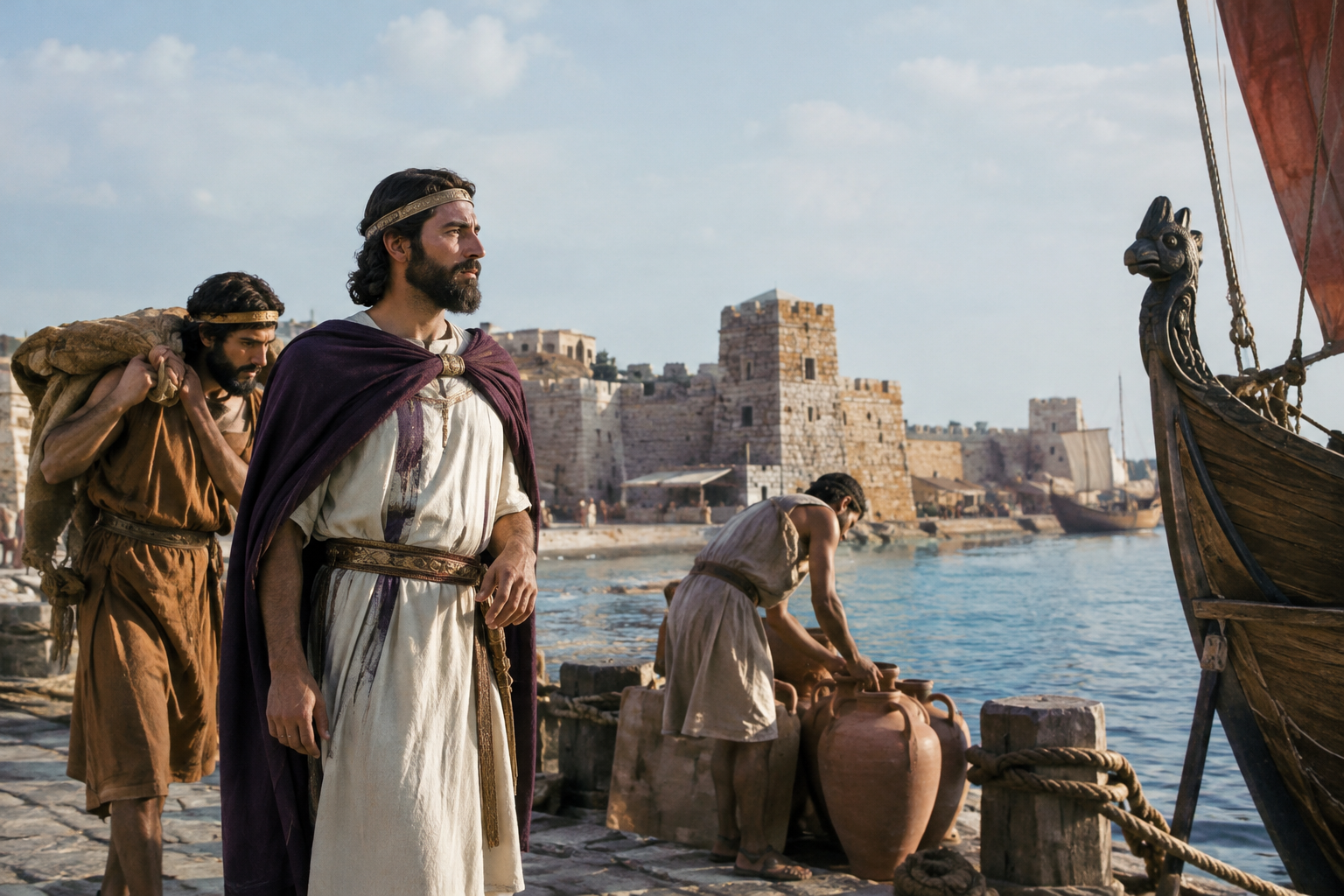
At Achzib on the northern coast of present-day Israel, a man dated to around 650 BC has become an unexpectedly useful guide to the history of Y-DNA haplogroup E1b1b1a1b2a4b. He appears in the ancient DNA record as I22260, identified as Phoenician and associated with the coastal world between Acre and Tyre. That matters because Phoenician history is usually told through ships, inscriptions, and trade goods. Here, instead, we get a paternal line carried by a real person from a real Iron Age shoreline.
That one result does not make E1b1b1a1b2a4b "the Phoenician haplogroup", and it certainly does not define Phoenician identity on its own. Y-DNA traces one direct male line out of thousands in any family tree. But when a branch turns up in a well-placed archaeological context like Achzib, it gives us something firmer than legend: a lineage anchored to the eastern Mediterranean during the age when Phoenician cities were tying together coasts from the Levant to the central and western Mediterranean.
Achzib was no backwater. In the Iron Age it belonged to that densely connected coastal zone where harbours, fortified settlements, and market towns lived by maritime exchange. Phoenician communities were famous in Greek and later Roman writing for seafaring and commerce, but the archaeology shows something more grounded: settlements linked by everyday movement of people as well as objects.
The individual I22260, dated to about 650 BC, sits in precisely that world. With him, the branch E1b1b1a1b2a4b is not floating in an abstract haplotree; it is attached to a Phoenician-period burial landscape on the Levantine coast. A recent ancient DNA study of the region, published in Nature, helps frame just how interconnected these eastern Mediterranean populations could be, even though any one paternal lineage still has to be treated carefully and specifically.
For someone exploring this haplogroup today, Achzib is important not because it solves everything, but because it places the branch in a historical setting with exceptionally long cultural reach. This is a coastline where local continuity, overseas contact, imperial pressure, and urban life all overlapped.
The label E1b1b1a1b2a4b is a very narrow paternal subclade within the broader E1b1b complex, a major Y-chromosome family with deep roots in parts of Africa and the Mediterranean world. But broad roots are not the same thing as the history of this exact twig on the tree. It would be quite wrong to take everything ever said about E1b1b and pour it straight into E1b1b1a1b2a4b.
What we can say more responsibly is that this branch is represented in at least one Iron Age coastal Levantine man from a Phoenician context. That alone already suggests a history tied to populations of the eastern Mediterranean, where male lines could persist locally while cultures, languages, and political masters changed around them. The Phoenician label here is archaeological and historical: it describes the community context of the burial, not a timeless ethnic essence encoded by one chromosome.
This is one of the useful lessons of archaeogenetics. A port city may speak one language, trade with five regions, marry across several communities, and bury men carrying quite different paternal lines. The reverse is also true: the same paternal branch can pass through shifting identities over centuries without changing its Y-DNA label at all.
The real historical interest of E1b1b1a1b2a4b lies in the setting around Achzib. The Levant was one of the great contact zones of the ancient world. Egyptians, Israelites, Phoenicians, Aramaeans, Assyrians, Babylonians, Persians, Greeks, and later Romans all moved through, ruled, traded, or settled parts of this coast. Any lineage found here may have a long local history, but it also belongs to a region where mobility was normal rather than exceptional.
That matters especially for Phoenician-period samples. Phoenician communities are often imagined as neat exporters of culture from a few city-states outward across the sea. The archaeology is less tidy and more interesting. These were urban societies shaped by local Levantine backgrounds, but also by constant interaction with Cyprus, Anatolia, Egypt, North Africa, and the central Mediterranean. A Y-DNA result from Achzib should therefore be read as part of a web, not a straight arrow.
It is also worth noting that coastal sites often preserve people whose ancestry was already layered long before the famous age of colonization. By the 7th century BC, the Levant had behind it millennia of movement, from Bronze Age state systems to Iron Age imperial entanglements. One paternal branch surviving into Phoenician Achzib may reflect local descent, older regional mixture, or both.
Bronze and Iron Age Mesopotamia DNA
Phoenician history has an unusually wide horizon. From the Levantine homeland, Phoenician-speaking communities and their descendants established or influenced settlements across Cyprus, Sicily, Sardinia, Ibiza, and the North African coast, with Carthage becoming the most famous later power in that network. So even a single Levantine paternal lineage from Achzib invites a larger question: how were male lines distributed across that maritime world?
At the moment, caution is essential. One sample from coastal Israel does not prove that E1b1b1a1b2a4b was common in all Phoenician colonies, nor that men with this lineage founded western settlements. Still, the Achzib result is exactly the kind of anchor point that makes future comparisons meaningful. If related branches appear in Punic or Phoenician-linked burials elsewhere, that eastern coastal context will become even more informative.
This is why ancient DNA has changed the conversation. Earlier generations of historians had texts, pottery styles, and burial customs; now they can add biologically related evidence without confusing biology for destiny. In the Phoenician case especially, that matters because the old literature often swung between two extremes: imagining pure colonists on one side or dismissing any real human movement on the other. Genetics tends to reveal the messier middle ground.
If your paternal line falls under E1b1b1a1b2a4b, the Achzib sample offers a historically vivid comparison point: an Iron Age man living in a Phoenician coastal environment at around 650 BC. That is not a personal genealogy, and it is not proof of descent from a named Phoenician city or merchant family. It is, however, a credible sign that this branch belonged to the human landscape of the Levant during one of its most internationally connected periods.
There is a broader historical elegance to that. Coastal societies often look glamorous from a distance because of trade and empire, yet their deeper story is usually one of endurance. Behind the ships and prestige goods were ordinary paternal lines passed from father to son through centuries of political change. E1b1b1a1b2a4b, as seen in I22260, belongs to that quieter history: not the slogan of a civilization, but one of the men who actually inhabited it.
Eastern Mediterranean DNA in Rome
The strongest supported insight for E1b1b1a1b2a4b is not that it can be reduced to a single people, but that it is already documented in a concrete Phoenician-period individual from Achzib on the Levantine coast. That places the branch inside a world of harbours, empire, and long-distance contact, where local family lines persisted within a famously mobile Mediterranean. For modern testers, that is a useful and disciplined kind of connection: not a myth of instant identity, but a genuine archaeological foothold in the Iron Age eastern Mediterranean.






Comments