Haplogroup E1b1b1a1b1a6a1

– 6 min read


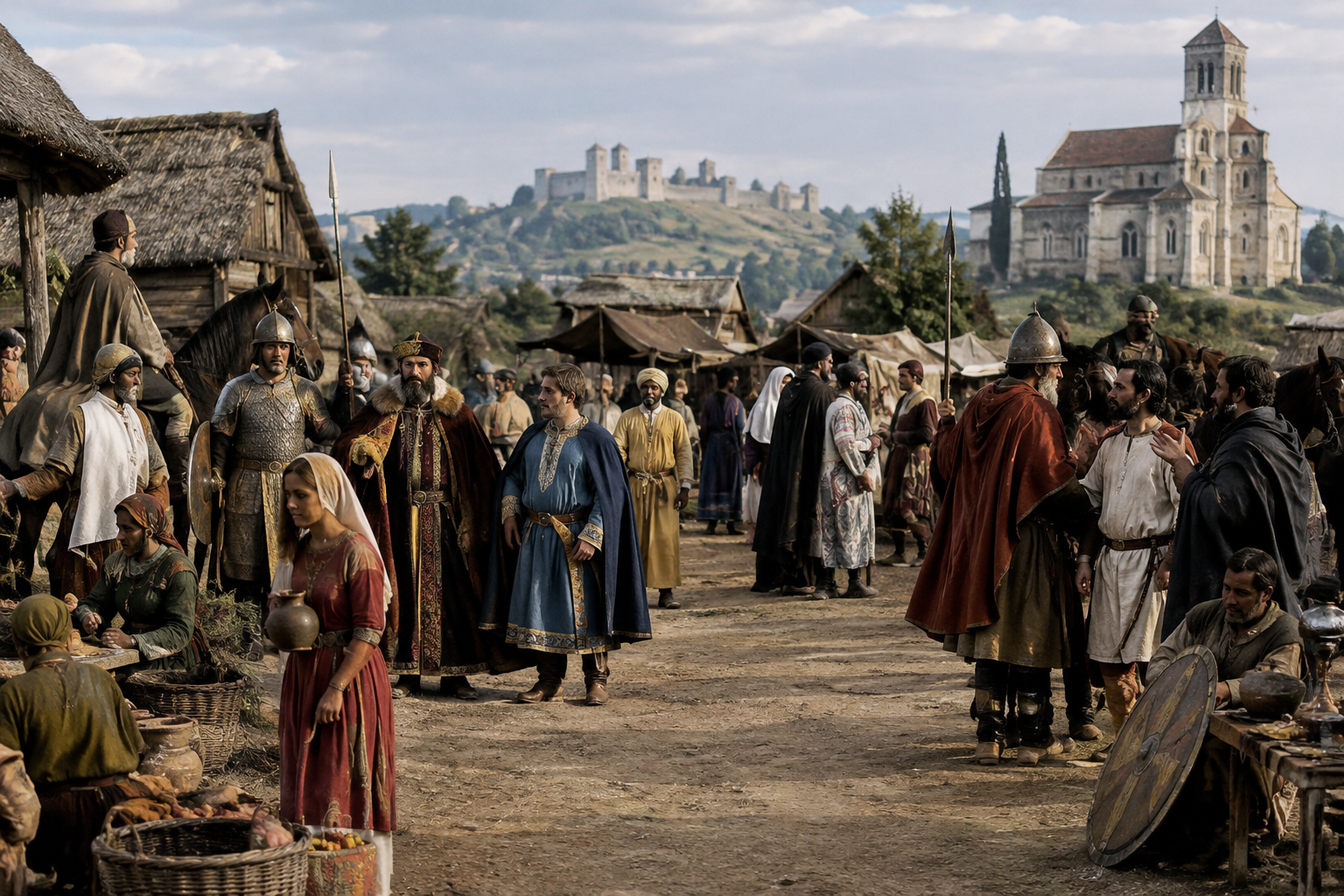
Some Y-DNA haplogroups arrive in the ancient DNA record like a flash of heraldry: one king, one crypt, one neat pedigree. E1b1b1a1b1a6a1 is more interesting than that. What makes it historically compelling is not a single famous burial, but its appearance across a striking spread of places and periods: Scythian Age Hungary, Roman and post-Roman Serbia, early medieval Austria, Burgundy, Spain, Sardinia, and even a sample from the Otyrar culture at Konyr Tobe. That is not the story of one tribe marching in lockstep. It is the story of a paternal lineage turning up again and again in the busy human traffic of Europe and its neighboring worlds.
As always, a quick genetic reality check is useful. Y-DNA haplogroups trace one very narrow line of ancestry: the direct paternal line, father to son to son. They do not describe a person's whole ancestry, ethnicity, language, or identity. Still, they are invaluable historical tools. They let us watch male lineages appear in cemeteries, frontier towns, royal circles, and migration-period communities, sometimes across more than a thousand years.
This haplogroup belongs to the wider E1b1b family, one of the major Y-chromosome lineages with deep roots in parts of Africa, the Mediterranean, and western Eurasia. Broadly speaking, branches of E1b1b have long been associated with movements around the Mediterranean basin, the Balkans, and southeastern Europe, though different subclades have very different histories. That distinction matters here. We should be careful not to pour the entire long history of E1b1b into one highly specific downstream branch.
What the supplied evidence does support is that this lineage, or a very closely related paternal thread within it, was present in the Carpathian Basin, the Balkans, and parts of western and central Europe during the Iron Age, Roman era, and Middle Ages. That makes it a useful marker for studying continuity and mobility in regions where Roman imperial networks, steppe contacts, local Balkan populations, and medieval frontier societies all overlapped.
Readers interested in the deeper background of Balkan population history may also enjoy this related piece on ancient regional foundations:
The ancient samples linked with this haplogroup sketch an extraordinary map. One early waypoint appears in Iron Age Hungary at Kesznyeten-Szeruskert, where Hung148 dated to 150 BC and Hung152 also dated to 150 BC are described as Scythian Age and Western Scythian individuals. That does not prove the lineage was "Scythian" in any simple ethnic sense. But it does place it in the Carpathian Basin during a period when steppe influences, local populations, and long-distance exchange were all entangled.
Then we find the same broad paternal signal farther south in the Roman Balkans. I15495 from the Late Roman Empire Viminacium Serbia Pirivoj Necropolis, dated to 150 AD, anchors the haplogroup in one of the great urban and military landscapes of Roman Serbia. Viminacium was not a remote village. It was a legionary and provincial center, the sort of place where soldiers, merchants, local families, and migrants from across the empire might all end up buried within the same orbit.
By the post-Roman centuries, the trail continues. I27297 from Post Roman Era Serbia Kormadin Jakovo dated to 450 AD, and I15537 from Medieval Era Serbia Timacum Kuline Ravna Village dated to 900 AD, suggest this paternal line remained part of the human landscape of the central Balkans across the collapse of Roman rule and into the medieval world. That is precisely the kind of evidence that makes Y-DNA valuable: not because it identifies a nation, but because it shows lineages surviving political upheaval.
For readers drawn to the wider Black Sea and steppe context behind some of these earlier finds, this article is a natural companion:
Discover Iron Age Scythian DNA
What stops this from being a purely Balkan story is the western scatter of samples in late antiquity and the early Middle Ages. In the Vienna Basin, CSK001, CSK002, and CSK003 from Early Medieval Austria Csokorgasse Vienna Basin, all dated to 650 AD, show the lineage in a zone where Roman legacies, incoming groups, and regional continuity met in complicated ways. The same broad pattern appears in AHPS206W from Medieval Hungary Carolingian Border Bodajk Homoki dulo dated to 800 AD, and OBT-106 from Late Avar Hungary Oroshaza-Bonum Teglagyar dated to 700 AD. These are frontier centuries, and frontier centuries rarely produce tidy ancestry maps.
Even more striking is the appearance of I20400 from Late Roman Early Migration Spain Girona Sarria de Ter Pla de lHorta dated to 475 AD, BRC043x from Migration Period Roman Outlier Germany Saxony-Anhalt Bruecken dated to 500 AD, and CGG023656 from Early Medieval France Burgundy Camp du Chateau dated to 849 AD. These do not prove a single migration stream from the Balkans to Iberia or Burgundy. But together they show that the paternal branch was not confined to one valley or one kingdom. It appears in the same centuries that Europe was being reorganized after Rome, when troops, settlers, captives, clerics, merchants, and families moved in many directions.
If you want to explore that western dimension further, especially the Iberian side of the story, this is well worth reading:
Read Roman Hispania's DNA Legacy
The supplied material also nudges us toward a later chapter: the world of noble families and royal memory in the Balkans and Carpathian lands. Here, caution is essential. A historical association between a haplogroup and a dynasty does not prove that every member of that house carried the same Y-DNA, nor does it prove direct descent from any ancient sample. Still, the historical geography is suggestive and worth exploring.
The Petrovic-Njegos Dynasty belongs to Montenegro's hard political landscape, where survival often depended on balancing independence against larger empires. The Cetinje Royal Palace, built between 1867 and 1871 as the home of Prince, later King, Nikola I Petrovic-Njegos, was not an overblown imperial residence. Its relative modesty tells its own story about a small state governing carefully in a dangerous neighborhood. Today, as part of the National Museum of Montenegro, it preserves the material world of the last Montenegrin monarchy.
In Serbia, the Obrenovic Dynasty is tied to Stari Dvor, the Old Palace in Belgrade. Built in the 1880s for King Milan I and Queen Natalia, it stood at the center of modern Serbian state-building, only to become the scene of the violent May Coup of 1903, when King Alexander I and Queen Draga were murdered and the Obrenovic line ended. Few buildings capture the drama of Balkan monarchy quite so brutally.
Then there is the House of Basarab, associated here with Poenari Castle in Romania. Poenari is no fairy-tale residence. High above the Arges Valley, it is remembered as the severe mountain stronghold of Vlad III Dracula in the fifteenth century, though the fortress began earlier as a strategic site guarding a Carpathian route. A ruin like this is useful for history because it reminds us what power often looked like in frontier zones: steep, exposed, and militarized.
For a fuller look at one of these ruling houses, readers can continue with this related feature:
Explore the Petrovic-Njegos Dynasty
If there is a lesson in E1b1b1a1b1a6a1, it is that paternal ancestry does not obey the borders drawn in school atlases. This lineage appears in Scythian Age Hungary, Roman Serbia, post-Roman and medieval Balkan sites, early medieval Austria, migration-period Germany, Burgundy, Spain, Sardinia, and even KNT001 from Otyrar culture Konyr Tobe dated to 300 AD. It also appears in the late medieval and dynastic record through CJM, Johannes Corvinus Hunyadi Dynasty, dated 1504 AD, and CKM, Christopher Corvinus Hunyadi Dynasty, dated 1506 AD. Those last two samples are especially tantalizing because they connect ancient DNA to a named ruling house, though even here the right response is disciplined excitement rather than overstatement.
Ancient DNA does something written genealogy usually cannot. It puts anonymous men from cemeteries beside princes and dynasts, not as proven ancestors and descendants, but as members of a much longer human story unfolding across the same regions. The result is less a family tree than a historical map of persistence, dispersal, and return.
MyTrueAncestry lets you explore exactly that kind of connection. By comparing your DNA to ancient individuals and historical populations, you may discover surprising links to the worlds discussed here, from Roman frontier communities to Balkan medieval landscapes. These matches do not by themselves prove direct descent from any ancient sample or noble house, but they can offer a fascinating new angle on your ancestry.






Comments