Haplogroup E1b1b1a1a1b1a

– 4 min read


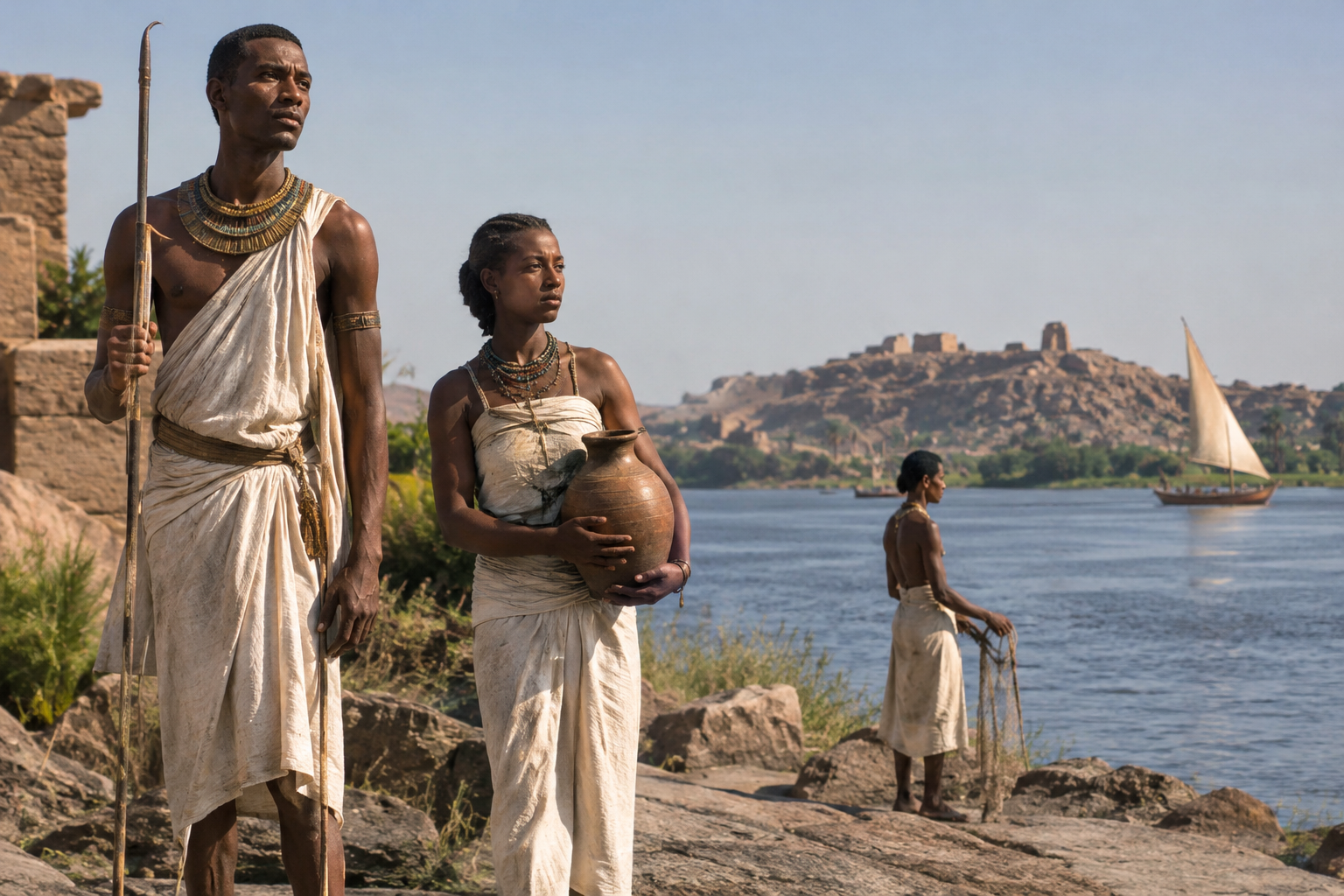
At Kulubnarti in Nubia, on the Nile between the First and Second Cataracts, archaeologists and geneticists have been able to glimpse a community living in the centuries around AD 750. One of the men from this Early Makurian setting, sample I17481, has been associated here with the Y-DNA haplogroup E1b1b1a1a1b1a. That matters because Kulubnarti is not a vague backdrop in "ancient Africa", but a sharply historical place: Christian Nubia, riverine trade, frontier politics, and a cemetery population now famous for showing how much lived experience can be recovered from bone and DNA.
The important thing to say at once is that a Y-chromosome lineage tracks one direct paternal line only. It does not tell us everything about a person's ancestry, language, religion, or social identity. But when a lineage such as E1b1b1a1a1b1a appears in an excavated individual from medieval Nubia, it gives us one more precise thread in a much larger historical fabric.
Kulubnarti is best understood not as an isolated burial ground, but as part of the medieval Nubian kingdoms that emerged after the end of earlier ancient polities in the Nile Valley. By the eighth century AD, Makuria was one of the major Christian states of northeast Africa, linked both to older Nile traditions and to the wider worlds of Egypt, the Red Sea, and the eastern Mediterranean.
That makes sample I17481 especially useful. He anchors this haplogroup in a real historical community rather than in abstract maps of modern frequency. A lineage reported in a medieval Nubian man belongs to a society that was literate, organized, and regionally connected, not to some timeless or ahistorical population block.
An ancient DNA study on the Kulubnarti population, available here as research on these medieval Nubian burials, helped draw attention to the site's biological diversity and social complexity. Even where one article or database gives a fine-grained Y assignment, the broader lesson is the same: Kulubnarti offers unusually direct evidence for how paternal lines persisted within a locally rooted but interconnected Nile Valley population.
African DNA population history
The haplogroup name is a very narrow branch within the larger E1b1b complex, one of the major Y-chromosome families long associated with parts of Africa, northeast Africa, and the Mediterranean world. But the narrower label matters. It is bad history, and bad genetics, to take everything known about the huge parent branch and simply pour it into one fine terminal subclade.
For that reason, the Kulubnarti evidence should be read carefully. What we can say is that a paternal line classified here as E1b1b1a1a1b1a was present in Early Makurian Nubia around the mid-first millennium AD. What we should not do is turn that single result into a sweeping claim about the exact birthplace of the branch, or a neat one-direction migration story stretching across millennia without intermediate evidence.
Still, one broad point is historically reasonable. Nubia sat in a corridor where African, Nile Valley, and eastern Mediterranean connections repeatedly met. A paternal lineage from the E1b1b family appearing there is not surprising in itself; what is valuable is the chronological and archaeological fix provided by an excavated individual.
Kulubnarti has become well known because the site allows historians to ask unusually grounded questions about status, health, kinship, and local community structure. Medieval cemeteries are sometimes lazily treated as anonymous collections of skeletons. Kulubnarti resists that. The individuals buried there belonged to a society with social distinctions, long-term settlement, and deeply local histories along the Nile.
In that context, I17481 is more than a haplogroup label. He represents a paternal line carried by one man in a community that was living through the political and religious realities of Christian Nubia. The Y-chromosome result therefore works best when read alongside the archaeology of the site, not as a substitute for it.
This is also why single-sample discoveries can be so compelling. They remind us that paternal lineages are not only found in imperial courts or spectacular warrior graves. Sometimes they survive in ordinary community burials, and those are often the places where population history becomes most human and most convincing.
If you are trying to place E1b1b1a1a1b1a in historical perspective, Nubia is a revealing setting. Medieval Nubian kingdoms were not sealed off from the outside world. They negotiated with Egypt, participated in exchange along the Nile, and stood in a zone where movement of people, goods, and ideas had been going on for thousands of years.
That larger geography matters because Y-DNA lineages often become historically visible at crossroads. The Nile Valley is one of the great corridors of Afro-Eurasian history, but it is also a place where local continuity can be very strong. A lineage found at Kulubnarti may reflect regional depth, movement from neighboring Nile populations, or older mixtures already long established by the medieval period. The sample does not let us choose between all those possibilities on its own, but it firmly places this paternal branch within that historical conversation.
Readers interested in how North Africa and adjacent regions have been reconstructed through archaeology and genetics may also want to compare the broader picture in this related discussion of regional change.
North Africa through ancient DNA
For members of the MyTrueAncestry community, the significance of E1b1b1a1a1b1a is not that it unlocks a single grand origin story. Its value is more disciplined, and in some ways more interesting. It places one branch of a paternal line in a documented medieval Nubian context, at Kulubnarti, in the age of Makuria.
That means a tester who belongs somewhere on this branch is looking at a lineage with at least one attested foothold in the historical Nile Valley of Christian northeast Africa. It does not mean every modern carrier descends from Kulubnarti, or from one medieval Nubian family. But it does mean the branch can be discussed in connection with a real excavated person, from a real society, at a real moment in African history.
And that is often the difference between genealogy as abstraction and genealogy as history. Instead of a bare code on a phylogenetic tree, E1b1b1a1a1b1a becomes visible in the life-world of medieval Nubia: river settlements, church kingdoms, local communities, and the durable human business of fathers and sons.





Comments