Haplogroup E1b1a1a1a1c1b1

– 5 min read


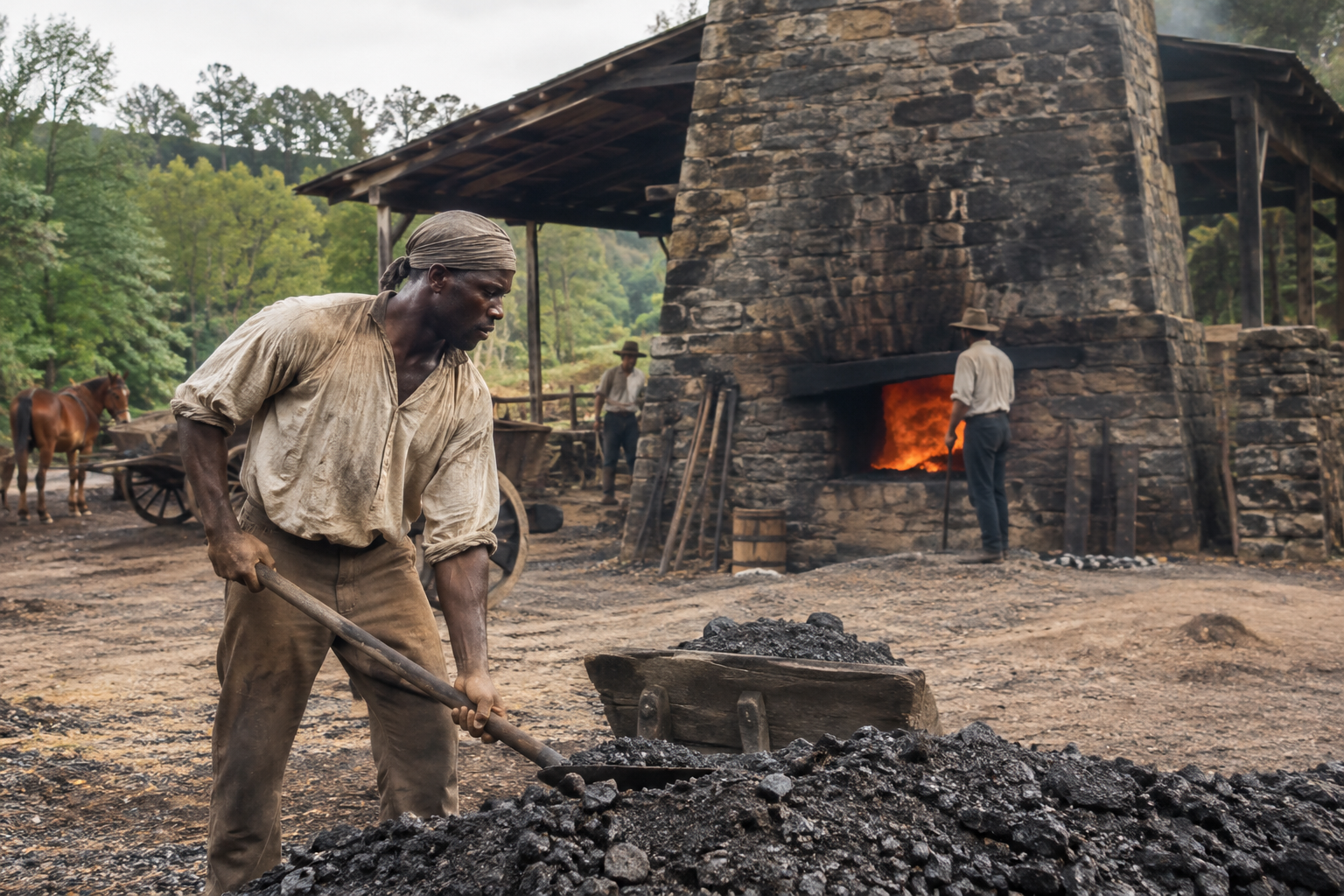
At the Catoctin iron-working furnace in antebellum Maryland, ancient DNA has given one enslaved man back at least a fragment of his own paternal history. The individual identified as I15331, dated around 1810 AD and described as an enslaved laborer at the furnace, is associated here with the Y-DNA lineage E1b1a1a1a1c1b1. That dry string of letters and numbers matters because it anchors a very human story: industrial America was built not only by furnaces, roads, and markets, but by coerced lives whose deeper family origins were often deliberately erased.
This is also a useful reminder of what Y-DNA can and cannot do. A Y-chromosome lineage traces one direct paternal line only - father to son across many generations. It does not summarize a whole person's ancestry, identity, or life. But in cases shaped by slavery, displacement, and archival silence, even one paternal line can be historically powerful.
Catoctin Furnace, in Frederick County, Maryland, was one of the industrial sites that tied the early United States to Atlantic systems of labor and extraction. Iron furnaces like this one needed constant, punishing work: mining ore, making charcoal, tending the blast furnace, hauling materials, and handling the dangerous rhythm of industrial production. Enslaved Africans and African Americans were central to that labor regime.
The significance of I15331 lies not in princely ancestry or an elite grave, but in the opposite. Here the archaeological and genetic record preserves a man who stood far from power. His association with E1b1a1a1a1c1b1 places his direct paternal line within the broader E1b1a branch, a major Y-DNA clade especially important in the population history of sub-Saharan Africa and, through the Atlantic slave trade, of the African diaspora in the Americas.
An ancient DNA study examining this community was circulated through research on the people buried at Catoctin Furnace, helping connect bioarchaeology, family history, and the study of forced migration. Even without over-claiming a precise homeland for this one narrow subclade, the wider setting is clear enough: the paternal line of I15331 belonged to a branch with deep roots in African population history, carried into Maryland through slavery.
There is a temptation, when faced with a very precise haplogroup label, to treat it as a complete map. It is not. E1b1a1a1a1c1b1 is a narrow twig on a much larger paternal tree. The broader E1b1a branch is widely associated with many West and West-Central African populations, but that does not mean every man in every downstream subclade shared the same language, kingdom, ethnicity, or historical experience.
That distinction matters especially here. The history behind an enslaved man in Maryland was not a single migration event but a chain of ruptures: African community histories before capture, the violence of the slave trade, sale and transport within the Atlantic world, and then life under bondage in North America. A haplogroup can place one paternal line within that enormous history, but it cannot on its own identify a named people, a specific port of embarkation, or a particular African ancestor.
Still, the branch is historically informative. In the Americas, lineages within E1b1a are one of the clearest genetic signatures of the African diaspora created by the Atlantic slave trade. In that sense, I15331 is not an isolated curiosity. He belongs to a much larger historical archive written into living bodies and now, painstakingly, recovered from archaeological remains.
The setting of Catoctin Furnace sharpens the meaning of this lineage. We are not looking at a plantation cemetery in the Deep South, nor a medieval battlefield, nor an ancient royal tomb. We are looking at an industrial labor site in the early republic. That matters because it complicates any tidy picture of northern and border-state history.
Maryland's economy drew on both plantation slavery and industrial slavery. Iron production was one of the places where these worlds met. Men like I15331 were caught in a system that treated technical skill, physical endurance, and hereditary status as property. Archaeology helps recover the community dimension of that system: not just anonymous labor units, but individuals who lived, worked, suffered, and formed families under conditions designed to deny them autonomy.
This is one reason ancient DNA from relatively recent historic sites can be so important. It does not replace documents, but it speaks where documents are partial, hostile, or absent. For enslaved communities, the written archive was largely created by owners, overseers, churches, and courts. Genetic evidence adds another line of testimony - one that can reconnect descendants to paternal and maternal histories that slave systems tried to break.
The deeper background of E1b1a1a1a1c1b1 belongs to African history long before Maryland entered the picture. The parent branches of E1b1a expanded across large parts of sub-Saharan Africa over many centuries, intertwined with shifting patterns of farming, mobility, language spread, and regional mixture. Precisely how this particular downstream branch fits into that wider history requires caution; the article's haplogroup label is more specific than the broader ancient comparative record usually available in public summaries.
But that caution should not make the evidence seem thin. In fact, the opposite is true. The presence of an E1b1a-derived paternal line at an enslaved cemetery in Maryland is exactly the sort of finding historians would expect from the forced transport of African men into British North America and, later, the United States. The genetic result does not merely decorate the known history - it confirms, at the level of one person, the African paternal ancestry written into the institution of slavery itself.
There is also a methodological point worth making. Ancient DNA has often been associated in the public imagination with prehistory or with spectacular elite burials. Yet some of its most ethically important work now lies in more recent contexts: cemeteries of marginalized people, colonial settlements, migrant communities, and sites where names were lost or records were distorted. The dead of Catoctin Furnace belong firmly in that category.
African DNA Population History
Some haplogroup articles can range across many ancient burials and several thousand years. This one cannot honestly do that, because the evidence supplied here centers on a single documented individual: I15331 from Catoctin Furnace. But there is no need to apologize for that narrow focus. One securely contextualized person can illuminate an entire historical structure.
In this case, the structure is the entanglement of African paternal ancestry, American slavery, and industrial labor. The archaeological context tells us where this man lived and died. The Y-DNA branch tells us that his direct paternal line belonged to a lineage with African roots. Together, those facts cut across the old habit of treating early American industry as somehow detached from the history of slavery.
They also remind us that haplogroups are not only about remote origins. For many descendants of the African diaspora, they are about historical interruption: what parts of family history were severed, and what fragments can still be recovered. A lineage like E1b1a1a1a1c1b1, in this setting, is not a badge of ethnicity or a shortcut to a named kingdom. It is evidence of continuity through rupture.
The most distinctive thing about E1b1a1a1a1c1b1 in this article is not antiquity for its own sake, but context. Through I15331 at Catoctin Furnace, this haplogroup appears in the burial ground of an enslaved worker in early 19th-century Maryland, linking one direct paternal line to the larger history of African diaspora in America. For anyone researching this lineage today, that is the responsible takeaway: not a promised leap to a single tribe or famous ancestor, but a strong connection to the African paternal histories carried into the Americas under slavery and preserved, against the odds, in the archaeological record.






Comments