Haplogroup E1b1a1a1a1c1a1
– 5 min read


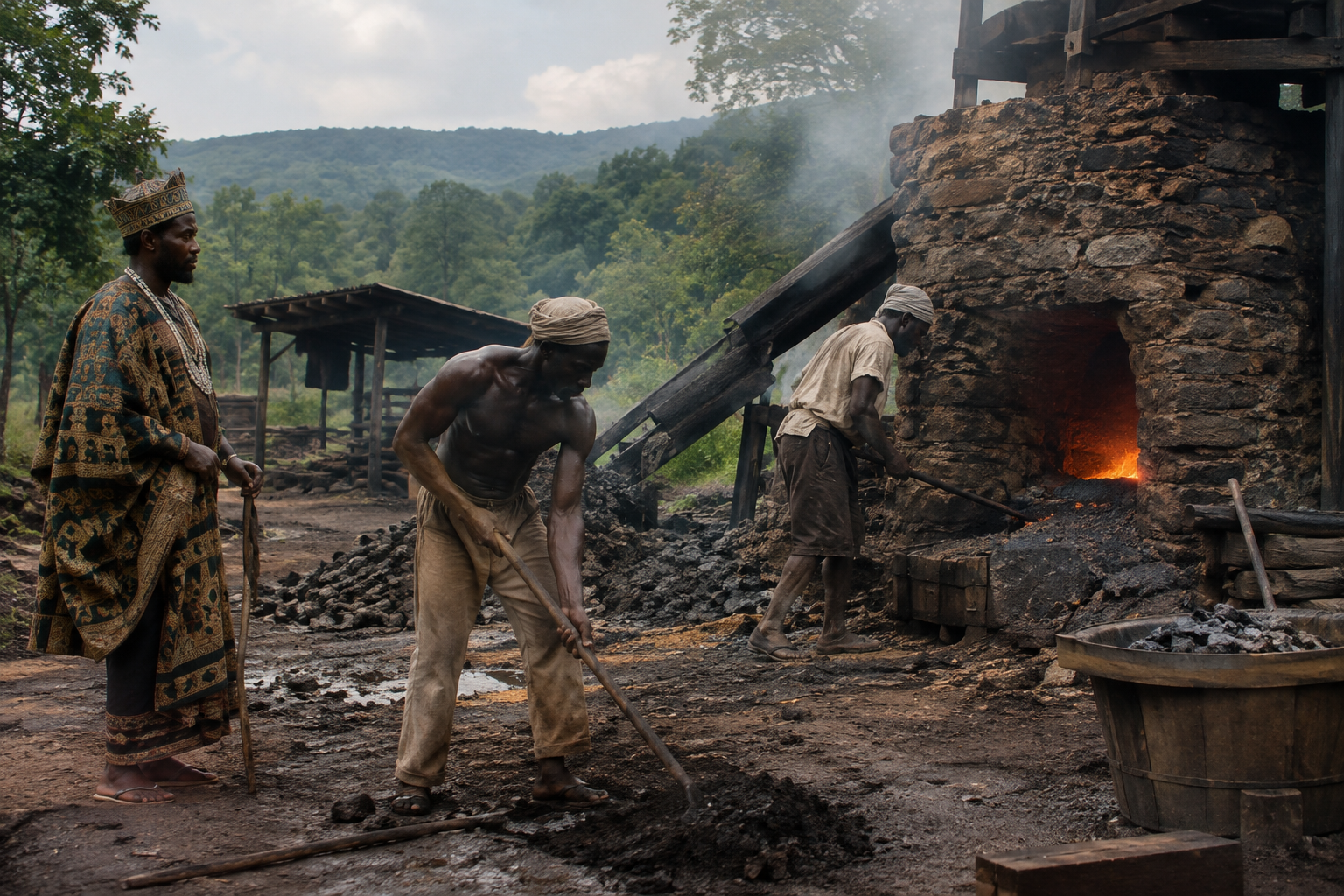
At Ngongo Mbata in the old Kongo Kingdom, one man dated to around AD 1700 carries a particularly telling Y-chromosome line: E1b1a1a1a1c1a1. He appears in the record as sample NGO001. That may look like a string of letters and numbers, but in historical terms it places a direct paternal line inside one of the most important African polities of the early modern Atlantic world: a Christian kingdom, a trading power, and a place deeply entangled with the upheavals of the slave trade.
The same branch also appears in two men from a very different setting: the remains of enslaved laborers at the Catoctin iron-working furnace in antebellum Maryland, samples I15336 and I15340, dated here to around AD 1810. Taken together, these finds do not give us a simple family story. What they do offer is something more historically valuable: a glimpse of a paternal lineage associated with West-Central African ancestry on both sides of the Atlantic, in a kingdom in Africa and in a forced-labor landscape in the United States.
Y-DNA follows one narrow line of descent: father to son, back through a single paternal chain. It does not describe a person's whole ancestry, culture, or identity. Still, when a branch such as E1b1a1a1a1c1a1 turns up in historically meaningful contexts, it can help anchor paternal ancestry within real movements of people.
This matters especially for African Atlantic history, where written records are often fragmentary, biased, or brutally incomplete. A narrow Y-chromosome branch cannot identify an ethnicity by itself, but it can connect living testers to broad regions and lineages that were part of major historical processes. In this case, the most useful pattern is not an ancient Bronze Age migration or a royal pedigree. It is the documented presence of this paternal line in West-Central African and African American contexts shaped by the Atlantic slave trade.
Ngongo Mbata was no obscure village. It lay within the Kongo world, a powerful Central African kingdom that became one of the best-documented African states in early encounters with the Portuguese and the wider Atlantic economy. By the 16th to 18th centuries, Kongo was politically complex, Christianized at elite levels, and deeply affected by warfare, commerce, and slaving.
That makes NGO001 especially interesting. A man from this setting carrying E1b1a1a1a1c1a1 helps place the lineage in a concrete historical landscape rather than an abstract map. We are not looking at a vague claim about "Africa" in general. We are looking at a paternal line present in a named kingdom with known ties to the Atlantic world.
An ancient DNA study of the region published in Science Advances helped bring attention to this sort of evidence from the Kongo sphere. For descendants researching paternal ancestry today, that sort of context matters enormously. It suggests that this branch can belong to lineages rooted in the societies of West-Central Africa that were drawn, willingly or unwillingly, into early modern Atlantic history.
African DNA in early historic burials
The Maryland samples shift the story from African kingdom to American industrial slavery. I15336 and I15340 come from enslaved laborers associated with the Catoctin iron-working furnace, dated here to around AD 1810. This is a harshly specific context: not a general plantation landscape, but an industrial site where enslaved people worked in the demanding world of charcoal iron production.
That setting matters because it shows how African-descended paternal lines were carried into all sorts of labor regimes in the Americas. Enslavement in the United States was not only agricultural. Furnaces, foundries, docks, towns, and workshops also depended on coerced African and African American labor. A branch like E1b1a1a1a1c1a1 appearing here reminds us that Y-DNA can survive as a trace of ancestry even where names, kinship ties, and origins were systematically broken by slavery.
Research on colonial and early American burials in Maryland has increasingly shown how genetics can recover family patterns, ancestry, and displacement where the archive is thin or distorted. One related example from the region is worth exploring here:
What we should not do is force a direct one-to-one link between the Kongo sample and the Maryland men. The evidence does not show that NGO001 was their ancestor, nor that all enslaved people at Catoctin came from Kongo. But the pairing is still historically powerful. It places the same narrow paternal branch in two connected worlds: one in Africa before or during the great Atlantic disruptions, and one in the United States after those disruptions had remade countless lives.
The broader parent haplogroup behind E1b1a1a1a1c1a1 belongs to a set of Y-chromosome lineages common in many parts of sub-Saharan Africa, especially among populations shaped by the long expansions of Niger-Congo-speaking farming communities. That broader fact is useful background, but it should not be confused with a precise origin story for this exact subclade.
What the current sample set really supports is narrower and better: this branch is documented in historically recent individuals tied to West-Central African and African diasporic settings. In other words, the strongest evidence here is not prehistoric speculation but early modern and modern-era continuity across the Atlantic rupture.
This is also a good reminder that lineages do not travel alone. The men who carried this Y-DNA would have had mothers, grandmothers, spouses, neighbors, and descendants from many different backgrounds. A paternal branch can mark one thread in a family history, while the genome as a whole reflects a much wider web of ancestry and experience.
The great historical force linking Ngongo Mbata and Catoctin is, of course, the Atlantic slave trade and its aftermath. The Kongo Kingdom and neighboring regions were drawn into centuries of political violence, alliance-making, raiding, and export of captives. In North America, African-descended communities then rebuilt life under conditions of enslavement, surveillance, forced labor, and family separation.
That is why even a small cluster of Y-DNA matches can be so evocative. They do not solve every genealogical problem, but they can restore historical depth to lineages that written records treated as disposable. A preprint study connected with the Catoctin material, available at bioRxiv, reflects the growing use of archaeogenetics to examine such communities with greater precision and care.
The broader archaeological lesson is not that one haplogroup equals one people. It is that named sites, dated burials, and carefully recovered DNA can reconnect paternal lines to real human settings. For African diaspora research, that is no small thing.
DNA and slavery in early America
If your paternal line falls under E1b1a1a1a1c1a1, the clearest historical signal in the present evidence is a connection to African paternal ancestry with documented presence in West-Central African and African American contexts. The most distinctive feature of this branch, as shown here, is not aristocratic glamour or deep prehistoric mystery, but its appearance in lives shaped by the Kongo world and by the forced Atlantic diaspora.
That makes it a lineage with unusual historical weight. It points toward paternal roots in societies that helped shape the early modern Atlantic, and toward descendants who endured one of the greatest dislocations in human history while still passing that line on.






Comments