Haplogroup D1a2a

– 5 min read


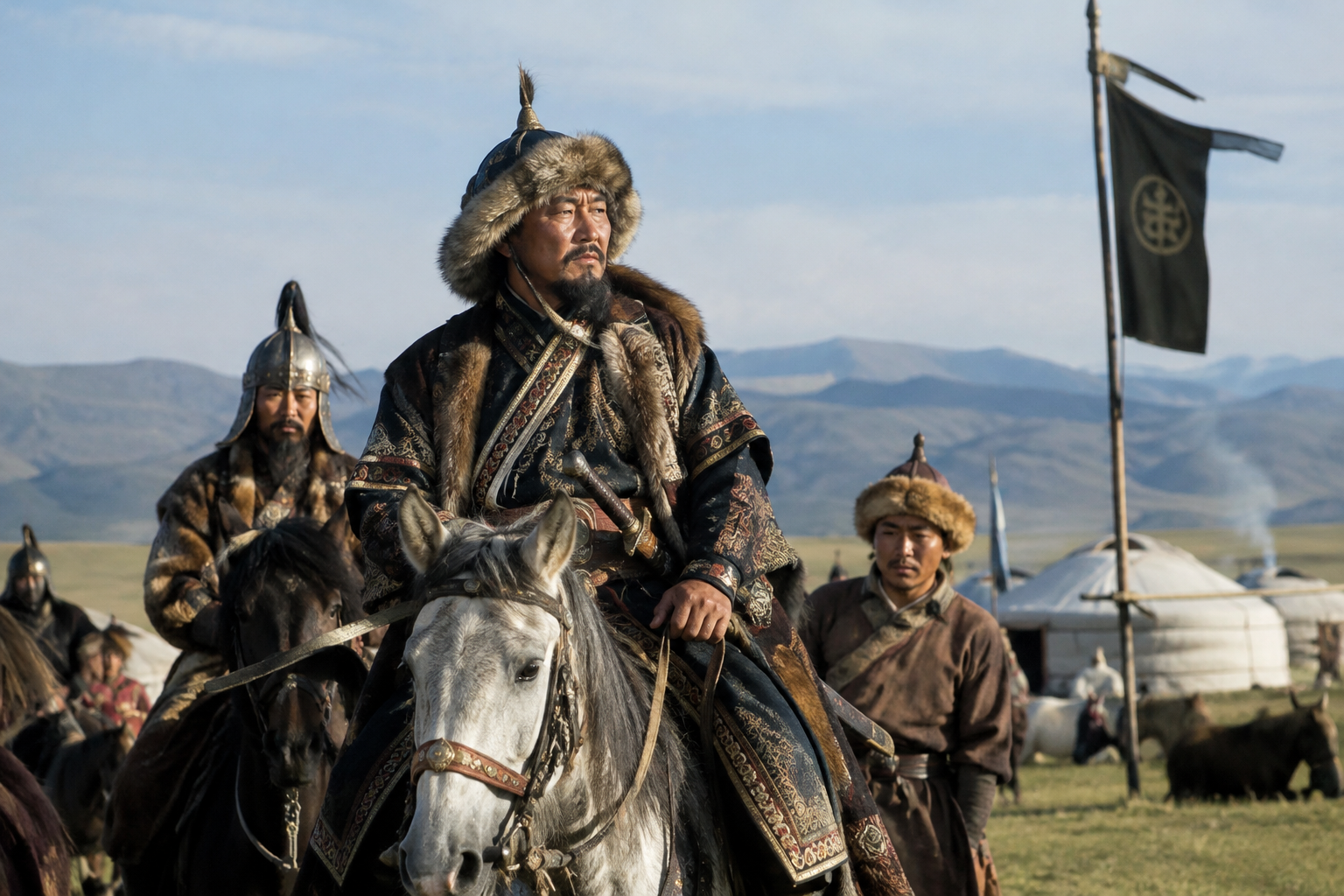
At Takhiltyn Khotgor II in Mongolia, one man buried in the era of the Mongol Empire has become a small but telling witness to a much larger paternal story. The individual known as TAH002, dated to around AD 1300, is associated here with the Y-DNA haplogroup D1a2a - a lineage far less commonly discussed in steppe history than the better-known paternal branches linked to western Eurasian or more widespread East Asian expansions.
That is what makes the sample so interesting. A single medieval burial does not define a people, a dynasty, or an empire. But when a lineage like D1a2a appears in a Mongol-period context, it reminds us that the empire was not a neat genetic bloc. It was a political world built across older populations, older local histories, and older paternal lines that had already been present in Inner and East Asia long before the Mongols rode out across Eurasia.
The site label matters here. Takhiltyn Khotgor II places TAH002 in a real archaeological landscape of medieval Mongolia, not in an abstract cloud of DNA results. Even with limited published detail about this particular burial in the present record, the dating alone places him in the centuries when Mongolia stood at the center of an imperial system stretching from East Asia to eastern Europe.
That context is important because Y-DNA follows a direct paternal line only: father to son across generations. It does not describe a person's whole ancestry, language, or social identity. So the significance of D1a2a in TAH002 is not that it tells us he was somehow outside the Mongol world, but that it shows the Mongol world included men whose paternal roots belonged to lineages with deeper regional histories than imperial labels alone can capture.
A broader ancient DNA study of the Mongolian steppe has helped show just how varied that landscape could be over time, with changing mixtures of eastern steppe, western steppe, and neighboring populations across different periods. For readers interested in that wider background, MyTrueAncestry has already explored it in Ancient DNA and Genetic History of the Mongolian Steppe.
Haplogroup D is one of the older and more distinctive Y-chromosome branches in Asia, with a history especially associated with parts of East Asia and nearby regions. But one must be careful here: D1a2a is not the same thing as all of haplogroup D, and it should not automatically inherit every migration story ever told about the wider parent branch.
What we can say responsibly is narrower and more useful. TAH002 shows that a man associated with D1a2a was present in a Mongol Empire setting in Mongolia around AD 1300. That is a concrete data point. It places this paternal branch inside the human reality of the empire itself, and not merely in distant prehistory or in modern frequency maps.
It also reminds us that empires often preserve older lineages as much as they spread new identities. Political unification does not erase local paternal diversity overnight. Indeed, one of the lessons archaeogenetics keeps teaching is that the men living under a single banner may belong to very different paternal histories.
Modern imagination often flattens the Mongol Empire into a story of one conquering lineage radiating outward. There were, of course, famous elite descent lines in the imperial world, and ruling clans mattered enormously in politics and legitimacy. But the archaeology of the steppe is full of ordinary lives, local communities, and regional continuities that sit beneath that grander narrative.
TAH002 belongs in that quieter history. His D1a2a assignment suggests that when we examine the population living in Mongol-period Mongolia, we are not simply looking at one newly created imperial gene pool. We are seeing the descendants of earlier East and Inner Asian populations who were drawn into, governed by, or otherwise living within Mongol imperial structures.
This point becomes even clearer when we compare steppe history across longer timescales. The steppe repeatedly brought together people of different ancestries and social roles: herders, frontier communities, mobile elites, and settled populations connected by trade and warfare. The result is not sameness, but layering.
An ancient DNA study linked to these materials can be found here: https://www.biorxiv.org/content/10.1101/2020.03.25.008078v1.supplementary-material. It is best read not as a source of simple ethnic labels, but as part of the growing scientific effort to reconstruct how populations on the Mongolian steppe changed through time.
It is tempting to dismiss a lone sample as too slight to say anything worthwhile. But archaeology is often like that: one inscription, one burial, one coin, one broken wall - each is small on its own, yet each fixes a human presence in place and time. TAH002 does exactly that for D1a2a in a Mongol imperial setting.
And there is another reason the sample matters. Lineages such as D1a2a are often overshadowed in popular discussions by branches that later became numerically dominant or historically famous. Ancient DNA is useful precisely because it interrupts those habits. It shows us that the past was not peopled only by the lineages that happen to loom largest in modern public imagination.
Readers following East Asian paternal history more broadly may also find it useful to look at work on long-term regional Y-chromosome patterns, especially where inland and coastal movements are compared across ancient East Asia.
East Asian Y-Chromosome History
One of the most interesting historical questions raised by TAH002 is not whether D1a2a was "Mongol" in some absolute sense, but how old local lineages persisted through periods of enormous political transformation. Mongolia in the 13th and 14th centuries was the core of an empire, yet it was also a homeland with its own demographic depth.
That is a familiar pattern in ancient DNA studies far beyond Mongolia. Large political systems - Roman, Tang, Viking, or Mongol - often unite populations that are more diverse than the imperial ideology suggests. The men buried within those worlds may share institutions, military obligations, or burial landscapes without sharing one recent paternal origin.
For comparison with another medieval East Asian setting where genetics helps illuminate social organization rather than simply naming populations, see MyTrueAncestry's discussion of Ancient DNA reveals family ties, ancestry, sex, and bone disease in degraded Song Dynasty remains.
There is also a wider frontier story here. Inner Asia was never sealed off from northern China, Siberia, the Altai, or the Gansu corridor. Movements of people, marriage networks, and shifting polities repeatedly crossed these regions. That does not let us assign TAH002 to a specific migration route. But it does make his D1a2a lineage part of a much older northern Asian human geography.
For a deeper look at population history on China's northwestern and steppe-facing frontiers, another useful comparison is MyTrueAncestry's piece on Ancient DNA reveals population history and burial practices in Bronze Age Gansu.
The clearest lesson from D1a2a in TAH002 is that this branch was present in Mongolia during the Mongol Empire, carried by at least one man living in that imperial age. That is not a dynastic claim, and it is not proof of descent from any famous house. What it does offer is something more solid: evidence that this paternal line belonged to the real population history of Inner Asia, including the world ruled from the Mongolian steppe in the 13th and 14th centuries.
For someone exploring D1a2a today, that makes the haplogroup historically vivid. It places your paternal line, or a closely related one, not only in deep Asian prehistory but in the documented human landscape of medieval Mongolia - where empire, mobility, and long local continuity met in the same ground.






Comments