Haplogroup 93
– 4 min read


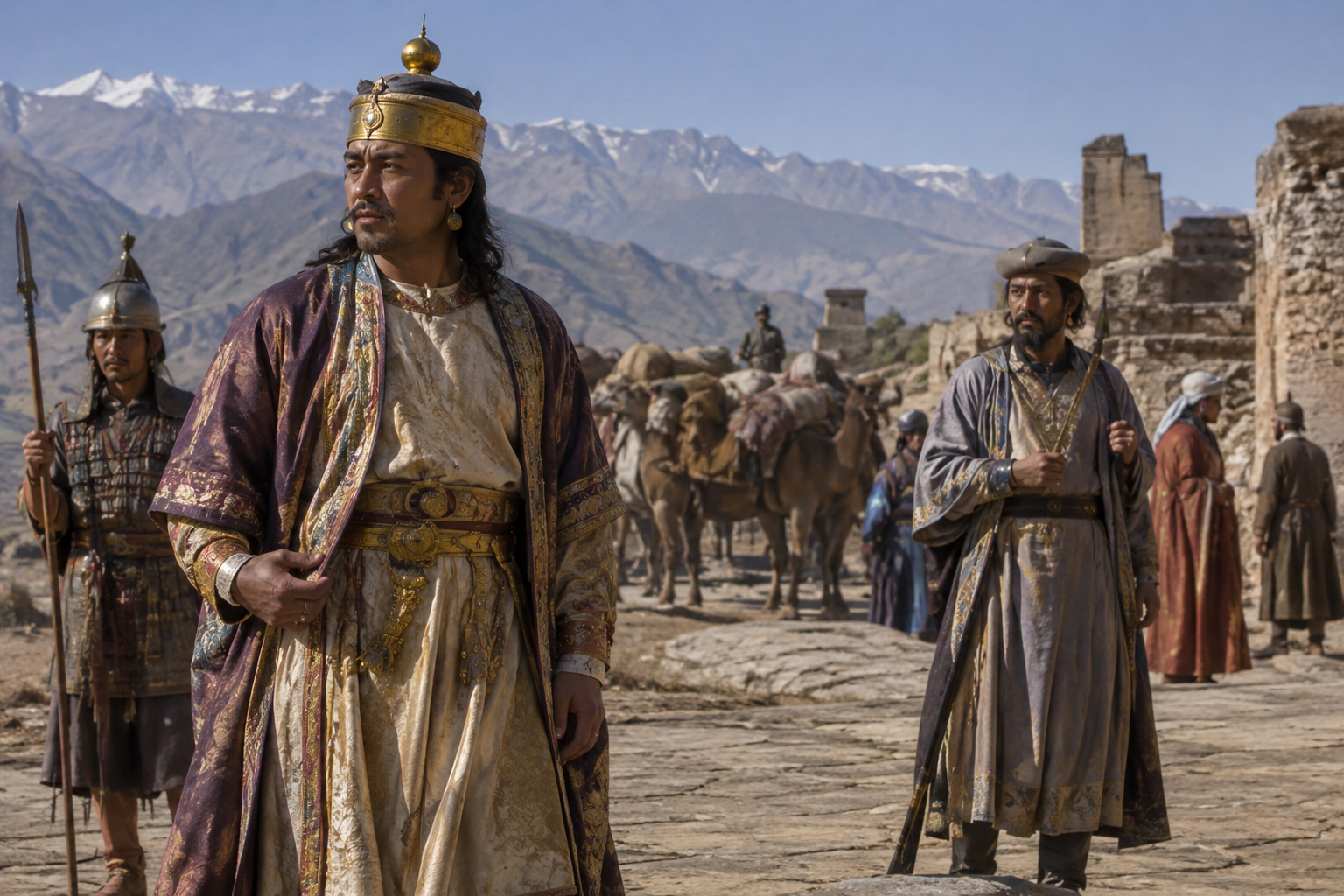
One of the few firm ancient signposts for Y-DNA haplogroup 93 comes from a man identified as L8005, dated to around AD 220 in Central Asia during the Late Kushan Empire. That may sound like a sparse entry, but in archaeology a single securely placed individual can be wonderfully revealing. Here is a paternal line appearing not in a mythic homeland or a royal pedigree, but in one of the great crossroads societies of the ancient world.
That setting matters. The Kushan world linked northern India, Afghanistan, and the oases and corridors of Inner Asia. It was a political empire, yes, but also a zone of traffic: merchants, soldiers, monks, scribes, camp followers, local farming communities, and long-distance families all moved through it. So when haplogroup 93 turns up in a Late Kushan context, the real question is not simply where this lineage was "from", but what sort of historical world could carry a paternal line into such a connected landscape.
The safe starting point is the sample itself. L8005 is associated with the Late Kushan Empire in Central Asia, around the early 3rd century AD. That places him in a period when Kushan power was changing shape, with older imperial structures under pressure and regional networks still very much alive. Even without an elaborate grave description, the context is enough to place this individual inside a historically busy zone rather than an isolated pocket.
For readers tracing Y-DNA, it is worth stating this once and clearly: a Y haplogroup tracks one direct paternal line only. It does not summarize a whole person's ancestry, language, or identity. A man living under Kushan rule could have had mixed ancestry from several regions while still carrying one paternal branch inherited through his father's father's line.
The value of L8005, then, is not that he "explains" haplogroup 93 on his own. It is that he gives the lineage a documented foothold in a real archaeological-historical setting: Central Asia at the meeting point of Iranian, South Asian, and Inner Asian worlds.
With a designation as short as 93, caution is essential. In genetic genealogy, broad numerical or shorthand labels can sometimes stand in for a branch used within a particular platform or reporting system, rather than a fully spelled-out terminal SNP in the style many researchers expect. So the responsible approach is not to assign grand migrations or precise prehistoric origins to "93" unless those are directly supported by the ancient evidence at hand.
What we can say is more modest and more useful. This lineage is represented in an ancient male from the Late Kushan sphere. That makes haplogroup 93 part of the documented paternal landscape of historical Central Asia in the centuries when long-distance exchange tied Bactria, Gandhara, and neighboring regions into wider Silk Road systems.
That is, in its own way, quite exciting. Ancient DNA often works like archaeology itself: not by producing a neat family tree for whole civilizations, but by pinning particular lineages to particular places and periods. Haplogroup 93, in this case, is attached to a man who lived in a deeply connected imperial borderland.
The Kushan Empire is often flattened into a textbook phrase - "Silk Road empire" - but the reality was more interesting. It emerged from earlier movements and political formations in a region already shaped by Achaemenid, Hellenistic, nomadic, and local traditions. By the time of the Late Kushan period, Central Asia was home to populations with layered ancestries and multiple cultural affiliations.
That broader picture fits what ancient DNA has repeatedly shown across Eurasia: political labels do not map neatly onto biological descent. A Kushan-period individual might be culturally tied to an imperial system, economically tied to trade routes, and genetically tied to lineages with much older regional histories. L8005 belongs squarely in that sort of world.
A regional ancient-DNA study touching Central and South Asian interaction zones is available through this research paper. Even where one article does not answer every question about a single paternal branch, such work is important because it frames the population complexity of the landscapes in which samples like L8005 lived.
Sogdians and Silk Road ancestry
If there is one historical lesson to draw from this evidence, it is that Central Asia rarely behaved like a sealed container. Steppe confederations, oasis towns, farming settlements, mountain corridors, and imperial administrations all interacted over long periods. Paternal lineages could persist locally, spread through mobility, or reappear in new political settings without requiring a single dramatic migration story.
That is especially important for anyone tempted to read one ancient Y result as the badge of a fixed ethnic identity. The man behind sample L8005 may have spoken a language now lost to us, worshipped in a local or imperial tradition, and lived among neighbors whose paternal lines were entirely different. His haplogroup tells us something real - but only one thing among many.
Archaeology is full of such humbling reminders. Empires look tidy on maps; cemeteries and genomes usually do not. They show households, local communities, strangers, descendants of earlier populations, and newcomers all folded together in the same historical moment.
There is a tendency to underrate isolated ancient samples. Yet for lesser-documented paternal branches, one credible placement can be far more valuable than pages of speculation. L8005 anchors haplogroup 93 in an identifiable imperial-era Central Asian context, giving descendants of this line at least one defensible historical horizon to think with.
It also invites better questions. Instead of asking whether haplogroup 93 belonged to one modern nation or one ancient people, it is more fruitful to ask how paternal lines survived within the constant reshuffling of Central Asian history. That is where archaeology and genetics work best together: not in tidy ethnic labeling, but in reconstructing the human traffic of real places.
For someone researching haplogroup 93 today, the most solid ancient clue in this evidence is a man living around AD 220 in the Late Kushan world of Central Asia. That does not prove a single origin point for all later bearers of the lineage, nor does it turn a Y-chromosome branch into a complete ethnic biography. What it does offer is something better than legend: a documented glimpse of this paternal line in one of antiquity's great contact zones, where empire, trade, and mobility met face to face.






Comments