Haplogroup T1a3b2

– 5 min read


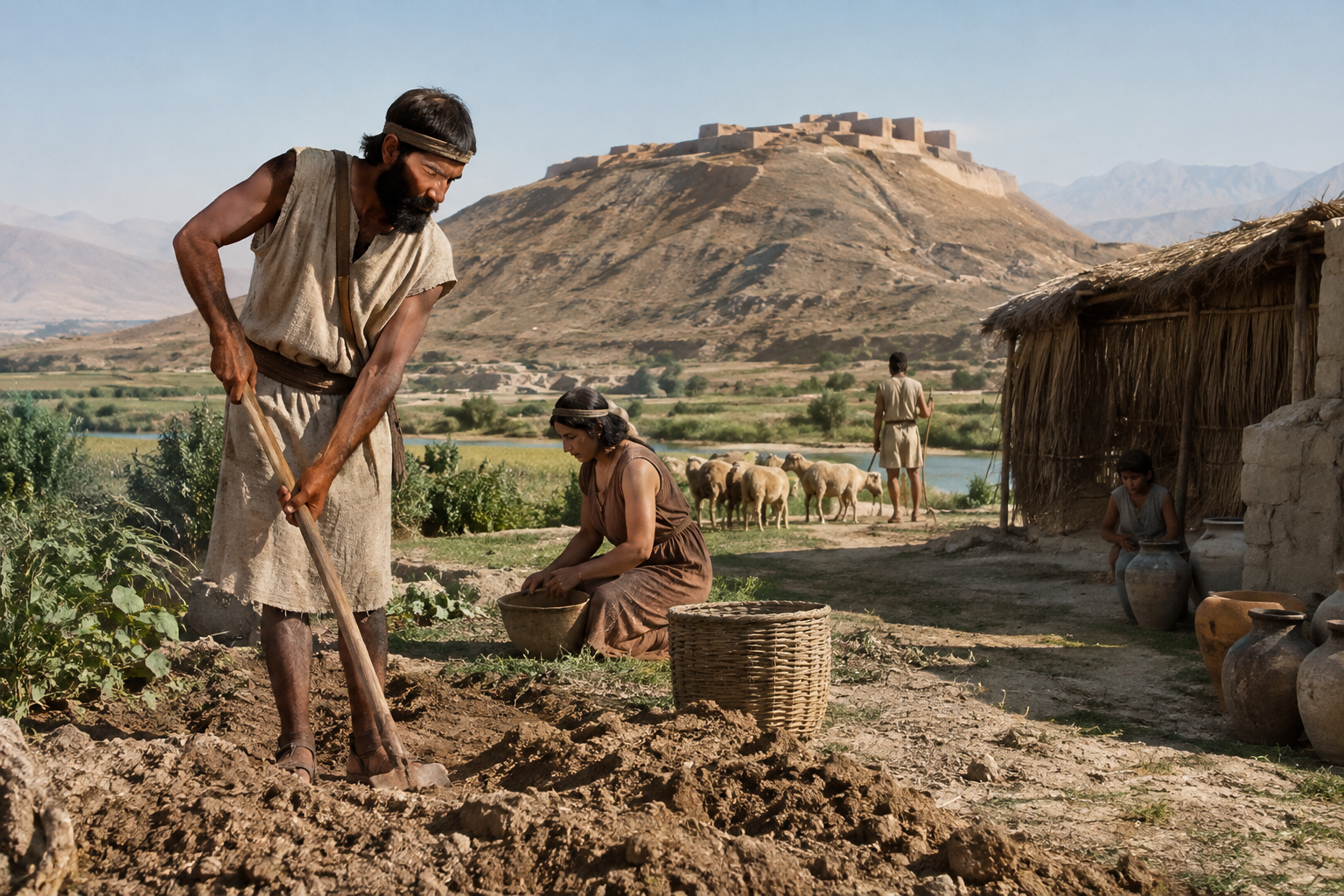
At Tepe Hissar on the northeastern Iranian plateau, archaeologists uncovered a Bronze Age individual now known in ancient-DNA work as I2514, dated to around 2380 BC. It is a modest-looking label for a very large subject. This man lived in a world of workshops, exchange routes, and early urban connections stretching across Iran, Central Asia, and Mesopotamia, and he matters here because he has been associated with the Y-DNA haplogroup T1a3b2.
That does not mean Tepe Hissar was somehow a "T1a3b2 culture", nor that one paternal line tells us everything about the man. Y-DNA tracks only a direct male line. But when a branch like T1a3b2 appears in a securely ancient setting, it gives us something precious: a real point on the map, in real time, for a lineage that today can otherwise feel frustratingly abstract.
Tepe Hissar, near modern Damghan, is one of those sites that repeatedly turns up when scholars try to understand the long history of northeastern Iran. It was occupied across several prehistoric phases and sat in a region that linked the Iranian plateau to the wider worlds of southern Central Asia and beyond. By the late 3rd millennium BC, when I2514 lived, this was not an isolated backwater. It was part of a corridor of movement, craft production, and cultural contact.
That is what makes the T1a3b2 association so interesting. Haplogroup T is a wider paternal lineage with a scattered but often telling distribution across parts of West Asia, Northeast Africa, South Asia, and the Mediterranean. A specific subclade such as T1a3b2 is much narrower. One should be careful not to pour the whole grand history of haplogroup T into this one branch, still less into this one man. Yet a Bronze Age occurrence on the Iranian plateau fits very neatly with the broader impression that some T lineages were established in the older population landscapes of Southwest and South-Central Asia.
An ancient DNA study that helped place Iranian and neighboring populations into a broader prehistoric framework can be found here. Even where a paper is used mainly for regional context, the value lies in showing that ancient Iran was genetically varied and historically connected rather than sealed off behind mountains and deserts.
There is a temptation, with rare or less frequently discussed haplogroups, to leap straight from one ancient sample to a sweeping migration saga. Better to do the opposite. Start small. I2514 tells us that a paternal line linked with T1a3b2 was present in Bronze Age northeastern Iran at roughly the time when nearby regions were seeing major developments in metallurgy, long-distance trade, and increasingly complex settlement systems.
That date matters. Around 2380 BC, the Iranian plateau was not merely receiving influences from elsewhere; it was participating in the making of Bronze Age Eurasia. Communities in and around Iran were tied into exchange networks that could carry raw materials, finished objects, techniques, and people over long distances. A paternal lineage present in such a setting may have deep local roots, may reflect earlier movements, or may represent the ordinary demographic texture of a connected region. What it does not allow us to do is identify a language, an ethnicity, or a political allegiance from Y-DNA alone.
Still, ancient samples matter because they anchor discussion. For many present-day testers with T-lineages, family history tends to become foggier as one moves beyond documented surnames and parish records. A Bronze Age individual like I2514 does not supply a family tree. He does something more archaeological and, in some ways, more useful: he proves that this paternal heritage was part of the human landscape of ancient Iran more than four thousand years ago.
Northeastern Iran is often best understood as a meeting ground. To its west lay the great lowland civilizations of Mesopotamia; to its east and northeast, the routes leading toward Central Asia; to its south, the broader plateau and the zones that connected onward toward the Persian Gulf and South Asia. Tepe Hissar sits in precisely the sort of place where archaeologists expect complexity rather than purity.
That is especially important for interpreting T1a3b2. Modern readers sometimes imagine haplogroups as badges of peoples moving about in neat blocks. Ancient reality was less tidy. A paternal line could persist through local continuity, marry into incoming groups, move with traders or herders, or spread through small-scale family expansion over many centuries. In a place like Tepe Hissar, the most responsible reading is not that T1a3b2 "came from" one single dramatic event, but that it belonged to the long and mixed human history of the plateau.
This wider Iranian and trans-regional setting is one reason MyTrueAncestry readers may also find value in broader regional pieces on continuity and change, especially where archaeology and genetics are read together rather than as rival stories.
If your own Y-DNA falls under T1a3b2, the Tepe Hissar evidence gives you a sober but intriguing clue. Your direct paternal line belongs to a branch with at least one documented foothold in Bronze Age Iran. That is already more historically specific than many lineages can presently claim. It places your paternal ancestry within a zone that was central to prehistoric interaction across western and central Eurasia.
But precision has its limits. The ancient sample does not prove descent from Tepe Hissar itself, nor from this exact man, nor from any named historical people. It also does not mean every T1a3b2 line expanded from one Bronze Age Iranian population in a simple outward wave. Lineages branch, disappear, persist, and reappear in the evidence unevenly, largely because ancient DNA depends on who happened to be buried where conditions allowed recovery.
That unevenness is worth stressing because haplogroup T is still less densely sampled in ancient contexts than some better-known West Eurasian Y lineages. In other words, the evidence is suggestive, not complete. Each new ancient result has the potential to redraw the map slightly.
Tepe Hissar is also a useful reminder that the ancient world was not built only from the better-publicized dramas of the steppe, the Nile, or the Roman Empire. The Iranian plateau was one of the great engines of prehistoric connectivity. It linked ecological zones, carried technologies, and hosted populations that were neither frozen in place nor endlessly replaced. For haplogroups such as T1a3b2, that matters enormously, because the branch makes most sense when placed in these older landscapes of contact.
Readers interested in how ancient DNA keeps changing our picture of Iranian and neighboring populations may also enjoy work on Mesopotamian and plateau-linked population change, where the same broad problem appears again and again: continuity mixed with movement, never quite reducible to a single origin story.
The most distinctive thing we can say about T1a3b2 from the evidence here is pleasingly concrete: this paternal branch is tied, at least in one documented ancient case, to the Bronze Age world of Tepe Hissar in Iran, through individual I2514 around 2380 BC. That places the lineage in a serious archaeological setting at a time when the Iranian plateau was one of Eurasia's great connective tissues. For anyone researching this haplogroup today, the lesson is not fantasy genealogy but something better grounded: your direct paternal line belongs to a history that was already present in an old and influential crossroads of the ancient world.






Comments