Haplogroup R1b1a1b1b3a1a1b

– 6 min read


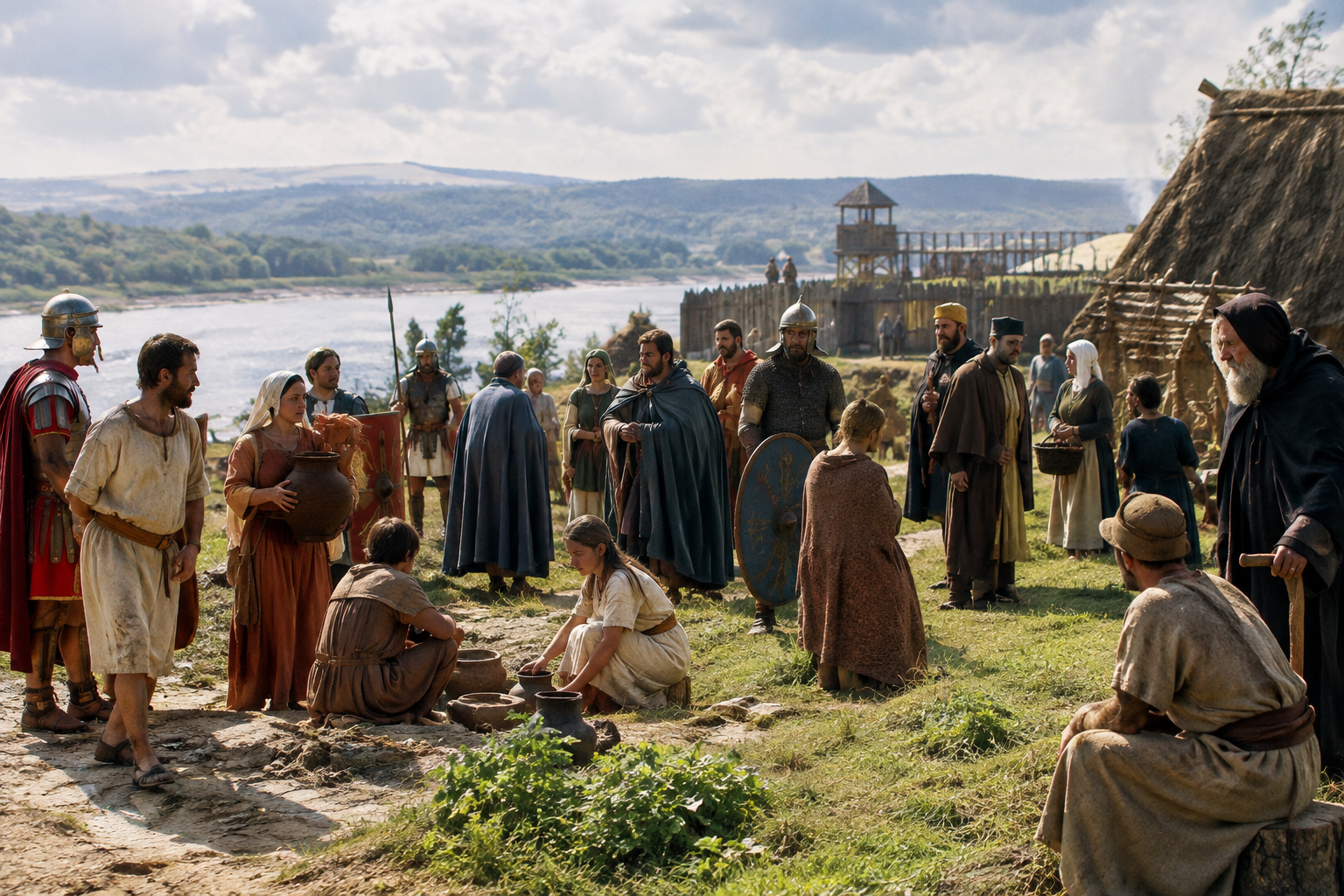
Some Y-chromosome lineages announce themselves with a neat national label in popular imagination, and then archaeology comes along to spoil the simplicity. Haplogroup R1b1a1b1b3a1a1b belongs to that more interesting category: a paternal line that sits within the wider R1b family, yet appears in ancient contexts scattered across the Balkans, central Europe, Roman frontiers, early medieval cemeteries, and later historical landscapes. It is interesting not because it can be made to stand for one people, one kingdom, or one clan, but because it refuses that kind of tidiness.
That matters for anyone exploring paternal ancestry. Y-DNA haplogroups trace one direct male line only: father to father to father, across many generations. They do not describe a person's whole ancestry, culture, language, or identity. But when a lineage like this appears in ancient DNA, it gives us something wonderfully concrete: a narrow thread that can be followed through graves, settlements, migrations, and changing political worlds.
R1b1a1b1b3a1a1b is a very specific branch within the wider R1b tree, one of the major Y-DNA lineages found across much of western Eurasia. For a branch this narrow, caution is essential. The full prehistoric story of broad R1b cannot simply be pasted onto this one subclade as if nothing changed along the way. What we can say more safely is that the samples supplied here place this paternal line in a long arc of European history, with especially notable appearances in the Balkans, central Europe, and regions shaped by Roman and post-Roman mobility.
The pattern is striking. Some of the earliest supplied evidence comes from the southern Balkans and the Carpathian-Balkan zone, while later examples turn up among communities linked with Romans, frontier populations, Goths, Franks, Merovingians, Carolingians, Avars, and medieval regional societies. That does not mean the haplogroup "belonged" to all of them in some exclusive way. It means that men carrying this paternal line moved through the same corridors of history that armies, traders, settlers, and local communities did.
Explore Celtic migrations in ancient DNA
If we begin with the oldest material in the dataset, the story opens in southeastern Europe. Sample I7231, from Ancient North Macedonia Ulanci-Gradsko dated to 860 BC, places this paternal branch in a landscape that sat between the Aegean world and the inland Balkans. Another early sample, I14690, from Ancient Illyrian Albania Cinamak Kukes District dated to 1100 BC, suggests that related paternal lines were present further west in the mountainous western Balkans.
Go further back and the trail reaches the Bronze Age. I23209 from Bronze Age Maros Ostojicevo Serbia dated to 1950 BC and I23207 from Early Bronze Age Kikinda Mokrin Serbia dated to 1800 BC show that this lineage, or a very close paternal branch, was already established in the broader Danube-Balkan world long before Rome, long before medieval kingdoms, and long before surnames.
These finds are important because they offer deep time without forcing a single grand theory. One plausible reading is that this branch had a long-standing presence somewhere in southeastern or central Europe before later historical expansions spread it more widely. But that remains a hypothesis, not a finished verdict. Ancient DNA gives us points on the map, not omniscience.
By the Roman era, the picture becomes even more revealing. Sample 3298s, from the Gallic Cenomani Tribe Italy Verona Seminario Vescovile dated to 300 BC, places the lineage in northern Italy before the full imperial period. That matters because northern Italy was one of the great contact zones of later prehistory and early history, shaped by local Italic groups, Celtic-speaking communities, and Roman expansion.
Then come the imperial and late Roman samples: VIC004 from Roman Era Cambridge Vicars Farm dated to 200 AD, I15552 from Late Imperial Roman Serbia Timacum Kuline Ravna Village dated to 380 AD, I26718 from Late Roman Trogir Dragulin Croatia dated to 350 AD, and STRAZ_I_14 from Late Roman Frontier Straubing Azlburg Germany dated to 400 AD. Taken together, these are not the remains of one marching tribe. They are evidence of a paternal line appearing in very different corners of the Roman world and its edges: Britain, the Balkans, the Adriatic, and the Danube frontier.
That is exactly what empire does. It mixes garrisons, farmers, merchants, hostages, settlers, and local families into new social worlds. A Y-DNA lineage found in Roman Cambridge is not therefore "Roman" in any ethnic sense. Nor is a similar lineage from Serbia or Germany proof of common recent descent. But the repeated appearance of this branch in Roman-period contexts does suggest that it moved well along the roads, rivers, and military zones that bound Europe together.
Read about Roman and early medieval Britain
The collapse of Roman imperial authority did not make populations stand still. If anything, it made movement harder to classify. Sample CSB-3 from Dark Ages Hungary Gothic Tribe Csongrad-Berzsenyi utca dated to 400 AD and RKF245 from Migration Period Outlier Hungary Rakoczifalva Szolnok dated to 500 AD belong to precisely that untidy post-Roman age, when labels like Gothic, Roman, local, and newcomer overlapped more than older textbooks liked to admit.
In the Merovingian world, the lineage appears again in Mln43 from Merovingian Period Frankish Moemlingen Germany dated to 650 AD and IND014 from Merovingian Grave North Rhine-Westphalia Germany Alt-Inden dated to 600 AD. Further west, CGG023657 from Early Medieval France Burgundy Camp du Chateau dated to 849 AD extends the pattern into the Carolingian age.
Meanwhile the Carpathian Basin remains central to the story: I16759 from Avar Elite Early Medieval Hungary dated to 775 AD, I16752 and I16753 from Early Medieval Visonta Nagycsapas North Hungary dated to 750 AD, and AHS23 from Medieval Hungary Carolingian Empire Zalavar Varsziget dated to 850 AD. This is less a tale of replacement than of repeated reuse of the same strategic zone by different powers and communities. Paternal lines persisted, mixed, and reappeared under new political names.
The later samples are worth a glance too. I14687 from Late Medieval Albania Bardhoc Kukes District dated to 1550 AD and ELW028 from Post Medieval Plague Victim Ellwangen Germany dated to 1550 AD remind us that the story does not stop in the early Middle Ages. This lineage remained part of Europe's living population into the post-medieval world, from the Albanian uplands to southwestern Germany.
Explore Balkan roots and medieval Albania
How does all this connect to later noble families? Carefully. The supplied associations point to Clan Blair and Clan Mercer, both linked to Perthshire in Scotland. That is historically evocative, but it is not proof that every Blair or Mercer male carried this exact Y-DNA branch, still less that a Bronze Age man from Serbia was a direct ancestor of a Perthshire laird. Genetics and genealogy are cousins, not twins.
Even so, the setting is irresistible. Ardblair Castle in Perthshire, associated with Clan Blair, began as a 16th-century tower house, probably built by the Blairs of Balthayock. It later expanded into a laird's residence, reflecting a familiar Scottish transformation: from defensible household in an age of feud and local power, to a more settled aristocratic estate. The building itself preserves that transition in stone.
Innerpeffray Castle, associated here with Clan Mercer, stands by the River Earn and was built in the later 1400s by the Drummonds, a family close to royal power in Scotland. It began as a fortified tower house and was enlarged over time as the balance shifted from defence to comfort. Nearby were a church, chapel, and later Scotland's first free public lending library, which gives Innerpeffray a particularly appealing place in Scottish cultural history. By the 17th and 18th centuries it had become much more country seat than fortress, before later decline left the ruin we see remembered today.
What these castles provide is not genetic proof but historical geography. They root later family traditions in a real landscape of river crossings, lordship, architecture, rivalry, and adaptation. If a paternal lineage like R1b1a1b1b3a1a1b appears in families associated with such places, the broader background is one of long European mobility eventually settling into named houses, estates, and clans.
Discover the history of Clan Blair
The real fascination of R1b1a1b1b3a1a1b is not that it can be reduced to one tribe or one noble house. Quite the opposite. Its supplied ancient record ranges from Bronze Age Serbia to ancient Albania and North Macedonia, from pre-Roman Verona to Roman Cambridge, from late Roman Croatia and Germany to Merovingian graves and medieval Hungary. That is the footprint of a paternal line living through some of the busiest corridors in European history.
Written genealogy usually begins late and narrowly, often with landowners, surnames, or dynasties. Ancient DNA works differently. It shows us that long before charters, heraldry, and castles, paternal lines were already crossing rivers, frontiers, and political worlds. Later noble families such as the Blairs and Mercers belong to that much older human story, even when no direct line of descent can be demonstrated from the ancient samples themselves.
If this part of the past interests you, you might also enjoy exploring how Scottish paternal histories fit into wider regional patterns.
Explore North Sea migrations to Britain
R1b1a1b1b3a1a1b shows how one paternal line can appear in Bronze Age Balkan communities, Roman settlements, frontier cemeteries, and medieval landscapes before entering the world of clans and castles. MyTrueAncestry lets you compare your DNA with ancient individuals like these and discover where your results may intersect with the archaeological past. Those matches can offer remarkable clues and historical context, even when they do not prove direct descent from a specific ancient person or noble family.






Comments