Haplogroup R1b1a1b1a2a

– 6 min read


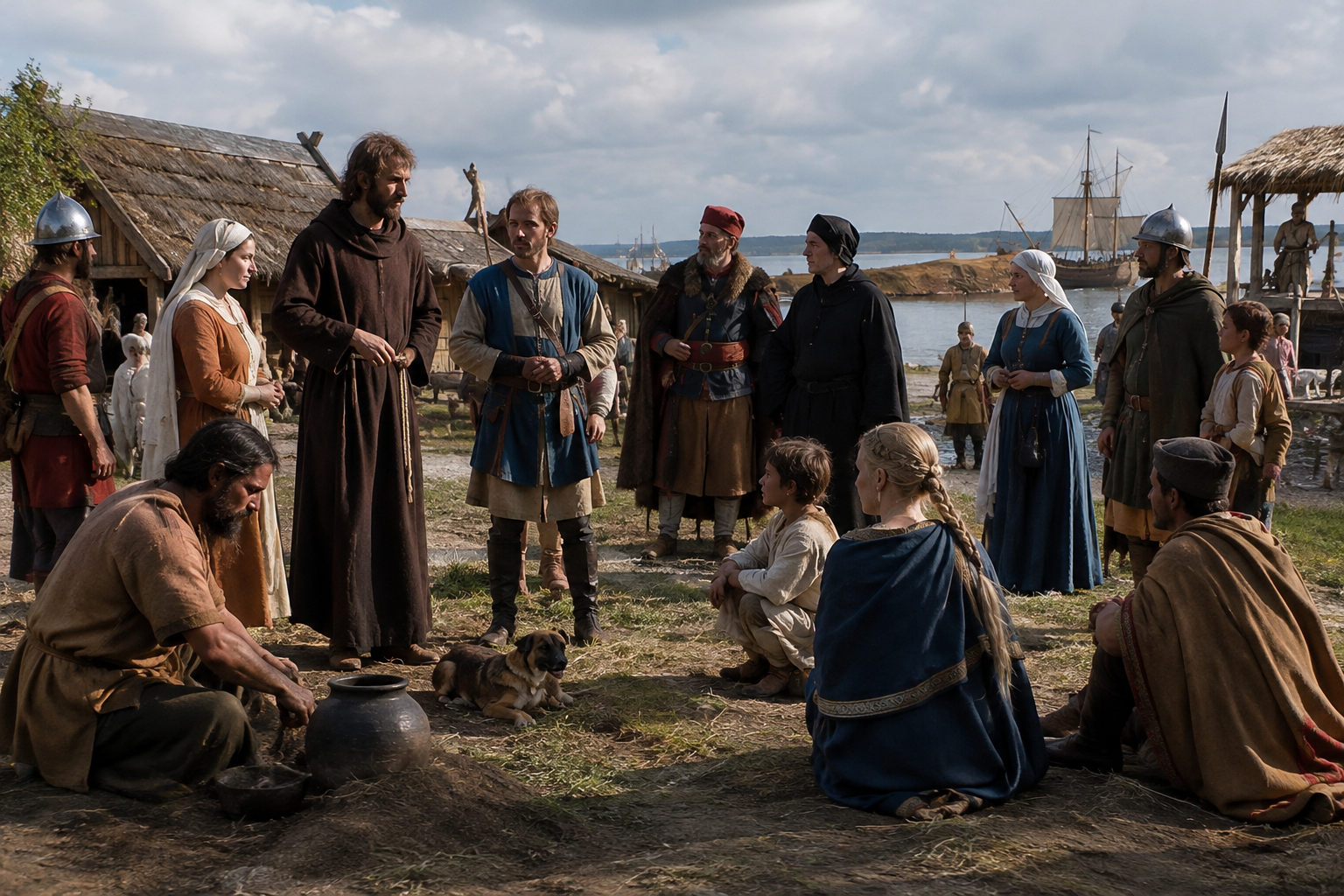
Some Y-chromosome lineages behave rather like stubborn place-names. They turn up in one century, then another, attached to people living in very different political worlds, and yet they hint at a much older paternal story beneath the noise of kingdoms, conquests, and changing identities. Haplogroup R1b1a1b1a2a is one of those lineages. It belongs within the wider R1b family, a major branch of Y-DNA that appears repeatedly in the archaeological record of western Eurasia, though any very specific subclade must be treated with caution and not simply equated with the whole history of R1b.
That point matters. Y-DNA tracks one direct paternal line only: father to father to father. It does not describe a person's full ancestry, culture, or identity. Still, when ancient DNA places related paternal branches in Bronze Age graves, Iron Age burials, medieval friaries, royal tombs, and even colonial-era contexts far from Europe, it gives us a remarkable way to think about continuity, mobility, and the long afterlife of male lineages in history.
R1b is a very large and internally diverse Y-chromosome family, and any discussion of R1b1a1b1a2a has to begin with that warning label attached. The broad parent lineage is deeply involved in the population history of Europe, especially from later prehistory onward, but the narrower branch named here should not automatically be projected backward into every culture associated with R1b as a whole.
What the supplied ancient evidence does allow us to say is that related paternal lines appear across a striking geographical spread: Iberia, Britain, France, the Low Countries, Central Europe, Italy, the Balkans, Scandinavia, and into later historical settings shaped by migration, empire, and trade. That does not prove a single tidy migration route. It does suggest that this branch belongs to a paternal world that became widely established across Europe and then persisted through many historical transformations.
Explore Celtic DNA and language spread
The prehistoric evidence is especially revealing because it shows this paternal signal appearing in quite different settings. In Iberia, EHU001 from Bronze Age El Hundido, Monasterio de Rodilla, Spain, dated to 2171 BC, and I7691 from Bronze Age Monte da Cabida, Evora, Portugal, dated to 1950 BC, place related paternal ancestry in the far west early on. In Britain, muw005 from a Bronze Age burial in Dorset at Monkton Up Wimborne, dated to 1900 BC, and I2464 from Bronze Age Boscombe Airfield, dated to 1680 BC, show comparable lineages on the other side of the Channel.
This is not a trivial pattern. It suggests that by the Bronze Age, related R1b paternal lines had already become part of communities stretching from Iberia to southern Britain. Add AITI_40, a 1788 BC North Alpine Bronze Age individual, I26829 from Bronze Age Wervershoof-Zwaagdijk in the Netherlands dated to 1450 BC, and WEZ57 from the Tollense Valley battlefield in Mecklenburg-Vorpommern dated to 1250 BC, and the picture broadens into a genuinely continental one.
Tollense is especially evocative. A paternal lineage found in a battlefield context reminds us that haplogroups are not abstract labels floating over maps. They belonged to actual men caught up in conflict, alliance, and local loyalties. The same is true of later Iron Age finds: CGG022455 from the Belgic Suessiones at Bucy-le-Long in France, dated to 274 BC; CGG101232 from Iron Age Hallstatt Hallein in Austria, dated to 340 BC; and I18531 from Celtic Hungary, Gyor-Moson-Sopron, dated to 250 BC.
Then there is Italy, where the record becomes deliciously complicated. The Gallic Cenomani burial at Verona Seminario Vescovile, dated to 300 BC, includes 3227, 3227n, and 3227s in a dog co-burial context. Nearby in historical imagination, if not in direct genealogy, are the Etruscan and late Etruscan individuals from Tarquinii: TAQ017 dated to 225 BC and TAQ024 dated to 226 BC. A single paternal branch appearing in both Celtic-associated and Etruscan-associated archaeological settings is a useful antidote to simplistic ethnic storytelling.
Discover ancient DNA from Italian islands
By the first millennium AD, the same broad paternal thread turns up in contexts shaped by migration-period politics and medieval state formation. I12032 from Visigothic early medieval Spain at Girona, Sarria de Ter Pla de lHorta, dated to 488 AD, places this lineage in post-Roman Iberia. OBM008 from the Thuringii tribe at Obermoellern, dated to 500 AD, and CGG107403 from the Danii tribe in Sjaelland Harlev, Denmark, dated to 375 AD, show how comfortably this paternal ancestry sits within the northern European evidence too.
England offers its own continuity. S11583 from the early Anglo-Saxon cemetery at West Heslerton, Yorkshire, dated to 550 AD, and ATP_PSN_509 from Medieval England Augustinian Friars, dated to 1226 AD, do not prove an unbroken local male line, but they do show related paternal ancestry persisting in English settings from the early medieval into the high medieval world.
Elsewhere, the lineage appears in elite and dynastic contexts. DEM3238 from the Royal Tombs of Aigai, Macedonia, Elite Tomb I, dated to 400 BC, is a reminder that such lineages could belong to high-status individuals as easily as to ordinary burials. Much later, PCA0651, a 1298 AD Piast Masovian Dynasty male, brings us into the sphere of medieval rulership in Poland. That is historically exciting, but one must be careful: sharing a haplogroup branch with a dynastic sample is not the same thing as proving close kinship or noble descent.
The same caution applies to LAHPS74 from Medieval Hungary Visegrad Szechenyi utca 25, dated to 1050 AD, and K3per3_GE from Hungarian Conqueror Karos III, dated to 900 AD. These finds show that related paternal lines were present in the medieval Carpathian Basin, a region where migration, conquest, and local continuity all overlapped in untidy and fascinating ways.
Read about the Piast rulers and DNA
One of the most arresting entries in the sample list is not European at all: HPD007, HPD007c, and HPD007d from Heping Dao, Taiwan, in the Dutch Colonial Period, dated to 1647 AD. Their presence does not make this a Taiwanese-origin lineage. Rather, it shows how early modern empires carried paternal lines far beyond their earlier heartlands. By the seventeenth century, European-linked male ancestry could appear in East Asian colonial settings, folded into the tangled history of trade, garrisons, missionaries, sailors, and settlers.
That is, in a way, the whole lesson of Y-DNA history. A paternal lineage may begin as a tiny branch in prehistory and then surface in a Bronze Age grave, an Iron Age tribal burial, a Roman frontier world, a medieval monastery, a dynastic tomb, and a colonial outpost. Written history tends to sort people into neat boxes. Ancient DNA rarely cooperates.
The supplied noble connection here is Clan Finney, linked not to a medieval keep but to the Forts of Dover on the Western Heights. That alone is a nice reminder that ancestral memory is not confined to the Middle Ages. The Western Heights were built mainly in the late 1700s and early 1800s, when Britain feared invasion from Napoleonic France and sought to secure the vital port of Dover from attack by land as well as sea.
The complex included bastions, ditches, tunnels, and barracks, all arranged to dominate the high ground above the town. Work continued for years and produced the most memorable feature of all, the Grand Shaft, a huge triple staircase cut into the chalk so troops could move quickly between the heights and the harbour. The forts were never tested in a major battle, but they remained an important military site through the nineteenth and twentieth centuries. They survive as one of the great defensive landscapes of the age of invasion scares.
How does this connect to haplogroup R1b1a1b1a2a? Carefully. The association gives historical context, not proof of a specific paternal descent line for every Finney. But geographically and symbolically it fits the wider story rather well. This is a lineage visible in Bronze Age and medieval England, and the Dover forts sit on one of Britain's great threshold landscapes: the chalk edge facing the Continent, where people, armies, languages, and lineages have arrived for millennia.
Explore the history of Clan Finney
Haplogroup R1b1a1b1a2a is historically interesting not because it belongs to one single people, but because it refuses to do so. In the evidence supplied here, related paternal lines appear in Bronze Age Iberia, Britain, and the Alpine world; in Iron Age Celtic, Etruscan, and Italic settings; in Scandinavian, Anglo-Saxon, Visigothic, and Central European medieval contexts; and in later dynastic and colonial settings.
That does not mean all these men were closely related in any genealogical sense we could recognize. It does mean that one paternal branch, or closely related branches, can outlast political systems, cultural labels, and even continents. Ancient DNA gives us access to that deeper framework. Castles, clans, friaries, tribal cemeteries, and royal tombs all preserve different parts of the story.
If your own Y-DNA falls within this wider paternal world, MyTrueAncestry can help you explore where your deep-line ancestry may intersect with ancient populations and archaeological discoveries. Those comparisons can be historically illuminating, even though they do not by themselves prove direct descent from a specific ancient individual, dynasty, or noble family.






Comments