Haplogroup R1b1a1b1a1a3a2

– 6 min read


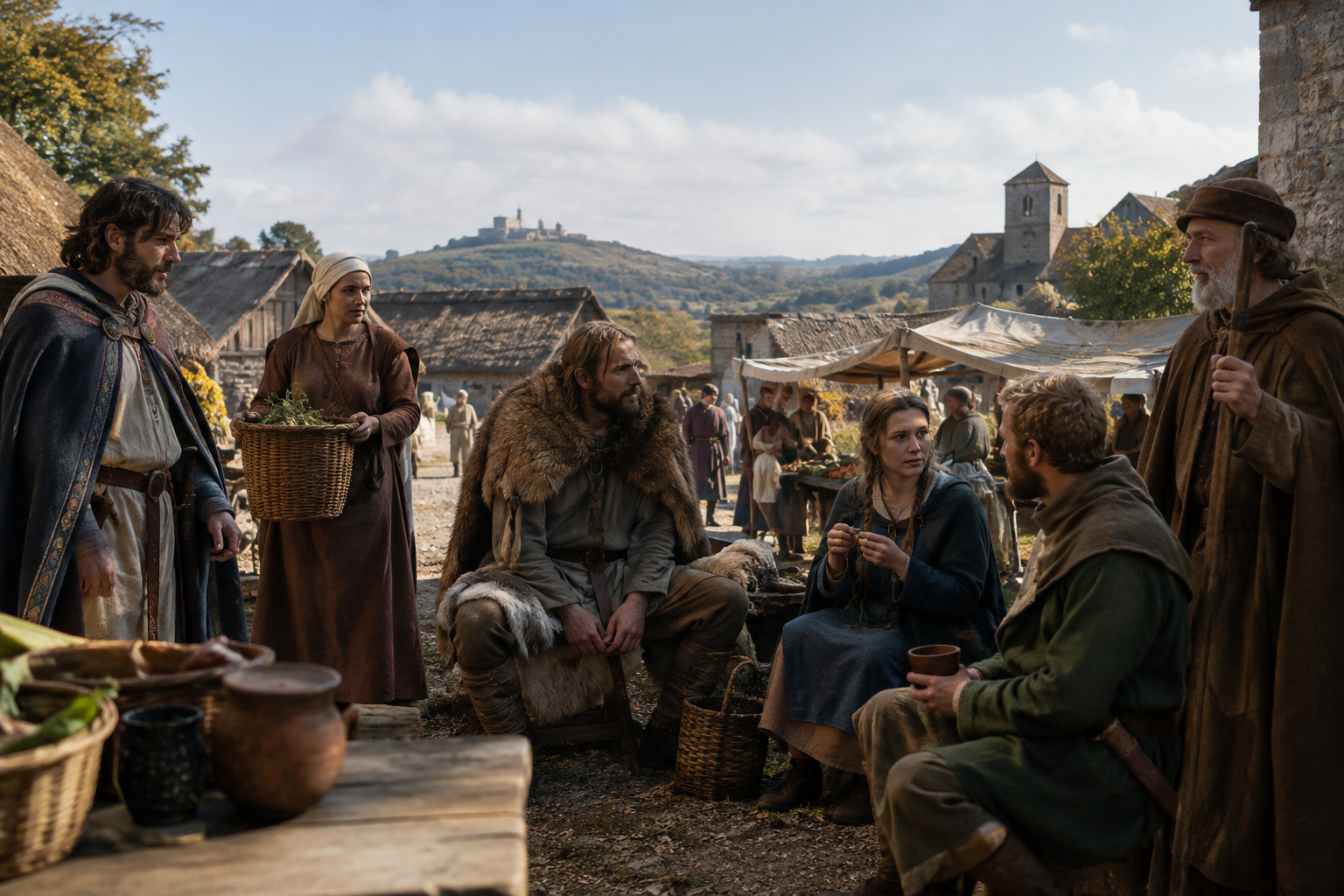
Some Y-chromosome lineages are easy to summarize in a sentence. R1b1a1b1a1a3a2 is not one of them. It sits well down the branching tree of haplogroup R1b, inside one of the great paternal families of western Eurasia, but the real historical interest lies not in reducing it to a slogan, but in watching where related paternal lines appear in the record. And when they do appear, they turn up in some very suggestive places: Iron Age Yorkshire, post-Roman southern England, early Anglo-Saxon Cambridgeshire, Lombard-period northern Italy, and early medieval Belgium.
That is precisely why this branch matters. Y-DNA traces one direct paternal line only: father to father to father. It does not describe a person's whole ancestry, culture, language, or identity. But used carefully, it can illuminate long-term patterns that written history alone cannot see. With a specific subclade like R1b1a1b1a1a3a2, caution matters even more. We should not simply pour the entire history of broad R1b into one narrow branch. What we can do is place it in its wider paternal context and examine the ancient men whose remains help sketch the historical landscape in which such a lineage circulated.
Broadly speaking, R1b is one of the major Y-chromosome haplogroups of western Europe today, and ancient DNA has shown that different branches of it became widespread through major prehistoric and later population movements. Many of those movements involved Bronze Age expansions, shifting regional identities, and later historical mobility under Celtic, Roman, and early medieval worlds. But a narrow branch such as R1b1a1b1a1a3a2 belongs to a far more detailed chapter of that story, one that has to be reconstructed from individual finds rather than grand generalities.
The pattern suggested by the supplied samples is especially interesting because it spans both sides of the North Sea and reaches into the continental interior and northern Italy. That makes this lineage historically useful not because it proves a single migration event, but because it appears in zones that were repeatedly connected by trade, war, settlement, elite movement, and ordinary family life across many centuries.
Explore Celtic migrations and DNA
The earliest supplied sample in this small set is I21617, from the Celtic Parisi Iron Age England East Yorkshire Pocklington, dated to 225 BC. Pocklington has become one of the most evocative Iron Age landscapes in Britain, with burials that remind us the period was neither uniform nor simple. A paternal lineage related to our haplogroup appearing in that context places it in a world of local communities, warrior display, regional identities, and continental connections. It does not prove that all such lineages were "Celtic" in any fixed genetic sense, but it does show that this paternal world was already established in Iron Age eastern England.
Then we move into the unsettled centuries after Rome. CE050, from Post Roman Dorset Worth Matravers, dated to 600 AD, belongs to a Britain often lazily described as dark. It was nothing of the kind. It was a period of reshaped communities, shifting power, Christianization in some places, and new links across the Channel and North Sea. A paternal lineage of this sort in Dorset suggests continuity and movement must both be kept in play. Some male lines endured locally through Roman collapse; others arrived with newcomers; many communities were mixtures of both.
That is sharpened by HAD017 from the Early Anglo Saxon Period Hatherdene Close Cambridgeshire England, dated to 500 AD. Here we are in one of the best studied settings for the making of early medieval England. Ancient DNA has repeatedly shown that Anglo-Saxon period cemeteries cannot be reduced to a single biological type. Some individuals show stronger continental affinities, others more local ones, and paternal lines can cut across simplistic ethnic labels. HAD017 is valuable because it places this wider paternal background squarely within that formative early English world.
Read about Anglo-Saxon genetic history
On the continent, COL_128x from Lombard Era Collegno Northern Italy, dated to 580 AD, opens another door. Collegno belongs to the Lombard-age world that emerged in Italy after the end of western Roman imperial rule. Northern Italy in this period was not isolated from the rest of Europe; it was one of the great meeting grounds of Roman survivors, newcomers, soldiers, families, and local elites. A related paternal lineage here does not make the haplogroup "Lombard" by definition, but it does show that branches in this paternal neighborhood were part of the human reality of post-Roman Italy.
Finally, ST2054 from Early Medieval Belgium Sint-Truiden Groenmarkt, dated to 900 AD, carries the story into the urbanizing medieval Low Countries. By this point, we are in a world of churches, market centers, lordship, and denser networks of movement than the term "medieval" sometimes suggests. Sint-Truiden is important because it shows such lineages persisting or circulating in a region central to Carolingian and post-Carolingian Europe.
Taken together, these individuals do not give us a single neat migration arrow. They give us something better: a historically credible map of paternal presence from Iron Age Britain to early medieval Belgium and Lombard Italy, across regions deeply entangled for over a millennium.
Discover medieval Sint-Truiden DNA
What does that mean for the history of R1b1a1b1a1a3a2? First, it suggests that its wider paternal neighborhood belonged to the long-lived male-line landscape of northwestern Europe. Second, it shows why ancient DNA is so useful: the same broad lineage background can appear in communities that later historians would classify very differently - Iron Age Britons, post-Roman islanders, early Anglo-Saxons, Lombard-period Italians, and medieval townspeople in the Low Countries.
This is a salutary reminder that Y-DNA does not obey the tidy borders of schoolbook history. Languages spread, kingdoms rise and fall, aristocracies reinvent themselves, but paternal lines may persist, subdivide, or travel in quieter ways. Sometimes they move with warriors and settlers. Sometimes with merchants, tenants, clerics, or younger sons. Often, no written source notices them at all.
The supplied noble connection brings us much later, to the House Harvey and Ickworth House near Bury St Edmunds in Suffolk. Here we are not dealing with an ancient cemetery but with the conspicuous afterlife of landed power. Built mainly between 1795 and the early 1800s for the Hervey family, later Marquesses of Bristol, Ickworth was designed not merely as a residence but as an argument: an argument for status, cultivation, and classical ambition. Its striking central Rotunda, inspired by Italy and the Grand Tour, tells us a good deal about aristocratic self-fashioning in Britain.
That Italian inspiration is a pleasing historical counterpoint to the ancient sample from Collegno. Not because one proves any direct genealogical tie to the other - it does not - but because elite Britain continued to look toward the Mediterranean as a source of prestige long after the population movements of late antiquity had faded into the background. Ickworth replaced an earlier family seat, was expanded over the 19th century, and filled with art, silver, and books. In the 20th century, however, the familiar pressures of changing fortunes and death duties made such estates harder to sustain. In 1956, house, park, and collections were given to the National Trust, though part remained with the family for a time.
Why mention a great Suffolk house in an article about a Y-haplogroup? Because noble houses preserve regional memory. They anchor surnames, estates, archives, and family stories to specific landscapes. Genetics can sometimes add another layer to that memory, but it should not be used to overclaim. A historical association between a family and a haplogroup is not proof that every man of that family carried it, nor does a shared broad haplogroup prove close kinship. Still, when readers interested in paternal ancestry encounter places like Ickworth, they are seeing the social architecture of lineages: not DNA proof, but the material culture of remembered descent.
Explore the history of Clan Harvey
R1b1a1b1a1a3a2 is best understood as a very specific twig on a very large tree. Its importance lies in how it helps place a direct paternal line inside the longer history of western and northwestern Europe. The supplied ancient DNA hints at a distribution touching Iron Age Britain, post-Roman England, early medieval Belgium, and Lombard Italy. That does not mean one uninterrupted noble bloodline from Pocklington to Ickworth House. History is rarely so obliging.
What it does mean is that paternal ancestry can illuminate broad continuities across dramatic historical change. Beneath the labels - Parisi, Anglo-Saxon, Lombard, medieval burgher, aristocratic family - there are male lines that connect us to real men buried in real places, each living within a local world but also within larger networks of migration and exchange.
If this part of the story interests you, readers may also enjoy broader work on Roman and early medieval Britain, where ancient genomes help complicate old assumptions about population replacement and continuity.
MyTrueAncestry lets you explore how your DNA compares with ancient individuals and historical populations, offering a fresh way to think about ancestry beyond surnames and family legends. A match to ancient DNA does not prove direct descent from a particular warrior, noble family, or castle owner, but it can place your lineage in the same broad human story that links Iron Age cemeteries, post-Roman villages, medieval towns, and aristocratic estates.






Comments