Haplogroup R1b1a1b1a1a2d

– 6 min read


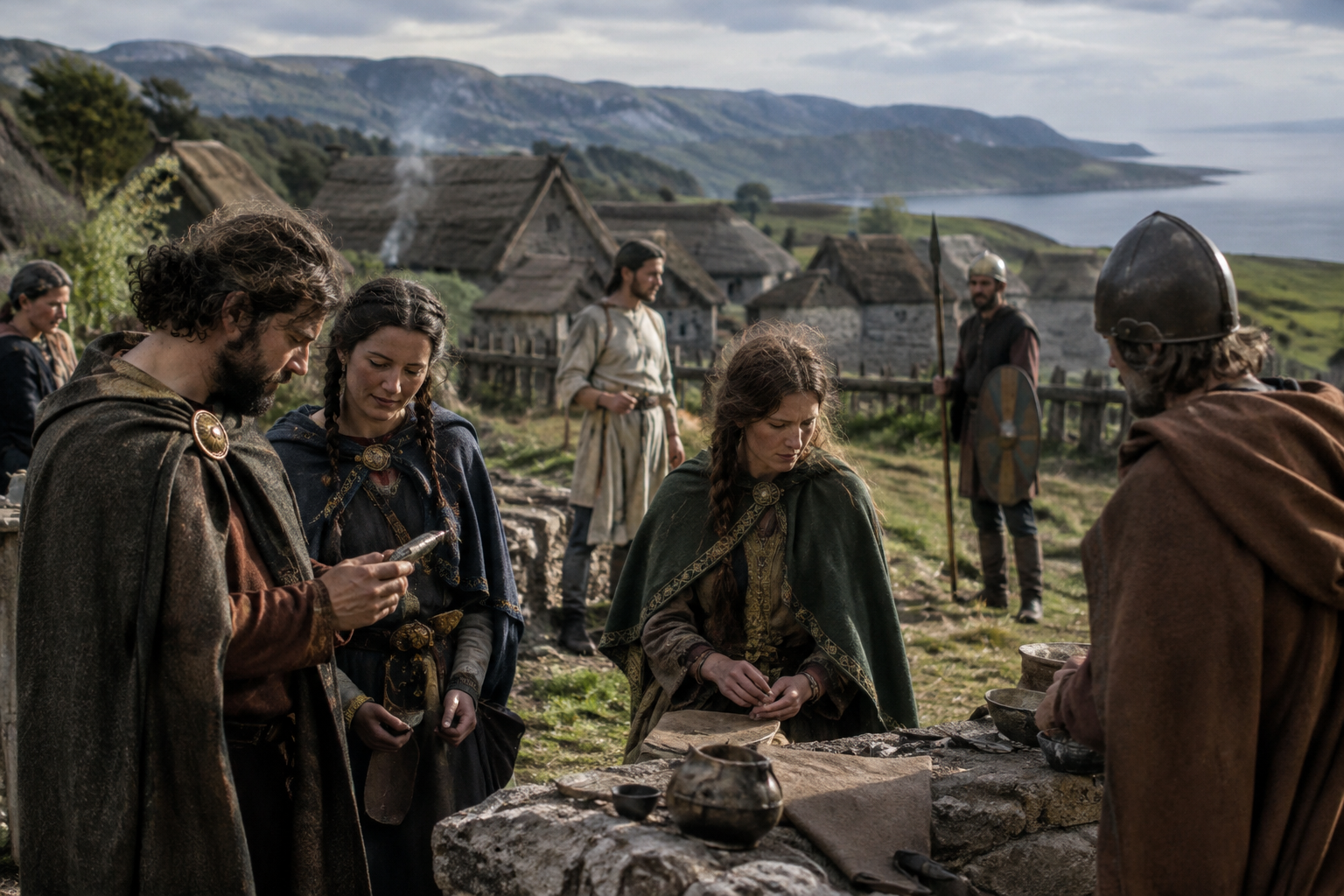
Some Y-DNA haplogroups appear in the ancient record like a flash of lightning: one dramatic burial, one famous royal tomb, one startling migration. Haplogroup R1b1a1b1a1a2d is more interesting in a quieter, more historically revealing way. It appears across a striking span of time and place, in early Bronze Age France, Iron Age central Europe and Britain, Roman and post-Roman communities, and medieval Iberia. That does not make every one of these men close relatives, still less members of one people. But it does make this lineage a useful guide to the long history of paternal ancestry in western Europe.
It is worth stating the obvious, because genetics is forever being asked to do more than it can. A Y-DNA haplogroup traces one direct paternal line only: father to father to father. It is not a person's whole ancestry, not a shortcut to identity, and certainly not proof that someone descends from a noble house because a broad lineage turns up in the same region. Even so, when a subclade such as R1b1a1b1a1a2d repeatedly appears in archaeological contexts stretching from Bronze Age graves to medieval Christian cemeteries, it gives us a rare chance to watch one paternal branch moving through history alongside changing languages, kingdoms, and burial customs.
Because this is a narrow branch, we should be cautious about telling too grand a story. Its wider ancestry lies within the enormous R1b family, a major part of the paternal history of much of western Europe. But the history of a specific downstream subclade is never simply the same as the history of all R1b. What the ancient samples here suggest is that lineages within this branch were already present in parts of western and central Europe by the Bronze Age, and later became visible in Celtic, Roman-period, and medieval settings.
Among the earliest clues are BRE445FK from Early Bronze Age France at les Pointes et les Grevottes, Greviandes, Aube, dated to 2339 BC, and SMGB54 from Saint-Martin-la-Garenne, Yvelines, Ile-de-France, dated to 2139 BC. These are not glamorous princely burials that come with handy labels saying "founder of a people." They are better than that: they show that this paternal branch, or one very close to it, was already part of the human landscape of Bronze Age France.
That matters because the later record broadens rather than narrows. In central Europe, the lineage appears in Iron Age high-status contexts such as APG001, APG001c, and APG003 from the elite Celtic burial at Asperg-Grafenbuehl in Germany, all dated to 450 BC, as well as LWB001 and related samples from Ludwigsburg Roemerhuegel, also 450 BC. There is a temptation to say: ah, therefore this is a "Celtic haplogroup." That would be too neat. But it is perfectly fair to say that men carrying this paternal branch appear in archaeological settings associated with Iron Age Celtic elites in south-west Germany.
Explore Celtic origins in ancient DNA
The same pattern of wide western European presence continues in Britain and northern Gaul. In Roman-period or late Iron Age Britain, we find WBK106 and WBK36 from Celtic Durotriges England, Duropolis, Winterborne Kingston, both dated to 125 AD. In East Yorkshire, the branch also appears repeatedly in the Parisi world: samples such as I36965, I36968, I14105, I21861, I21864, and I5502 span burials between roughly the 3rd and 1st centuries BC. That is not a stray occurrence. It suggests that this paternal line had become well established in parts of Iron Age Britain.
On the continental side, there is I21059 from Gallic Belgium, Gallia Belgica, Tongeren, dated to 35 AD, and a cluster from Gallo-Roman Metz Lunette Sablon in France, including R2055a, R2055b, R2055c, R2055d, and R2055e, all dated to 432 AD, plus R2055 at 490 AD. Samples like these are reminders that Roman provinces were not genetic blank slates onto which Rome simply wrote a new story. Old regional lineages persisted, mixed, traveled, and turned up in military, urban, and rural communities alike.
In Iberia, the Roman and post-Roman evidence becomes especially intriguing. We see I23276 from Late Roman Early Migration Spain, Merida Corralon de los Blanes, dated to 450 AD, I23764 from Late Roman Iberia, Merida Necropolis Blanes, also 450 AD, and I20382 from Early Visigothic Spain, Girona Sarria de Ter Pla de lHorta, dated to 611 AD. None of these individuals can be made to stand in for "Romans" or "Visigoths" as if such labels were genetically pure categories. But together they show this paternal branch present in Iberia through the centuries when Roman administration faded and new political orders emerged.
Read about Roman Hispania's legacy
If there is one place in this dataset where the story becomes almost tactile, it is Las Gobas in northern Spain. Here the lineage appears across several centuries: ldo062 from the Dark Ages, dated to 620 AD; ldo066, ldo037, and ldo040 from 1000 AD; and ldo046 and ldo048 from 1025 AD. That is precisely the sort of pattern archaeologists and geneticists love, because it hints at local or regional paternal continuity rather than a one-off arrival.
One should not overstate it. Continuity in a burial ground is not proof that the same family line held the same land uninterrupted for four centuries. Medieval communities were mobile, marriages moved people, and paternal lines could expand or disappear by chance. But Las Gobas does suggest that branches related to R1b1a1b1a1a2d were part of the social fabric of northern Spain in the centuries when Christian polities, frontier zones, and local lordships were taking shape.
That broader Iberian context becomes richer when set beside nearby evidence such as CGG022052 from Migration Period Spain, Estevillas Virgen de la Torre, dated to 792 AD, and I19990, the Late Iron Age Cantabrian Spain sample from 80 BC. Add earlier Iberian examples like VAD004 from Bronze Age Valdescusa, Northern Spain, dated to 1560 BC, and the pattern is clear enough: this is not a lineage briefly passing through Iberia, but one with deep roots there as well as ties to the wider west European world.
Discover diverse early medieval Iberia
This is where written history begins to meet the genetic landscape, though not in the simplistic way people sometimes hope. The House de Medrano belongs to the world of late medieval and early modern Navarre. Their seat, the Palace of Velaz de Medrano in Iguzquiza, Navarre, grew from a late medieval noble house into a Renaissance-style palace, built in stages from the later 15th century and reshaped in the 16th. It belonged to a family deeply involved in the politics and warfare of the old Kingdom of Navarre.
What makes the palace so evocative is that it preserves a moment of transition. It began in the age when frontier aristocrats still needed defensive architecture, then evolved into a grander residence, more concerned with lineage, heraldry, and status than with resisting siege. In other words, it is a building that records the taming of noble violence into noble display. Stone, coats of arms, and family memory all do the same work there: they announce that this was a house rooted in a particular region and determined to be remembered.
Can we say that the de Medrano paternal line was certainly R1b1a1b1a1a2d? No. The input does not give us that proof, and historical association is not genetic demonstration. What we can say is something historically worthwhile: the same broad northern Spanish zone that produced medieval ancient DNA evidence for this lineage also produced noble houses like the de Medrano, whose fortunes were tied to local continuity, frontier politics, and inherited status. Genetics and architecture are telling parallel stories about place, persistence, and paternal memory, even when they do not meet in one documented family tree.
Explore the House of de Medrano
R1b1a1b1a1a2d looks, from the evidence supplied here, like a western and central European paternal branch with a notably broad archaeological footprint. It appears in Bronze Age France, in Iron Age elite burials in Germany, in Celtic and Romano-British contexts in England, in Gaul under Rome and after it, and in Iberia from the Bronze Age through the Middle Ages. That does not mean a single tribe carried it everywhere, nor that everyone with the lineage shared one culture. Quite the opposite: the fascination lies in its adaptability. The same paternal branch could belong, over the centuries, to Bronze Age villagers, Iron Age aristocrats, Roman provincials, early medieval Christians, and later populations living under very different political orders.
That is also why Y-DNA can be so useful. Written genealogies rarely reach beyond the medieval period, and even then they favor elites. Ancient DNA lets us glimpse the deeper background population from which later histories emerged. It cannot prove that a man buried at Las Gobas was an ancestor of a Navarrese noble house. But it can show that paternal lines related to this haplogroup were already present in the region long before palaces, coats of arms, and notarized family trees appear in the record.
If your own Y-DNA falls within this branch, the real excitement is not the fantasy of claiming a castle. It is the chance to place one paternal line within a long, messy, wonderfully human history stretching from Bronze Age burial grounds to medieval kingdoms.
Upload your DNA to MyTrueAncestry to explore whether your results show affinities to ancient individuals such as BRE445FK, APG001, I21059, or the medieval men of Las Gobas. These matches do not prove direct descent from any one ancient person or noble family, but they can offer a vivid new perspective on where your paternal ancestry fits into the archaeological past.






Comments