Haplogroup R1b1a1b1a1a2c1b2a

– 6 min read


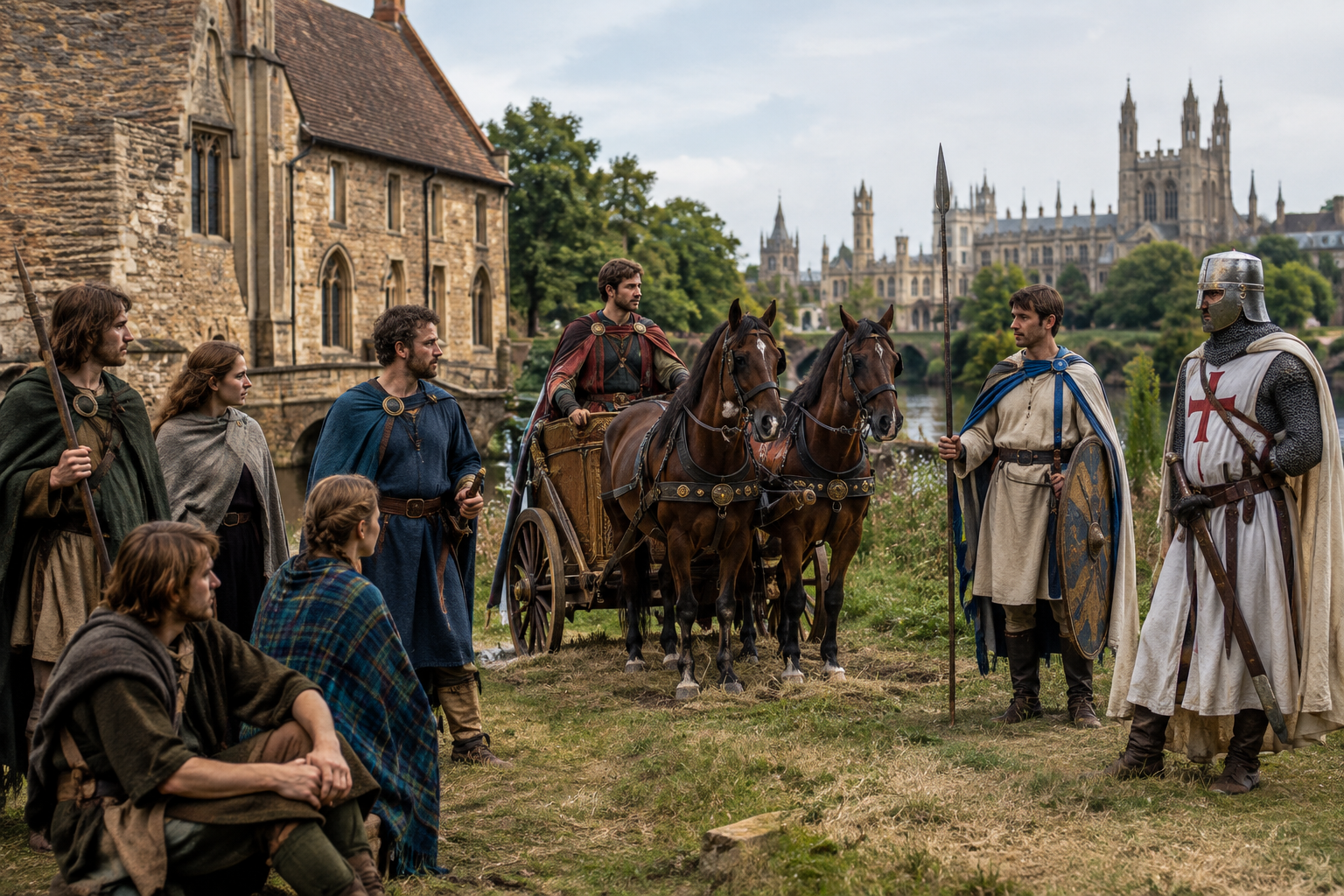
Some Y-chromosome lineages announce themselves with imperial grandeur. Others are more interesting because they appear in the places where history is thick with ordinary continuity: graves, hospital cemeteries, warrior burials, old lordships, and the stubborn survival of paternal lines across centuries. Haplogroup R1b1a1b1a1a2c1b2a belongs to that second, more revealing category. It sits deep within the wider R1b family, a major branch of West Eurasian paternal ancestry, but this very narrow subclade is best understood not as a label for an entire people, still less a nation, but as one twig on a very large and tangled tree.
That matters because Y-DNA is powerful and limited at the same time. It traces one direct paternal line only: father to father to father. It does not describe a person's full ancestry, culture, language, or identity. Yet when a subclade like R1b1a1b1a1a2c1b2a turns up in ancient DNA from Iron Age Britain, Iron Age France, medieval England, and even a Crusader burial connected with the eastern Mediterranean, it gives us something precious: a way to watch one paternal thread pass through very different historical worlds.
The broader R1b tree has long been important in the study of European paternal ancestry, especially in western Europe. But one must be careful here. The history of the large parent branch is not automatically the history of every tiny descendant subclade. For a highly specific lineage such as R1b1a1b1a1a2c1b2a, the responsible question is not "what civilization did this haplogroup belong to?" but rather: in what times and places does this branch actually appear?
The supplied ancient evidence points above all toward a western European and particularly Britain-France context in later prehistory and history. Several of the most striking finds come from Iron Age Yorkshire and from Iron Age northern France. That is suggestive, not because it proves a neat ethnic label, but because it places this paternal lineage in landscapes associated with late prehistoric communities on both sides of the Channel, at a time when exchange, migration, and kin networks tied Britain and the Continent together more closely than old schoolbooks sometimes allowed.
In that sense, this haplogroup fits well into the now familiar archaeological picture of Iron Age mobility and connectivity. The Channel was never much of a wall. It was a route.
Explore Celtic DNA and language spread
If you want to understand how ancient DNA turns abstraction into history, start in East Yorkshire. Wetwang Slack has become one of the key Iron Age burial landscapes in Britain, and three individuals from that context are especially relevant here: I36888, I36872, and I31507, all described as Celtic Parisi Iron Age England East Yorkshire Wetwang Slack, dated to 225 BC. The Parisi are well known from this region, and the burials belong to a society that used striking funerary customs, including chariot burials in some cases, and maintained links across the North Sea and the Channel.
These men are not "the founders" of the haplogroup, and they are certainly not proof of a single homogeneous Iron Age tribe. What they do show is that this paternal line, or a closely related position within the tree, was present in eastern Yorkshire before the Roman conquest. In other words, this is not merely a medieval or modern British story. The line was there in Iron Age Britain among real communities with distinctive burial traditions and local power structures.
Then there is I5511, the Elite Charioteer Briton Pocklington Yorkshire England, also dated to 225 BC. Pocklington has attracted attention precisely because elite vehicle burials are so evocative: they hint at rank, display, and social memory. It would be silly to romanticize him into some kind of genetic king of Yorkshire. But equally, it would be missing the point not to notice that this paternal branch appears in a burial associated with status in Iron Age Britain.
Across the Channel, a further clue appears in CGG022457, described as Belgic Suessiones Iron Age France Bucy-le-Long, dated to 355 BC. The Suessiones belonged to the Belgic world of northern Gaul. This is important because it places the lineage in pre-Roman France as well as Britain. Taken together, the Yorkshire and Bucy-le-Long samples suggest a paternal line moving within, or persisting across, the connected societies of Iron Age northwestern Europe.
Read more on Iron Age Britain and ancient DNA
The story does not stop in the age of chariots. One of the most useful later samples is ATP_PSN_85, from Medieval England Cambridge St Johns Hospital, dated to 1250 AD. The setting matters. This is not a princely tomb but a medieval institutional burial context, a reminder that paternal lineages survive not only in the famous and the armed but in the urban, the pious, the poor, and the sick. By the thirteenth century England was already a thoroughly mixed historical society, shaped by pre-Roman ancestry, Roman rule, Anglo-Saxon settlement, Scandinavian movement, and the Norman aristocracy. A Y-line turning up in Cambridge in 1250 AD therefore speaks to persistence through change, not to any single simple origin story.
Even more intriguing is SI-53, the Crusader Knight Tuscan / Lebanon, dated to 1250 AD. This is one of those samples that reminds us how medieval men could move astonishing distances. Whether born in Tuscany or connected to a Tuscan background, here is a paternal line found in the Crusader world of the Levant. It does not make the haplogroup "Crusader" any more than a Roman coin found in India makes India Roman. But it does show that this branch could travel with the military, religious, and aristocratic networks of the high Middle Ages.
That combination is rather marvellous: Iron Age Yorkshire, Iron Age Gaul, medieval Cambridge, and a Crusader context in Lebanon. Not one people, then, but one paternal line appearing in several historical theatres.
Discover medieval Cambridgeshire DNA
This brings us north, to Clan Calder and Cawdor Castle in Nairnshire, Scotland. Here one must be especially careful. A historical association between a clan and a haplogroup is not proof that every Calder male bore this exact Y-DNA line, nor that a modern tester with the haplogroup descends from the Calders. Medieval and early modern families were complicated things, with adoptions, non-paternal events, cadet branches, and social identities that genetics alone cannot tidy up.
Still, Cawdor Castle offers precisely the sort of historical setting that makes paternal-line history vivid. Built around the late 14th century as a tower house of the powerful Calder family, later called Cawdor, it grew over time into a far grander residence with halls, wings, and gardens. In the 16th century, ownership passed to the Campbells through marriage. Shakespeare made the name famous through Macbeth, though the real castle is later and has no strong link to the historical Macbeth. That distinction is useful. Real history is often less theatrical and more instructive: Highland lordship, landholding, marriage alliances, and the long management of power in a difficult landscape.
In other words, castles preserve memory even when they do not preserve DNA. They tell us where families ruled, how they styled themselves, and how regional identities endured. A haplogroup like R1b1a1b1a1a2c1b2a gives us a different but complementary sort of evidence: not charters and masonry, but biological continuity and movement across time.
Explore the history of Clan Calder
So what do we really learn from R1b1a1b1a1a2c1b2a? First, that this paternal lineage has a documented presence in Iron Age Britain and Iron Age France, which places it in the world of late prehistoric northwestern Europe. Second, that it persists into medieval England and appears in a Crusader-era burial linked with the eastern Mediterranean, showing how old western European paternal lines could survive and travel through later historical networks. Third, that regional history, noble houses, and castles such as Cawdor can provide a human landscape in which to think about those lineages, even when they do not prove direct descent.
And just as importantly, we learn what not to claim. Shared haplogroups do not prove that two men were close relatives. Ancient DNA does not automatically identify ethnicity. A castle is not a chromosome. But when archaeology, genetics, and written history are read together, they let us see the past not as a pageant of disconnected periods, but as overlapping continuities of family, mobility, status, and survival.
If you want to place your own paternal story in that larger human past, MyTrueAncestry can help you compare your DNA with ancient individuals and historical populations. The result will not certify descent from an Iron Age charioteer or a Highland clan chief, but it may reveal striking connections to the same deep historical landscapes discussed here.






Comments